How Do You Know Your Radiator Needs Bleeding?
Look out for these signs before you start. They all point to air trapped inside the radiator.
- Cold spots at the top. The bottom feels warm but the top stays cold.
- Gurgling or bubbling noises. Air moves through the water when the heating runs.
- The radiator takes longer to heat up. Air slows down circulation through the system.
- You have to turn the thermostat up. The room never quite reaches the set temperature.
If the whole radiator is cold while others are hot, the problem may be a stuck valve or sludge rather than air. In that case, bleeding alone will not fix it.
What Can You Use Instead of a Radiator Key?
A radiator key is just a small tool that grips the square bleed valve. Any of these household items will do the same job.
A Flathead Screwdriver
This is the best substitute. Choose one whose blade fits snugly into the slot on the bleed valve. A snug fit matters, because a loose blade can slip and round off the valve.
A Sturdy Coin
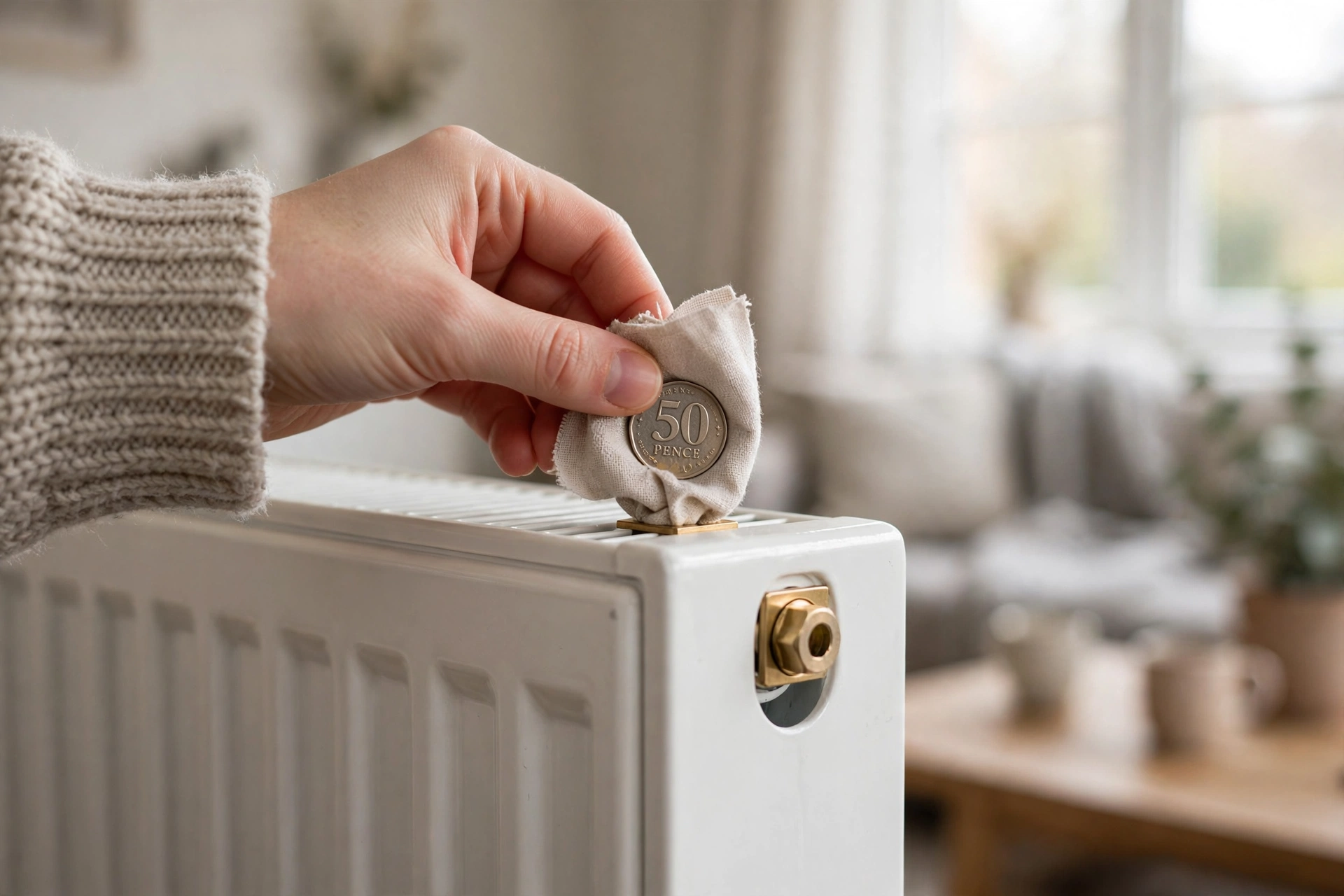
If you have no tools at all, a coin is often the answer. A 2p or 50p coin works best because the edge is thick enough to grip the valve slot without bending. Hold the coin upright so its edge sits squarely across the slot, then wrap a tea towel around it to protect your fingers and improve your grip. Press the coin firmly into the slot with your thumb and forefinger and turn it slowly anticlockwise. If the coin slips, stop and reposition it rather than forcing the turn. A slipping coin can round off the valve and make it harder to open later. Coins work best on valves that move freely. If the valve feels stiff, switch to pliers or a screwdriver for more control.
A Pair of Pliers
Adjustable pliers or a small wrench can grip the square end of the valve. Use a cloth between the pliers and the valve to protect the metal. Pliers give you the most turning force, which helps with older, stiffer valves.
Avoid using a knife or anything sharp. It can slip easily and injure your hand.
What If the Bleed Valve Is Painted Over?
In many older UK homes, layers of paint have sealed the bleed valve shut. This is one of the most common reasons a valve will not turn, and forcing it can snap the valve head clean off.
First, pick the old paint out of the valve slot. An old toothbrush works well, or use a pin to scrape out the slot carefully. Once you can see the square shape clearly, put a drop of penetrating oil such as WD-40 on the valve and wait ten to fifteen minutes so it can work into the thread. Then try turning it again with gentle pressure only. If it still refuses to move, repeat the oil and wait longer rather than forcing it.
Safety First: Before You Touch the Valve
Bleeding a radiator is a safe DIY job, but take these precautions first.
- Switch the heating off. Let the system cool for at least 30 minutes. Hot water and steam can scald you.
- Protect the floor and wall. Put an old towel or a shallow container under the bleed valve, and hold a towel behind the valve itself. The water that escapes is often black and stains carpets and walls badly.
- Keep a cloth in your hand. Hold it around the valve to catch drips and to grip the tool safely.
- Only open the valve a quarter turn. That is all it takes for the air to hiss out. Never unscrew the valve fully. System water can spray out under pressure if you go too far.
- Do not force a stuck valve. If it will not turn with gentle pressure, stop. Forcing it can snap the valve and flood the room.
Which Radiator Should You Bleed First?
Air rises, so always work from the ground floor upwards. Start with the coldest radiator, the one with the biggest cold spot at the top. Bleed the downstairs radiators first, then move upstairs.
You do not need to bleed every radiator in the house. If only one radiator is cold at the top, just bleed that one. Bleed others only if they show the same signs. After bleeding three or four radiators, check the boiler pressure gauge and top it up if it has dropped below 1 bar. This stops the system pressure falling too far during the job.
How to Bleed a Radiator Without a Key: Step by Step
- Find the bleed valve. It sits at the top corner of the radiator, on the opposite end from the main inlet pipe. It looks like a small square peg or a slotted screw.
- Place your towel and container. Put them directly under the valve to catch any water. Hold a cloth behind the valve to protect the wall.
- Fit your tool. Push the flathead screwdriver into the slot, press the coin firmly against the square through a cloth, or grip the valve with pliers through a cloth.
- Turn the valve anticlockwise a quarter turn. That is enough. You should hear a hissing sound as air escapes. Do not unscrew it further.
- Wait for the hiss to stop. Keep the valve open while air comes out. This usually takes less than a minute.
- Close the valve when water flows. As soon as water runs out in a steady stream with no sputtering, turn the valve clockwise to close it. Tighten it firmly but do not overtighten, or you can strip the thread.
- Wipe the valve dry. Check for drips over the next few minutes. A tiny weep is normal at first, but it should stop.
- Repeat for other radiators if needed. Work from the coldest radiator downstairs to the top floor, checking the boiler pressure every three or four radiators.
What Does Black or Dirty Water Mean?
Do not be alarmed if the water that comes out is black or dark brown. This is normal in many systems and it is not dangerous. Black water is a sign of sludge and iron oxide inside the radiators, and it usually means the chemical inhibitor in the system water is wearing out.
The main risk is staining. Keep that old towel held behind the valve while you bleed, because black water marks walls, carpets and curtains permanently. If every radiator in the house runs black, the system may need a power flush and a fresh dose of inhibitor. That is a job for a heating engineer rather than a DIY one.
How to Check Your Boiler Pressure After Bleeding
Releasing air lowers the pressure in your heating system. Always check the boiler pressure after bleeding, or your heating may not work properly.
What Is the Correct Boiler Pressure?
Look at the pressure gauge on the front of your boiler. When the system is cold, the needle should sit between 1 and 1.5 bar. Most gauges mark this range in green. If it has dropped below 1 bar, you need to top it up.
How to Top Up the Pressure
Most UK boilers have a filling loop, which is a flexible hose under the boiler with one or two small valves.
- Find the filling loop. Look under the boiler for a braided silver hose with a valve at one or both ends.
- Open the valve slowly. You will hear water entering the system and see the gauge needle rise.
- Stop at 1.2 to 1.5 bar. Close the valve firmly once the needle is in range.
- Run the heating and recheck. Switch the heating back on, let it warm up, and check the gauge again. It should stay between 1 and 2 bar when hot.
If the pressure keeps dropping over the following days, there may be a leak in the system. That is a job for a heating engineer.
What About Older Open-Vented Systems?
Not every UK home has a modern combi boiler. If your house has an older system with a feed and expansion tank in the loft, the pressure topping up works differently. After bleeding, check that the small tank in the loft still has water in it. Its ball valve should refill it automatically as the system level drops. If the tank is empty or the ball valve is stuck, do not keep bleeding radiators. Call a heating engineer, because running the system dry can damage the boiler.
What If the Bleed Valve Is Stuck or Leaking?
Older radiators sometimes have valves that have seized up over the years. Try these steps in order before giving up.
- Apply penetrating oil and wait. Put a drop of oil on the valve and leave it for several hours. Patience works better than force.
- Support the valve body. Hold the hex nut around the valve steady with an adjustable spanner while you turn. This stops the whole valve assembly twisting in the radiator.
- Try a socket on a rounded valve. If the square has worn round, tap a small socket gently onto it with a hammer and turn it with a ratchet. The socket grips where a coin or screwdriver cannot.
- Know when to stop. If the valve starts to crack, bend or weep around its base, stop immediately and call a heating engineer. A snapped bleed valve can empty a radiator onto your floor in minutes.
If the valve drips constantly after bleeding, the internal seal may be worn. Tightening it a fraction more sometimes stops the drip. If it continues, the valve needs replacing, which is also a job for a professional.
If you are comfortable with small DIY plumbing jobs, our guide on how to fix a dripping tap walks through another simple fix you can do yourself.
Buy a Radiator Key: The Cheapest Permanent Fix
The coin, screwdriver and pliers methods are emergency fixes. The permanent fix costs almost nothing. A universal radiator key costs one to two pounds at Screwfix, B and Q or Toolstation, and it fits every standard UK bleed valve.
Buy one after you finish bleeding and keep it with the boiler or in your toolbox. Next time a radiator needs bleeding, the job takes two minutes instead of ten.
Frequently Asked Questions
Can I bleed a radiator with the heating on?
No. Always switch the heating off and let the system cool for at least 30 minutes first. Bleeding a hot radiator risks scalding, and air keeps entering the system while the pump is running.
How often should I bleed my radiators?
Once a year, ideally before winter, is enough for most homes. Bleed them sooner if you notice cold spots or gurgling noises.
What should I do if water sprays out straight away?
Close the valve immediately. The radiator probably did not need bleeding. Check your boiler pressure instead, as low pressure causes similar symptoms.
Is it safe to bleed radiators myself?
Yes, it is one of the safest heating jobs you can do yourself. Just let the system cool first and stop if anything feels stuck. Call a heating engineer for leaks or valves that will not turn.
Why did my boiler pressure drop after bleeding?
This is completely normal. Letting air out reduces the water volume in the system, which lowers the pressure. Top it up through the filling loop as described above.
Can I use a knife instead of a screwdriver?
It is not recommended. A knife blade can slip out of the valve and cut your hand. A flathead screwdriver, a coin or pliers are all safer and more effective.
Should I bleed all my radiators or just the cold one?
Just the ones that need it. Bleed the radiators with cold spots at the top or gurgling noises, and leave the rest alone. There is no need to bleed a radiator that heats evenly.
Do I need to bleed radiators in an old house with a loft tank?
Yes, the process is the same. The only extra step is checking the feed and expansion tank in the loft afterwards. Its ball valve should refill it on its own. If it does not, call a heating engineer.
Final Thoughts
Bleeding a radiator without a key takes ten minutes and no specialist tools. Release the trapped air, close the valve, and restore your boiler pressure, and your radiators should heat evenly again. It is also one of the simplest ways to keep your heating running efficiently through winter. If you are planning bigger heating upgrades, take a look at our guide to the best flooring for a kitchen with underfloor heating for more ideas.