
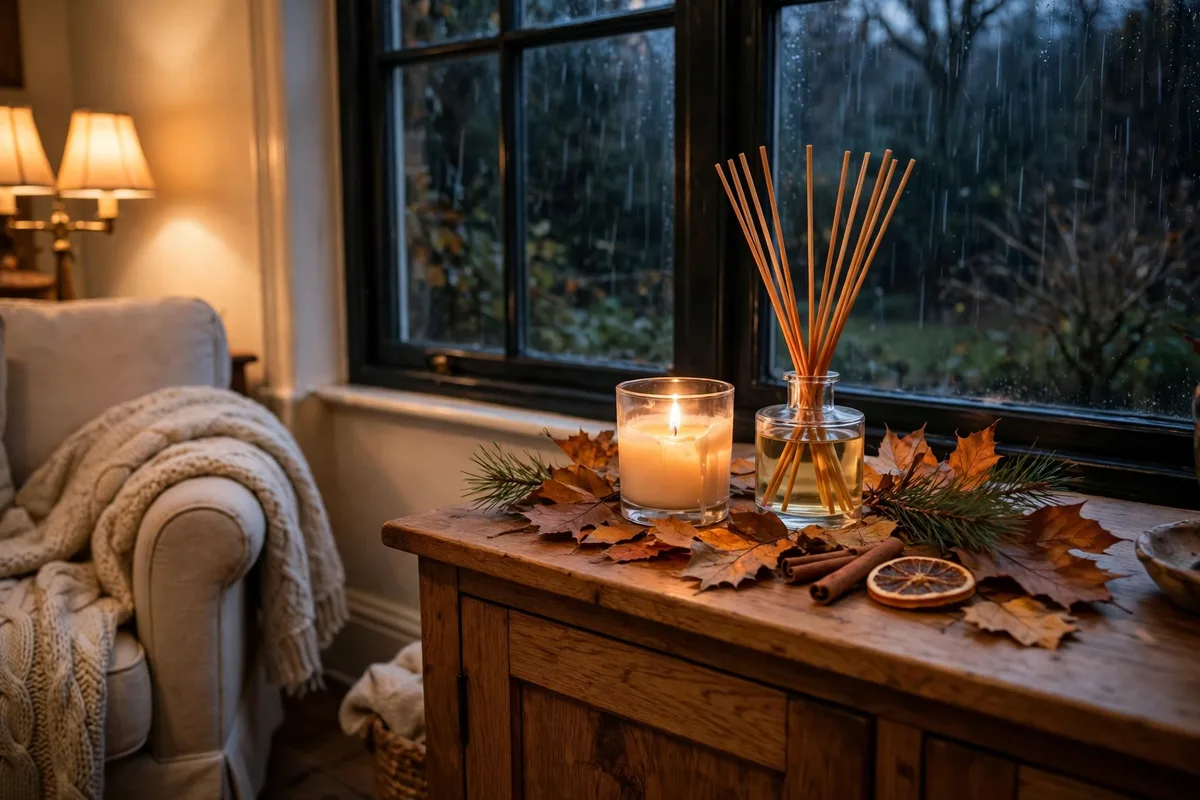
Quick answer: Autumn and winter home scents work because the season changes what a room does to fragrance. Windows stay shut, heating comes on, evenings darken early, and a closed room holds scent instead of letting it drift away. The notes that suit the season have weight to them: orchard fruit in early autumn, smoke and wood in deep autumn, baking notes and evergreen in December, and a bright citrus or berry note kept for winter mornings so the dark days do not feel heavy. The rule is to move through the season in stages, not to swap everything on one day, and to finish what you have before you start something new. A candle suits the evening, a reed diffuser suits the background, and a wax melt or room spray suits a short reset. The families, the formats and the switching routine are all in this guide, written for UK homes: small rooms, flats and terraces, draughty hallways, radiators under windows, and rooms that stay shut up all day.
Most homes get seasonal scenting wrong in the same way. A candle is bought because it smells wonderful in the shop, it is lit in a room that is too small for it, and then it is blamed when the room smells of too much, or of nothing at all. Or the opposite happens: every fresh scent is put away in October, nothing but vanilla is burned until March, and by January the house smells tired and the nose has stopped noticing any of it. The candle was never the problem. The season was, and the season was never given a plan. This guide is that plan, and it is built on the consensus of the guides checked on 19 November 2026: Mallow & Moo Candles, Eliora Home, Plum & Ashby, The Flora Lab and Love to b. Where a source describes a scent or a rule in a particular way, that is reported here as the source’s description, not as a fact this site has tested. No seller’s own product picks are presented here as recommendations. Only scent families, notes and formats are used.
Why We Crave Warmer Scents as UK Evenings Darken
The craving for warmer scents in autumn is not a fashion. It is a response to what a British home becomes when the evenings darken. Mallow & Moo Candles put the practical reason plainly in the guide checked for this article: in summer, with windows open and air moving, a fragrance needs to be bright and volatile to register at all, but in winter a closed room holds scent, so a heavier fragrance has the still air it needs to build slowly and sit. The same candle that felt subtle in July can feel considerably stronger in December, and that changes how much of it you need, not just which one you choose.
There is a second reason, and it is about light. The evenings are lit earlier and lower, the curtains are closed by five, and the room is lit by lamps and by candle flame rather than by daylight. A scent that suits that light is a scent with warmth in it: amber, vanilla, wood, spice, orchard fruit. Mallow & Moo name exactly those families as the notes that suit autumn and winter, and every other guide checked for this article agrees on the same families, even when the names differ. A bright citrus candle that felt right in a sunlit room in June feels thin in a dark room in November, not because the candle changed, but because the room did.
A third reason is the heating. Radiators come on, and they change the air in two ways that matter for scent. Warm air rises and moves, so a diffuser placed near a radiator will throw its scent faster and use its oil faster, and a candle burned in a warm room will throw more strongly than the same candle in a cool room. That is why the placement rules in this guide matter more in winter than in summer: a diffuser belongs away from radiators and direct heat, and a candle belongs where its flame is not in a draught from a door that opens and closes. The guide on where to place a reed diffuser covers the placement rules in detail, and they are worth following more carefully in the cold months, when a misplaced diffuser can empty itself in weeks instead of months.
The last reason is the simplest, and it is the one the guides checked for this article agree on without exception: autumn and winter are the seasons when a home becomes a place to stay in, rather than a place to pass through. The evenings are long, the weekends are slow, and the home has to feel like somewhere you would choose to be. Scent is part of that, and the families that do it are the families with depth: woods that smell of the room itself, spices that smell of baking, fruits that smell of the orchard, and resins that smell of Christmas. The rest of this guide works through those families in the order the season actually arrives, because the season does not arrive all at once, and the scent should not either.
The Season Arc: From September to January
The most useful idea in seasonal scenting, and the one no competitor guide gives in full, is the arc: the season moves in stages, and the scent should move with it, one stage at a time. Mallow & Moo give the arc for candles in the guide checked for this article, and the table below extends it across formats and rooms, using the consensus of all five guides checked. The dates are for a typical UK year, and they are starting points to adjust by living with them, not rules to follow blindly. A mild October may want orchard fruit for an extra week. A cold November may want smoke and wood a week early. The arc is the shape, not the calendar.
| Stage | When | The scent | The format that leads |
|---|---|---|---|
| Early autumn | September to early October | Orchard fruit: pear, quince, apple, fig, with warmth underneath | Candle in the evening, diffuser for the day |
| Deep autumn | Late October to late November | Smoke, wood and gentle spice: smoked vanilla, guaiac wood, cedar, cinnamon, clove | Candle in the evening, diffuser with a warmer expression |
| Bonfire Night | Early November, one week | Woodsmoke, bonfire, ember, toasted notes | Candle only, for the evening itself |
| Winter and Christmas | December | Baking notes and evergreen: spiced biscuit, cocoa, vanilla sugar, fir, spruce, pine, frankincense | Candle for gatherings, diffuser for the background |
| The January reset | January | Bright and clean: citrus, blackberry, eucalyptus, light woods | Diffuser for the day, one bright candle in the morning |
Three things to notice in the table before reading on. First, the scent gets heavier as the season deepens, and then it gets lighter again in January, because a house that smells of baking and spice for three months straight stops smelling of anything at all. Second, the format that leads changes with the stage: candles lead in the evening from October onwards, because the evenings are when the home is lived in, but the diffuser leads in the day all through the season, because it works without a flame and without needing to be watched. Third, Bonfire Night is a stage of its own, and it is only a week long, because a woodsmoke scent that is wonderful for one evening is too much for a whole month.
How Much Scent Does a Closed Room Need
The single most practical change in autumn and winter is not which scent you choose. It is how much of it you use, because a closed room holds scent in a way an open room does not. In summer, with windows open and air moving through the house, a fragrance has to be bright and volatile to register at all, and a lot of it is carried away on the draught. In winter, the windows stay shut, the heating is on, and the same amount of fragrance builds up in the same room until it is stronger than it was meant to be. Mallow & Moo note this in the guide checked for this article: the same candle that felt subtle in July can feel considerably stronger in December, so it is worth burning for shorter sessions as the season turns.
The adjustment is simple, and it applies to every format. A candle that was burned for three or four hours in summer should be burned for two hours in winter, and then blown out, because the room will hold the scent for an hour after the flame is out. A diffuser that ran with the full set of reeds in summer may need one or two reeds removed in winter, because the same reeds in still air will throw more strongly than they did in moving air. A wax melt that was warmed for two hours in summer should be warmed for one hour in winter, because the melt will keep releasing scent after the warmer is switched off. The test for the strength is always the same, and it is the test every guide checked for this article agrees on: walk into the room from another room, and notice what you smell in the first five seconds. That is the strength that matters, not the strength you smell when you stand next to the diffuser. If you can smell the diffuser clearly when you sit down in the room, it is too strong. If you walk in from outside and the room smells gently of the scent, it is right.
There is a second adjustment, and it is about the nose rather than the room. In winter, the nose spends more time indoors, in the same air, for more hours of the day, and it adapts to a scent that never changes. A scent that is always there stops being noticed, and a scent that is never noticed is wasted money. That is why the season arc matters, and why the bright morning rule matters: the nose notices a change far more than it notices a scent that never varies, and a home that smells slightly different in the morning from the way it smells in the evening feels deliberate and cared for, while a home that smells the same all day, every day, feels like one candle left burning too long.
The third adjustment is about the heating cycle. Radiators come on in the morning and go off at night, and the air in a room rises and falls with them. A diffuser placed near a radiator will throw its scent faster when the heating is on and slower when it is off, so the scent will be stronger in the evening than in the morning, even though nothing was changed. A candle burned in a warm room will throw more strongly than the same candle in a cool room, so a candle lit in the evening, when the heating has been on all day, will smell stronger than the same candle lit in the morning, when the room is cool. The fix is placement, not strength: a diffuser belongs away from radiators, at waist height, in gentle moving air, and a candle belongs where its flame is not in a draught from a door that opens and closes. The placement rules are covered in full in the guide on where to place a reed diffuser, and they are worth following more carefully in the cold months, when a misplaced diffuser can empty itself in weeks instead of months.
Early Autumn: Orchard Fruit and Warmth Underneath
Early autumn is the gentlest stage, and it is the one most people skip, because they jump straight from summer citrus to winter spice and miss the season in between. Mallow & Moo describe it precisely in the guide checked for this article: the turn of the season wants orchard fruit rather than full winter spice, because it is still light in the evening and the weather has not properly committed, so a fragrance with fruit at the top and warmth underneath fits the mood better than anything heavier. Pear, quince and apple are the fruits most often named, with fig close behind, and the warmth underneath is usually amber, vanilla or a soft wood.
The families for this stage are worth describing one at a time, because they behave differently in a room. Pear is the lightest of the orchard fruits, crisp and clean, and it suits a hallway or a kitchen, where a bright first impression matters more than depth. Quince is richer and slightly spiced, and it suits a living room, where the scent needs to last an evening. Apple is the most familiar of the three, and it suits a home with children, or a home where the scent needs to be liked by everyone rather than loved by one person. Fig is the warmest of the orchard family, green and slightly sweet at the same time, and it suits a living room that is neither fully cosy nor fully fresh, because fig bridges the two moods. The full guide to the living room, including the choice between cosy, fresh and polished moods, is in our guide to the best scents for the living room.
The warmth underneath the fruit matters as much as the fruit itself. A pear scent with nothing underneath it will smell thin in a closed room, because a top note on its own fades within half an hour. The warmth is usually amber, vanilla, cedar or a soft musk, and it is the part of the scent that stays in the room after the fruit has gone. When you test an early autumn scent, do not judge it on the first sniff. The fruit is doing the talking then, and it will be gone within half an hour. Live with it for an evening, and judge it on what is left when the candle is blown out, because that is the warmth underneath, and that is the scent you will actually live with.
The format for early autumn is the same as for the rest of the season, but the strength is lighter. A candle in the evening, in the living room, lit for an hour or two. A diffuser for the day, with the full set of reeds in a hallway or a living room, and three or four reeds in a bedroom or a bathroom. The windows are still open sometimes in September, so a diffuser may need one or two more reeds than it will need in December, when the windows stay shut and the same diffuser will throw more strongly. The guide on how long reed diffusers last covers the lifespan maths in detail, including the way heat and airflow shorten a bottle’s life, and it is worth reading before you set the reed count for the season.
Pumpkin and dried fruit are the other early autumn notes, and they are worth mentioning separately, because they are the notes that divide opinion most. Eliora Home name apple, pumpkin and dried fruits as the autumn fruity undertones in the guide checked for this article, and they suit a kitchen or a dining room, where they smell of the harvest and of baking, rather than a bedroom, where they can feel too sweet. A pumpkin spice scent in a living room in October is one of the most popular seasonal scents there is, and it is also one of the easiest to get wrong, because a pumpkin scent that is too strong smells artificial, and a pumpkin scent in a room where someone is cooking dinner will fight the food rather than complement it. The rule for pumpkin and for dried fruit is the same as for the rest of the orchard family: use it as an accent, not as a default, and choose a blend that pairs the fruit with a wood or a spice that gives it structure. Pumpkin with cinnamon, apple with cedar, dried fruit with amber: all of these are more livable than the fruit on its own, and all of them suit October and November especially well, when the season itself smells of baking and spice.
Deep Autumn: Smoke, Wood and Gentle Spice
Deep autumn is the stage the season is really about, and it is the stage where the guides checked for this article agree most strongly. Mallow & Moo describe it in the guide checked for this article: this is when smoke and wood come into their own, because the evenings are properly dark, the heating is on, and the fragrance you want is the one that makes a room feel like somewhere you would choose to stay. The families are smoked vanilla, resinous woods such as guaiac wood, cedar and sandalwood, and gentle spices such as cinnamon, clove, nutmeg and cardamom. Eliora Home name the same families for autumn in the guide checked for this article: cinnamon, clove, nutmeg and cardamom for spice, cedarwood, sandalwood and patchouli for wood, and apple, pumpkin and dried fruits for the harvest note underneath.
Smoke is the note that needs the most care, because it is the note that goes wrong most easily. A smoked vanilla or a woodsmoke scent that is used lightly smells of a fireside, and a home that smells of a fireside feels warm and safe. The same scent used too strongly smells of a bonfire that has got out of hand, and a room that smells of too much smoke feels stuffy and tired within an hour. The rule is to use smoke as an accent, not as the main scent, and to choose a blend that pairs the smoke with something softer, such as smoked vanilla with amber, or guaiac wood with pink pepper, which is the pairing Mallow & Moo describe for their deep autumn candle in the guide checked for this article. A smoke scent in a small room needs a smaller candle, or a diffuser with fewer reeds, or a shorter burn, because a small room has less air to hold it.
Woods are the most reliable family of the deep autumn stage, and they are the family that suits the most rooms. Cedarwood is grounding and slightly dry, with a clean woodiness that never smells sweet. Sandalwood is softer, creamier and warmer, and it suits the evening better than the daytime. Both carry well in large rooms and in open-plan spaces, because their warmth does not thin out as quickly in moving air as a light floral does. They are the best family for a large living room, a room with high ceilings, or a room that opens onto a hallway, because they have the presence to fill the space without needing to be strong. In a very small, low-ceilinged room, they can feel heavy, and the fix is to choose a blend that pairs the wood with a lighter note, such as cedar with bergamot, or sandalwood with vanilla, rather than a pure wood scent.
Gentle spice is the family that gives deep autumn its warmth, and it is the family that needs the lightest hand. Cinnamon is the warmest and the most familiar, and it suits a kitchen, where it smells of baking, and a living room, where it smells of the season. Clove is deeper and slightly medicinal, and it suits a hallway, where a little of it goes a long way. Nutmeg is the softest of the spices, and it suits a bedroom, where a gentle spice is better than a sharp one. Cardamom is the brightest of the spices, and it suits a home office, where a little lift is useful without being distracting. The failure mode for spice is the same as for smoke: too much of it, and the room smells of a spice jar rather than a home. The fix is the same too: a smaller candle, fewer reeds, a shorter burn, and a blend that pairs the spice with a wood or a vanilla that gives it structure. Cinnamon with cedar, clove with amber, nutmeg with vanilla: all of these are more livable than the spice on its own.
Bonfire Night: One Week of Woodsmoke
Bonfire Night is the shortest stage in the arc, and it is the one that should stay short. The scent of the night is woodsmoke, ember and toasted notes, and it is a scent that belongs to one evening, not to a whole month. A woodsmoke candle lit for the evening of the 5th of November, while the fireworks are going off outside and the house is full of people coming in from the cold, is one of the best seasonal scents there is. The same candle burned every evening for a fortnight will make the house smell tired, and the nose will stop noticing it, because a scent that never changes stops being noticed.
The practical rule for Bonfire Night is simple: buy one candle, or use one wax melt, for the night itself, and do not build the rest of the season around it. The deep autumn palette already contains smoke and wood, so the Bonfire Night scent is an expression of the same family, used more strongly for one evening, rather than a different family altogether. A smoked vanilla candle that has been burning all through deep autumn can be the Bonfire Night candle too, lit a little earlier and burned a little longer on the night itself. A woodsmoke wax melt, warmed for the evening and then put away, is the other way to do it, and it is the better way if the house is small, because a wax melt can be stopped when the evening ends, while a candle that is half burned has to be burned to the end.
Safety matters more on Bonfire Night than on any other night of the season, because the house is busy, people are coming and going, and a candle is more likely to be knocked or forgotten. A candle must never be left burning in an empty room, and never left burning overnight, and on a night when the house is full of people and coats and bags, that rule is worth stating twice. A reed diffuser is the format for the rooms that are not being watched, because it has no flame and nothing to watch, and a candle is the format for the room where people are sitting, where it can be seen and blown out when the evening ends.
Winter and Christmas: Baking Notes and Evergreen
December is the stage where the season is at its fullest, and it is the stage where the guides checked for this article give the most detail. Mallow & Moo describe it in the guide checked for this article: December belongs to the baking notes, spiced biscuit, buttermilk, cocoa and vanilla sugar, because those are what a house smells like when something good is happening in it. Eliora Home name the same families for winter in the guide checked for this article: fir, spruce and pine for evergreen, frankincense, myrrh, cinnamon and clove for resins and spice, and vanilla, caramel and toasted chestnut for the sweet and gourmand side. Plum & Ashby describe the winter palette in the guide checked for this article as fir balsam and winter berries for the green note, cinnamon and clove for the nostalgic note, and green sandalwood and fern for the grounding note.
Baking notes are the most forgiving family of the whole season, because almost nobody dislikes them. A spiced biscuit scent, a cocoa scent, a vanilla sugar scent: all of them smell of a kitchen where something is being made, and a house that smells of baking feels welcoming in a way that no other scent quite manages. The failure mode for baking notes is over-sweetness, and it is the failure mode to watch in a small room, where a sweet scent can turn cloying within an hour. The fix is the same as for every sweet scent: a smaller candle, fewer reeds, or a blend that pairs the sweet note with a wood or a spice that gives it structure. Vanilla sugar with cedar, cocoa with amber, spiced biscuit with cinnamon: all of these are more livable than the sweet note on its own. The baking notes are also the easiest fragrances to gift, because almost nobody dislikes them, which is why they are the notes most often given at Christmas, and the reason to buy them early, because the popular ones sell out by the end of November, as Mallow & Moo note in the guide checked for this article.
Evergreen is the other half of the December palette, and it is the half that keeps the baking notes from becoming too sweet. Fir, spruce and pine bring the outdoors inside, and they smell of a walk in cold air, which is exactly the contrast a warm house needs in December. A fir balsam scent in a hallway, where it greets a visitor coming in from the cold, is one of the best uses of evergreen in the whole season. A pine scent in a living room, where it sits underneath the baking notes, is the other. The failure mode for evergreen is sharpness: a pine scent that is too strong smells of cleaning product rather than a forest, and the fix is to choose a blend that pairs the green note with something warmer, such as fir with amber, or pine with cedar, rather than a pure green scent. The Flora Lab describe their Alpine Air blend in the guide checked for this article as lemon zest and eucalyptus over white woods and gentle spice, with pine resin and soft amber underneath, which is exactly the pairing rule in practice: a bright green top, a warm base, and a scent that smells of a forest without smelling of a bottle.
Resins are the third part of the December palette, and they are the part that gives Christmas its particular smell. Frankincense and myrrh are the resins most often named, and they are warm, golden and slightly sticky, the backbone of countless winter fragrances, as the guides checked for this article describe them. They suit a living room or a dining room, where they can be noticed by guests, and they suit a candle better than a diffuser, because a candle lets the resin be lit for an occasion and blown out when the occasion ends, while a diffuser would carry it all day and make it too much. A frankincense scent used lightly, for a dinner or a gathering, is one of the most festive scents there is. The same scent used heavily, in a small room, will overwhelm it, and the nose will stop noticing it, which is the waste the season arc is designed to avoid.
Winter Mornings: Keep Something Bright
The most important rule in the whole guide, and the one the guides checked for this article agree on most clearly, is the rule about winter mornings. Mallow & Moo put it plainly in the guide checked for this article: it is tempting to put the fresher scents away in October and burn nothing but vanilla until March, and that temptation should be resisted, because winter mornings benefit enormously from something bright. A blackberry note or a lemon and lavender note in the kitchen at eight in the morning does more for a dark day than another warm candle would. The contrast is what makes the evening candle feel like an event, and a home that smells of nothing but warmth for three months stops smelling of anything at all.
The bright notes for winter mornings are worth listing, because they are not the same as the bright notes for summer. In summer, a bright scent is a citrus scent, light and volatile, and it works because the windows are open and the air is moving. In winter, a bright scent needs a little more weight to it, because the windows are shut and the air is still. Blackberry is the best of the winter brights, because it is fruity and dark at the same time, and it suits a kitchen in the morning, where it smells of the fruit bowl rather than the cleaning cupboard. Lemon and lavender together are the other classic, because the lemon gives the brightness and the lavender gives the calm, and the two together suit a kitchen or a hallway at the start of the day. Eucalyptus is the third, because it smells clear and clean, and it suits a bathroom in the morning, where it cuts through the steam and the humidity. The full guide to the bathroom, including the humidity rules, is in our guide to the best scents for the bathroom, and the morning bright rule applies there more than anywhere else, because a bathroom that smells of nothing but warmth in the morning feels stuffy rather than fresh.
The practical way to keep a bright note going through the winter is to keep one bright product in the house at all times, and to use it in the morning, in one room only. A blackberry diffuser in the kitchen, with three or four reeds, running through the day, is one way. A lemon and lavender candle in the kitchen, lit for half an hour while breakfast is made and then blown out, is another. A eucalyptus room spray in the bathroom, used after the shower, is a third. The point is not to have a bright scent everywhere. The point is to have one bright scent, in one room, in the morning, so the nose has something to notice when it wakes up, and the evening candle still feels like a change when it is lit.
Christmas, Guests and the House Full of People
Christmas is the week when the house is used hardest, and it is the week when scent matters most, because it is the week when the most people walk through the door. The rules for Christmas are the same as the rules for the rest of December, but they are worth stating separately, because a house full of people behaves differently from a house with two people in it. More people means more body heat, more cooking, more doors opening and closing, and more air moving through the rooms, and all of that changes what a scent does.
The hallway is the room that matters most at Christmas, because it is the room every guest walks through, and it is the room that has to make a first impression in five seconds. A hallway diffuser in December should be the warmest expression of the family’s scent, because the hallway is draughty and the scent has to hold its own against the cold air that comes in every time the door opens. Fir and amber, or pine and cedar, are the families that suit a Christmas hallway, because they smell of the outdoors and of warmth at the same time, and they greet a visitor coming in from the cold without overwhelming them. A room spray in the hallway, used a few minutes before guests arrive, is the finishing layer for Christmas, because it gives a burst of scent that fades fast and makes the house feel cared for at exactly the moment it matters.
The living room at Christmas needs a candle for the evening, in the same family as the diffuser, lit an hour before guests arrive and blown out when the evening ends. A large candle suits a living room full of people, because the room is big enough to hold it, and a candle that is too small for a room full of people will disappear, because the scent has more air to fill and more noses to reach. The baking notes are the best choice for a Christmas living room, because they smell of a kitchen where something good is happening, and almost nobody dislikes them, which matters when the room is full of people with different tastes. A spiced biscuit candle, a cocoa candle, or a vanilla sugar candle, in a large size, lit for the evening, is the safest choice for a Christmas gathering.
The dining room at Christmas needs the lightest touch of all, because scent and food are in the same room, and a scent that is too strong will fight the food rather than complement it. A dining room should have no candle on the table while food is being served, because the flame is a risk near plates and glasses, and the scent will sit on the food. A diffuser in the corner of the room, with three or four reeds, in a light family such as fir or cedar, is enough, and a candle can be lit after the meal, when the plates are cleared and the room is for sitting rather than eating. The kitchen at Christmas needs the same rule as the kitchen all year: citrus and herbs for the day, a wax melt or a room spray after cooking, and a candle only after the cooking is done, never while food is on the hob.
The bedroom at Christmas needs no change at all, because it is the room where guests do not go, and the room where the season matters least. A bedroom diffuser should stay at three or four reeds, in a soft family, and the candle should stay a small one, for the hour before bed only. A house that smells of baking and evergreen in the living room and of lavender in the bedroom is a house that smells deliberate, because the rooms have different jobs, and the scent changes as a person moves through the house. That change is the point, and it is the reason the room-by-room matrix in our guide to home fragrance by room is worth following at Christmas more than at any other time of the year.
Format Choices for Cosy Rooms
The format matters as much as the scent in autumn and winter, because the season changes what each format does. A candle in a closed room throws more strongly than the same candle in an open room, so a candle that felt subtle in July can feel considerably stronger in December, as Mallow & Moo note in the guide checked for this article, and it is worth burning for shorter sessions as the season turns. A diffuser in a warm room uses its oil faster than the same diffuser in a cool room, so a diffuser placed near a radiator will empty itself in weeks instead of months. A wax melt in a cold room throws less strongly than the same melt in a warm room, so a wax melt that felt strong in a warm kitchen in September may feel quiet in the same kitchen in January, when the heating is off and the room is cold. The format choices below are the ones the guides checked for this article agree on, and they are worth following in order.
Candles are the format for the evening. They suit the evening because the flame and the warm light add to the mood of a dark evening in a way a diffuser cannot, and the scent can be blown out when the evening ends. A large candle suits a living room in the evening, where the room is big enough to hold it, and a small candle suits a bedroom for the hour before bed only, lit while you wind down and blown out before you sleep. A candle must never be left burning in an empty room, and never left burning overnight, and that rule matters more in winter than in summer, because the house is shut up and a forgotten candle is a risk that is not worth taking. The candle care guide on this site covers the burn rules in detail, including the first burn, the wick trim and the session length, and those rules matter more in the cold months, when a candle burned too long in a warm room will soot and smoke.
Reed diffusers are the format for the background. They suit the day because they work all day without a flame and without needing to be switched on or watched, and they give a steady background scent that builds slowly. A diffuser with the full set of reeds suits a hallway or a living room, where the room is large and the scent has air to fill, and a diffuser with three or four reeds suits a bedroom or a bathroom, where the room is small and the scent needs to be lighter. A diffuser must never be placed on or beside a radiator, or in direct sunlight from a low winter sun through a window, because heat makes the oil evaporate faster and shortens the bottle’s life, and the oil is flammable, so a diffuser must never be placed close to a lit candle. Keep at least a metre between a lit candle and a diffuser, and never place them on the same shelf or the same table.
Wax melts are the format for a short, strong reset. They suit the hour after cooking, or the hour before guests arrive, because they release scent fast and can be stopped when the moment ends. A wax melt in a living room in the evening, warmed for an hour and then switched off, is a good way to add a low level of fragrance to a room that already has a candle or a diffuser in it, without doubling the intensity. A wax melt in a kitchen after cooking is the other classic use, because it clears the air after frying or garlic without needing to be lit. The safety rule for wax melts is the same as for candles: a warmer is a source of heat, and it must never be left on in an empty room, and never left on overnight.
Room sprays are the format for minutes, not hours. They suit the moment before guests arrive, or the moment after a room has been used, because they give a burst of scent that fades fast, usually within an hour. A room spray in a hallway before visitors arrive, or in a bathroom after use, is the right use. A room spray used all day is not a finishing layer. It is a second background layer, and it will fight the first one. A room spray must never be sprayed over food, plates or cooking surfaces, and it must never be sprayed near a lit candle, because the propellant is flammable.
Autumn and Winter, Room by Room
The season changes every room, but it changes them differently, and the room-by-room detail is where the season arc becomes a plan for a real house. The full room-by-room matrix, including the scent families, the formats and the strengths for each room, is in our guide to home fragrance by room, and the detail below is the seasonal layer on top of that matrix, not a replacement for it. The room guides on this site go deeper into each room alone, and they are linked where they matter.
The hallway is the room where the season is noticed first, because it is the room where the cold air comes in. A hallway diffuser in autumn and winter should be warmer than the one used in summer, because the hallway is draughty and the scent has to hold its own against the cold air that comes in every time the door opens. A citrus and cedar diffuser in September, a cedar and amber diffuser in November, and a fir and amber diffuser in December is the arc for a hallway, and the reed count should start with the full set, because a draughty hallway needs more reeds than the same diffuser would need in a bedroom. If the scent follows you into the living room and fights the scent there, it is too strong, and the fix is to remove one or two reeds, not to change the scent.
The living room is the room where the season is lived in, because it is the room where the evenings are spent. A living room in autumn and winter needs a diffuser for the day and a candle for the evening, in the same family, so they do not fight each other. The diffuser should be the warmer expression of the family, and the candle should be the stronger expression, lit when the curtains are closed and blown out when the evening ends. A living room that is small needs a lighter hand than a living room that is large, and a living room that is open to a kitchen needs two small diffusers in the same family, one at each end of the space, rather than one large candle in the middle. The full guide to this room, including the choice between cosy, fresh and polished moods, is in our guide to the best scents for the living room.
The bedroom is the room where the season matters least, and that is worth saying plainly, because it is the room where most people over-scent in winter. A bedroom in autumn and winter needs the same light touch it needs in summer, because it is a small, still room, and it is the room where you spend eight hours breathing the same air. A scent that is pleasant for an hour in a living room can become cloying over a whole night in a bedroom, and a warm scent that is cosy in a living room can make a bedroom feel stuffy when the heating is on. The bedroom diffuser should stay at three or four reeds, in a soft family such as lavender, chamomile or soft musk, and the candle should stay a small one, for the hour before bed only, lit while you wind down and blown out before you sleep. The full guide to this room, including the calm scent families and the diffuser-over-candle logic for overnight, is in our guide to the best scents for the bedroom.
The bathroom is the room where the season is felt through humidity, because steam from a shower or a bath will carry scent, and it will also make a scent feel stronger than it is. A bathroom diffuser in autumn and winter should be placed away from the shower, on a shelf or a windowsill where it is not in the direct path of steam, because steam will make the oil evaporate faster and shorten the bottle’s life. The families for a bathroom in winter are the same as for the rest of the year, eucalyptus, mint, cypress and sea salt, but the strength should be lighter than in summer, because the windows stay shut and the room is smaller than it feels. A bathroom that smells of damp should never be covered with scent, because scent masks a smell, it does not fix it, and a stronger scent on top of a damp smell makes the room smell worse, not better. Find and fix the cause first, then add scent.
The kitchen is the room where the season is felt through cooking, because the kitchen is used harder in autumn and winter, when more meals are cooked at home and more baking happens. A kitchen diffuser in autumn and winter should stay citrus and herbal, because those are the families that sit well with food, and a warm spice or a sweet vanilla in a kitchen will fight cooking smells rather than clearing them. A wax melt or a room spray after cooking is the format for the kitchen in the cold months, because it releases scent fast and clears the air after frying or garlic, and a candle is best as a post-meal ritual, lit after the cooking is done and never while food is on the hob. The bright morning rule applies in a kitchen more than anywhere else, because a citrus or blackberry note in the kitchen at eight in the morning does more for a dark day than another warm candle would.
Switching Without Waste
The most expensive mistake in seasonal scenting is not buying the wrong scent. It is throwing away half-used products when the season changes. A diffuser that still has a month of oil in it is not thrown away because the calendar says autumn. It is finished, and then it is replaced with the autumn expression of the same family. A candle that is half burned is not put away because the season changed. It is burned to the last centimetre, and then it is replaced. The waste in home fragrance is not in the products. It is in the half-used bottles that were replaced because a season changed on a calendar. The switching routine below is the one the layering guide on this site describes in detail, and it is repeated here because it is the rule that saves the most money, and it is the rule most people break.
Rotate the heart layer, not the background layer. The background layer is the diffuser, and it runs all day, every day, so it should change slowly, one bottle at a time, as each one finishes. The heart layer is the candle, and it is lit for an evening, so it can change quickly, one candle at a time, as each one finishes. A citrus diffuser in summer becomes a citrus and fig diffuser in autumn, with the same reeds, the same bottle, and the same place, and the candle that was citrus and basil becomes citrus and cedar, with the same format and the same place. The rotation is done one product at a time, as each one finishes, not all at once on the first day of a season.
Finish what you have before you start something new. A diffuser that still has oil in it is finished, and then it is replaced. A candle that is half burned is burned to the last centimetre, and then it is replaced. A wax melt that is half used is warmed until it is spent, and then it is replaced. The only exception is a product that smells wrong, or a product that has gone off, and in that case it should be thrown away, not kept out of guilt. A diffuser oil that has darkened, or a candle that smells of nothing when it is lit, is a product that has finished, even if the bottle is not empty.
Store what you are not using, properly. A candle that is put away for the season should be stored with its lid on, in a cool, dark place, away from radiators and direct sunlight, because heat and light will fade the scent, and a candle stored without a lid will lose its scent to the air. A diffuser that is put away should have its reeds removed and the bottle capped, because reeds left in a bottle will keep evaporating the oil, and a bottle left open will lose its scent. A wax melt that is put away should be kept in its packaging, in a cool place, because heat will melt it and light will fade it. The full storage rules, including how to store scented candles so they keep their scent, are in the candle care guide on this site.
Change one thing at a time. If the home smells wrong after a seasonal switch, change one element, live with it for a day, and then decide. A layered home is built by adjusting, not by buying, and the right combination is the one you stop noticing after ten minutes and still enjoy when you walk back in from outside. The full layering system, including the intensity budget table by room and the candle and diffuser pairing rules, is in our guide to scent layering at home.
The Mistakes That Waste Money and Scent
Most disappointing seasonal scenting is not bad fragrance. It is good fragrance used in the wrong way, and the mistakes below are the ones the guides checked for this article agree on.
Swapping everything on one day. A home that changes its scent all at once, on the first day of October, will smell confused for a week, and the nose will stop noticing any of it. Move through the season in stages, one product at a time, as each one finishes.
Putting all fresh scents away in October. A home that smells of nothing but vanilla from October to March will smell tired by January, and the nose will stop noticing it. Keep one bright note going through the winter, in one room, in the morning, so the evening candle still feels like a change.
Using a winter scent at summer strength. A closed room holds scent, so a candle that felt subtle in July can feel considerably stronger in December. Burn for shorter sessions as the season turns, use fewer reeds, or choose a smaller candle, rather than burning the same candle for the same length of time.
Placing a diffuser on or beside a radiator. Heat makes diffuser oil evaporate faster, and a diffuser placed on a radiator will empty itself in weeks instead of months. A diffuser belongs away from radiators and direct heat, at waist height, in gentle moving air.
Lighting a smoke or spice scent in a small room at full strength. Smoke and spice are the strongest families of the season, and they need the lightest hand in a small room. A smaller candle, fewer reeds, a shorter burn, or a blend that pairs the strong note with a wood or a vanilla that gives it structure.
Using scent to cover a smell that needs cleaning. Scent masks a smell. It does not fix a greasy extractor filter, a full bin, a blocked drain, a damp bathroom or a dirty oven, and a stronger scent on top of a stale smell makes the room smell worse, not better. Find and fix the cause first, then add scent.
Throwing away half-used products when the season changes. A diffuser that still has a month of oil in it is not thrown away because the calendar says autumn. Finish it, and then replace it with the autumn expression of the same family. The waste in home fragrance is in the half-used bottles, not in the products themselves.
The Seasonal Switch in Five Steps
If the system above feels like too much to hold at once, the whole guide can be reduced to five steps, in this order. Get the order right and the name on the jar stops mattering very much.
Step one: pick the stage, not the season. Look at the arc table above and work out which stage the house is in now: early autumn orchard fruit, deep autumn smoke and wood, Bonfire Night, December baking and evergreen, or the January reset. Choose the scent for the stage, not for the season as a whole.
Step two: set the background layer. A reed diffuser in the hallway and the living room, with fewer reeds in the bedroom and the bathroom, in the stage’s family, at the strength the room needs. Keep it away from radiators and direct heat. Let it run for a day before you add anything else, so you know what the background smells like on its own.
Step three: add the heart layer for the evening. A candle, in the same family or sharing one note with the background layer, lit when the curtains are closed and blown out when the evening ends. Keep a metre between the candle and the diffuser. Burn for shorter sessions than you did in summer, because a closed room holds scent.
Step four: keep one bright note for the morning. A citrus, blackberry or eucalyptus note, in one room, in the morning, so the dark days do not feel heavy and the evening candle still feels like a change. A diffuser with three or four reeds in the kitchen, a candle lit for half an hour while breakfast is made, or a room spray in the bathroom after the shower.
Step five: finish, then replace, one product at a time. When a diffuser finishes, replace it with the next stage’s expression of the same family. When a candle finishes, replace it with the next stage’s expression. Do not replace everything at once, and do not throw away half-used products because the calendar changed.
Start with one room, live with it for a week, and notice when you reach for it and when you do not. The right scent for a room is the one you stop noticing after ten minutes and still enjoy when you walk back in from outside. That is the scent that suits your room, and no list can choose it for you. The room-by-room detail, including the scent families for each room and the format that suits each one, is in our guide to home fragrance by room, and the layering system, including the intensity budget and the pairing rules, is in our guide to scent layering at home.
Frequently Asked Questions
What are the best autumn home scents?
The best autumn home scents are the ones with weight to them: orchard fruit such as pear, quince and apple in early autumn, then smoke, wood and gentle spice such as cedar, sandalwood, cinnamon and clove in deep autumn. The guides checked for this article agree on those families, and the choice should be made for the stage of the season, not for autumn as a whole, because early autumn and deep autumn want different scents.
What are the best winter home scents?
The best winter home scents are baking notes and evergreen: spiced biscuit, cocoa, vanilla sugar, fir, spruce, pine, frankincense and myrrh. Baking notes suit gatherings and evenings, because they smell of a kitchen where something good is happening, and evergreen suits hallways and living rooms, because it brings the outdoors inside and keeps the sweet notes from becoming too much.
Should I change my home scent for autumn?
Yes, but in stages, not all at once. Move from summer citrus to early autumn orchard fruit, then to deep autumn smoke and wood, then to December baking and evergreen, one product at a time, as each one finishes. A home that changes its scent all at once will smell confused for a week, and the nose will stop noticing any of it.
Do candles smell stronger in winter?
Yes, because a closed room holds scent instead of letting it drift away, so the same candle that felt subtle in July can feel considerably stronger in December. Mallow & Moo note this in the guide checked for this article, and the practical fix is to burn for shorter sessions as the season turns, or to choose a smaller candle, rather than burning the same candle for the same length of time.
Where should I put a reed diffuser in winter?
Away from radiators and direct heat, at waist height, in gentle moving air, and at least a metre from any lit candle. Heat makes diffuser oil evaporate faster, so a diffuser placed on or beside a radiator will empty itself in weeks instead of months, and diffuser oil is flammable, so it must never be placed close to a flame.
Can I use the same scent all winter?
You can, but the nose will stop noticing it, because a scent that never changes stops being noticed. The better approach is to keep one family across the home and change the expression of it through the season, so the home smells deliberate rather than tired. Keep one bright note for winter mornings too, so the evening candle still feels like a change.
How do I store candles and diffusers between seasons?
Store candles with the lid on, in a cool, dark place, away from radiators and direct sunlight, because heat and light will fade the scent. Store a diffuser with its reeds removed and the bottle capped, because reeds left in a bottle will keep evaporating the oil. Store wax melts in their packaging, in a cool place, because heat will melt it and light will fade it.
Is it safe to burn candles more in winter?
A candle is safe when it is used properly, and the rules do not change with the season: never leave a candle burning in an empty room, never leave one burning overnight, keep it on a stable, heatproof surface away from bedding and curtains, and keep it at least a metre from a diffuser. The risk in winter is that the house is shut up and a forgotten candle is more likely to be missed, so the rule is worth stating twice.
When should I switch from autumn scents to winter scents?
Switch one product at a time, as each one finishes, rather than on a fixed date. A good guide is the arc in this article: orchard fruit through September and early October, smoke and wood from late October, baking and evergreen in December, and a bright, clean reset in January. If a diffuser still has a month of oil in it in December, finish it first, and then replace it with the winter expression of the same family.
What should my home smell like in January?
January wants a reset, not a continuation. After three months of baking, spice and evergreen, the house needs something bright and clean: citrus, blackberry, eucalyptus and light woods, in a diffuser for the day and one bright candle in the morning. The warm notes can stay in the background, in a diffuser with fewer reeds, but the note that leads should be fresh, because a house that smells of Christmas in February feels tired, and the nose has stopped noticing it.
Sources
The seasonal palettes, the season arc and the switching rules in this article restate the consensus of the five guides checked on 19 November 2026: Mallow & Moo Candles, “The Best Candles for Autumn & Winter Evenings”; Eliora Home, “The Best Home Fragrance for Every Season”; Plum & Ashby, “A Guide to Seasonal Home Fragrance”; The Flora Lab, “Our Guide To Cosy Autumnal Scents For Your Home”; and Love to b, “Autumn Scent Guide”. The room-by-room detail this article links to is in the room guides on this site, checked against the same sources for the room detail. No claim here is presented as our own survey or test, and no volume or keyword difficulty figure is stated, because none has been verified.