Quick answer: Scent layering at home means combining two or more fragrance formats, such as a reed diffuser and a candle, so they work together instead of competing. The system is simple: pick one scent family for the whole home, give each room its own expression of that family, set the strength to the size of the room, and let the scent change through the day. A diffuser provides the steady background, a candle adds warmth in the evening, and a wax melt or room spray is kept for short resets. Done this way, a home smells deliberate. Done the other way, with a different strong scent in every room, it smells confused, and the nose stops noticing any of it.
Most homes that smell disappointing do not have bad fragrance in them. They have too much of it, in too many directions. A candle is lit in the living room, a diffuser stands in the hallway, a plug-in runs in the kitchen, and each one is a different scent, at a different strength. None of them is wrong on its own. Together they cancel each other out, and the house ends up smelling of nothing in particular, or of a muddle that nobody would choose. Layering is the fix for that, and it is not about buying more products. It is about giving the products you already own a job, a place and a strength, so they add up to one home instead of six competing rooms.
This guide is written for UK homes: small rooms, flats and terraces, rented homes where you cannot change the ventilation, draughty hallways, small bathrooms with no window, and open-plan kitchen diners where one space has to do two jobs. The layering rules in this guide restate the consensus of the guides checked on 18 November 2026: Mallow & Moo Candles, Parks Candles, Hampshire Candles, Artisan Goods, The Flora Lab, Columbia Fragrance, AromaStacker, Gya Labs, Candle Town and Botanical Blueprint. Where a source describes a rule or a pairing in a particular way, that is reported here as the source’s description, not as a fact this site has tested. No seller’s own product picks are presented here as recommendations. Only scent families, notes and formats are used.
What Scent Layering Actually Means
Scent layering is the practice of combining multiple fragrance sources in one space so they complement each other rather than compete. That is the definition the guides checked for this article agree on, and it is worth reading carefully, because the word “layering” is used in two different ways, and mixing them up is the most common mistake.
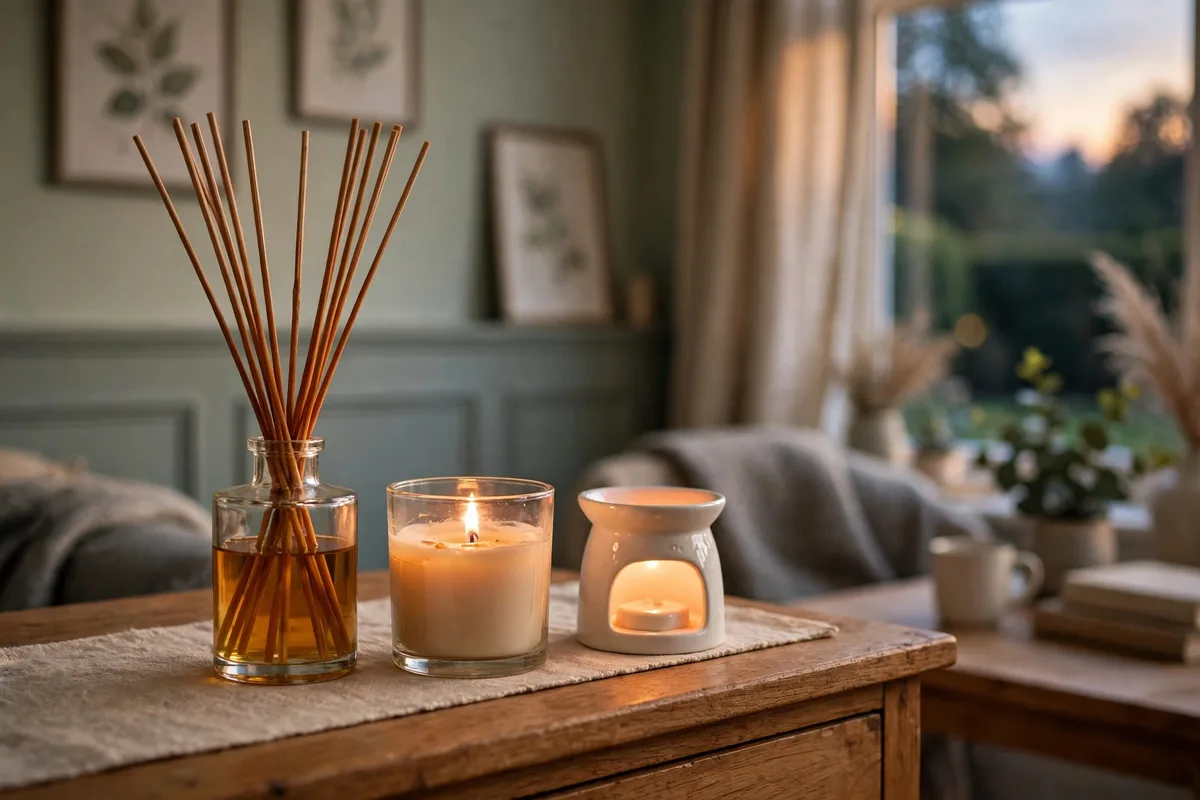
The first way is layering within one room: a diffuser running quietly in the background, a candle lit in the evening, and a room spray used for a few minutes before guests arrive. Each format does a different job, at a different strength, at a different time, and together they build a scent that has depth. This is the sense that matters most, and it is the sense this guide spends most of its time on.
The second way is layering across the home: a different expression of the same scent family in each room, so the scent changes as a person moves through the house, from a bright hallway to a warm living room to a soft bedroom. This is the sense our guide to home fragrance by room covers in full, with the room-by-room matrix of families, formats and strengths. It is mentioned here only where it affects the layering system, because the room-by-room detail already lives there.
The mistake is to treat layering as variety. Mallow & Moo Candles put it plainly in the guide checked for this article: the most common mistake is treating layering as an excuse for variety, and the professional approach is the opposite, to take a single fragrance and express it in several formats and intensities. A reed diffuser in the hallway and the matching candle in the sitting room means someone walking through the house experiences one continuous scent that simply gets stronger as they move into the room. That is layering. Three different strong scents in three rooms is not layering. It is a competition, and the nose is the loser.
The Anchor Family: One Family Across the Home
Every layered home starts with one decision, and it is the decision most people skip: choose one scent family to be the anchor for the whole home. The anchor family is the thread that ties the rooms together, the scent that makes a house smell like one home rather than a collection of rooms. Without it, layering has nothing to hold it together.
The anchor family is not a single product, and it is not a single scent. It is a family: citrus, warm woods, soft florals, fresh greens, gentle spice, or a clean linen character. The family is chosen for the feeling you want the home to have, not for the prettiest name on a jar. A home built around warm notes might combine vanilla, amber, sandalwood, cinnamon and gentle woods, as Candle Town notes in the guide checked for this article. A home built around fresh notes might combine citrus, mint, eucalyptus and light herbs. The family is the background note that keeps different spaces connected, and the choice is made once, for the whole home, before any product is bought.
Once the anchor family is chosen, each room gets a different expression of it, not a different family. A citrus anchor might mean a citrus and basil diffuser in the kitchen, a citrus and black pepper diffuser in the hallway, a citrus and fig candle in the living room, and a citrus and lavender diffuser in the bedroom. The family is the same, so the rooms do not clash, but the expression is different, so each room has its own character. The nose notices the change, and the home smells deliberate rather than confused. This is the one-family system our room-by-room pillar describes, and layering is how it is put into practice.
If a second family is wanted, it must share something with the anchor. Mallow & Moo Candles give the rule in the guide checked for this article: when two fragrances run in a home, pick ones with something in common, and a shared base note is the strongest link, because base notes are what linger and what travel between rooms. Parks Candles give the same rule for a single room: a candle and a diffuser can be used together as long as the two scents share at least one fragrance note. A citrus diffuser and a citrus and cedar candle share citrus. A lavender diffuser and a lavender and sandalwood candle share lavender. A citrus diffuser and a heavy spicy candle share nothing, and in a small British home they will fight each other across the room.
The physical rule for two families is distance. Mallow & Moo Candles advise separating them by physical distance and by a door, and ground floor and upstairs is the simplest division that works in almost any house. Two families in one room, or in rooms that open into each other, will mix in the air whether you want them to or not. Two families on different floors, with a door between them, can each have their own character without fighting.
The Three Layers: Background, Heart and Finish
A layered room is built in three layers, and each layer has a job, a format and a strength. The guides checked for this article agree on the three layers, even when they give them different names, and the agreement is the useful part: the background layer runs all day, the heart layer is lit or warmed for an occasion, and the finishing layer is used for minutes, not hours.
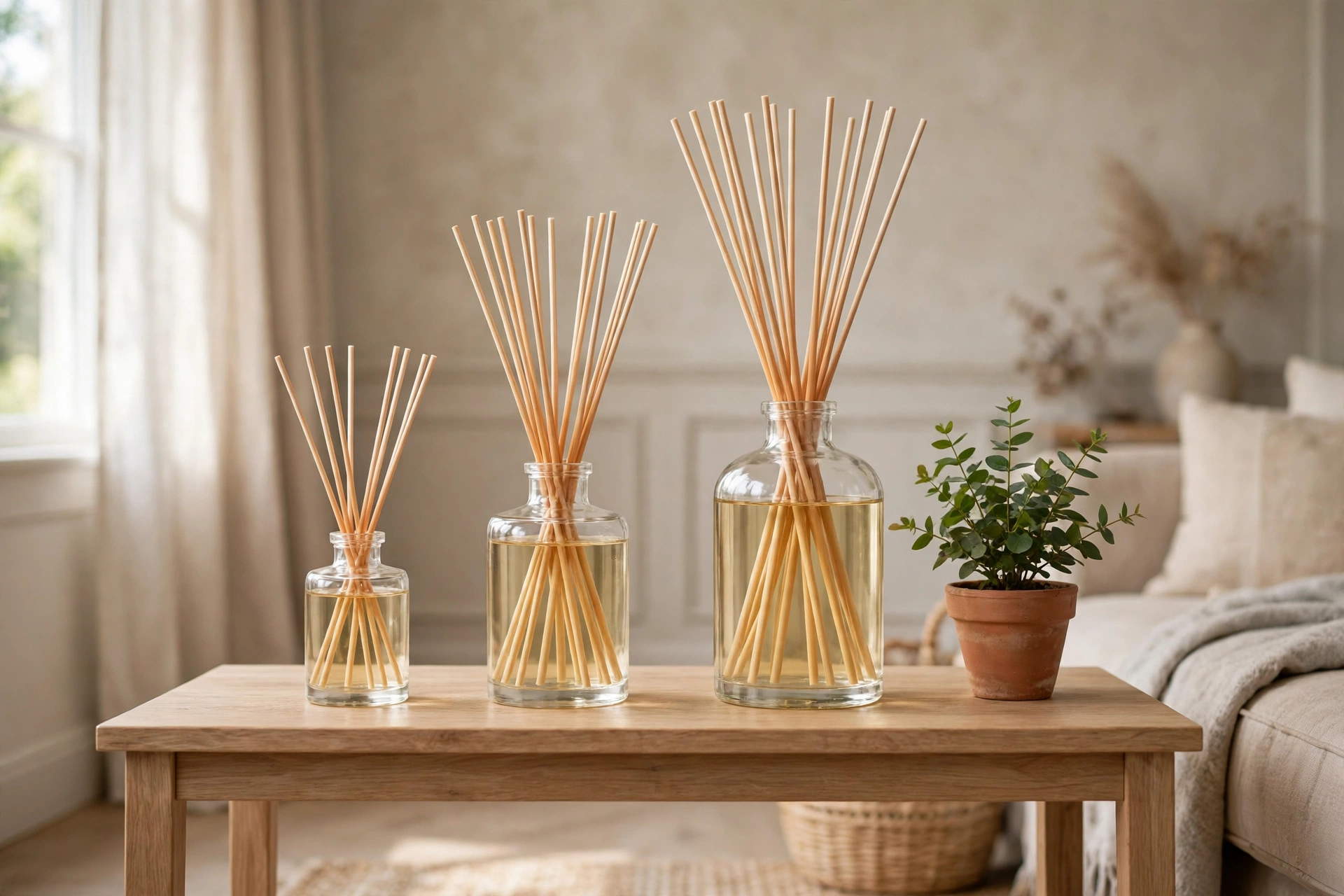
The background layer is a reed diffuser. It is the quiet thread that ties a room together, because it works all day without a flame and without needing to be switched on or watched. Artisan Goods describe it in the guide checked for this article as the fragrance people notice without having to think about it, and that is exactly the job: a steady, low scent that is there when you walk in and forgettable once you sit down. The background layer should be the lightest layer in the room, not the strongest, because it never switches off. A diffuser with three or four reeds in a small room, or the full set in a large living room, is the usual starting point, and the guide on how to make a reed diffuser smell stronger covers the reed-count maths in detail.
The heart layer is a candle or a wax melt. It is the emotional centre of the room, because it is chosen for a moment: an evening in the living room, a quiet hour before bed, a slow weekend afternoon. A candle adds warmth and light as well as scent, and it is lit when you settle in and blown out when the moment ends. A wax melt is the quieter version of the same layer: it lets you add a low level of fragrance to a room that already has a candle or a diffuser in it, without doubling the intensity, as Mallow & Moo Candles note, and it lets you switch scents day to day without buying a new candle each time. The heart layer should share a note with the background layer, and it should be the layer that is noticed when it is lit, and missed when it is not.
The finishing layer is a room spray, or a short run of an electric diffuser. It is a burst of scent that fades fast, usually within an hour, and it is used for a specific moment: before guests arrive, after cooking, or when a room needs a quick lift. It must never be the main scent in a room, because it fades too fast, and it must never be sprayed over food, plates or cooking surfaces. Used sparingly, it is the layer that makes a home feel cared for at exactly the moment it matters.
AromaStacker gives a useful ratio for the three layers in the guide checked for this article, called the 1-2-1 rule: start with one base source, a reed diffuser or a long-burn candle, two heart sources, a wax melt and a medium-burn candle, and one top-note source, an oil diffuser on a timer. The ratio is a starting point, not a law, and in a small British home one base and one heart is often enough. The point of the ratio is restraint: depth without chaos, and easy to adjust by swapping one element at a time until the balance feels right.
The Fragrance Pyramid in a Room
The three layers above are the practical version of a older idea, the fragrance pyramid, and understanding the pyramid is what makes layering stop being guesswork. A scent is not one smell. It is three smells that arrive at different times, and each layer of the pyramid suits a different format.
Top notes are the first smell, the one you notice in the first five minutes. Citrus, bergamot, mint and eucalyptus are the top notes most often named in the guides checked for this article. They are bright and light, and they fade first, usually within half an hour. A scent that smells wonderful in the shop and of nothing an hour later is usually a scent that is mostly top notes. In a layered room, top notes are the finishing layer: an electric diffuser run for twenty minutes when guests arrive, or a room spray before dinner, and then they are gone.
Heart notes are the middle smell, the one that arrives after the top notes fade and stays for a few hours. Lavender, rose, jasmine, geranium and warm spices such as cinnamon sit in this category. They are the character of the scent, the part that tells you whether it is floral, fruity or herbal. In a layered room, heart notes are the candle or the wax melt: the format that is lit or warmed for an evening, and that carries the room while it burns.
Base notes are the last smell, the one that stays in the room for hours. Sandalwood, amber, vanilla, cedar, musk and oud are the base notes most often named. They are the depth of the scent, the part that makes a warm wood candle smell cosy long after the flame is out. In a layered room, base notes are the reed diffuser: the format that runs continuously and reliably without needing attention, and that provides the invisible foundation every other layer builds on.
The practical use of this is simple. When you test a pairing, do not judge it on the first sniff. The top notes are doing the talking then, and they will be gone within half an hour. Live with the pairing for an evening, and judge it on what is left when the candle is blown out, because that is the heart and the base, and that is the scent you will actually live with. The same rule applies to buying: a scent that smells bright in the first five minutes and of nothing by the evening is a top-note scent in a room that needs a base.
Intensity Budgeting Room by Room
The most useful idea in layering, and the one no competitor guide gives in full, is the intensity budget: each room gets a total amount of scent, and the layers in that room must add up to that total, not exceed it. A room with a diffuser running at full strength and a large candle burning at the same time has two full-strength layers, and it will smell of too much. A room with a light diffuser and a candle that is lit only in the evening has one layer at a time, and it will smell right.
The budget is set by the room, and the table below gives a starting point for the rooms in a typical UK home. The numbers are reeds for a diffuser and size for a candle, and they are starting points to adjust by living with them for a day, not rules to follow blindly.
| Room | Background layer | Heart layer | Finishing layer | Total feeling |
|---|---|---|---|---|
| Hallway | Reed diffuser, full set of reeds | None, or a small candle for guests only | Room spray before visitors arrive | Medium, welcoming on arrival |
| Living room | Reed diffuser, full set of reeds | Large candle in the evening, or wax melt | Room spray before guests arrive | Medium to full in the evening, medium in the day |
| Bedroom | Reed diffuser, 3 to 4 reeds | Small candle for the hour before bed only | None | Light, less than you think |
| Bathroom | Reed diffuser, 3 to 4 reeds | None | Room spray after use, if needed | Light to medium, fresh and airy |
| Kitchen | Reed diffuser, 4 to 6 reeds | Wax melt or spray after cooking | Room spray after cooking | Light for the day, strong for the after-cooking reset |
| Home office | Reed diffuser, 3 to 4 reeds | None | None | Light, steady background |
Three things to notice in the table before reading on. First, the bedroom and the home office have no heart layer in the day, because they are rooms where you sit still for hours, and a second layer would build into something too strong. Second, the hallway and the living room are the only rooms with a full set of reeds, because they are the largest rooms and the rooms where scent has the most air to fill. Third, the finishing layer is used in only three rooms, and only for minutes, because a room spray that is used all day is not a finishing layer. It is a second background layer, and it will fight the first one.
The test for the budget is always the same, and it is the test every guide checked for this article agrees on: walk into the room from another room, and notice what you smell in the first five seconds. That is the strength that matters, not the strength you smell when you stand next to the diffuser. If you can smell the diffuser clearly when you sit down in the room, it is too strong. If you walk in from outside and the room smells gently of the scent, it is right. If the scent follows you into the next room and fights the scent there, the budget has been exceeded, and the fix is to remove a layer, not to add a different one. Candle Town make the same point in the guide checked for this article: when the nose gets used to one fragrance, the natural instinct is to add more, and usually the better move is to reduce the number of active products and let the room breathe.
Candle and Diffuser Pairing Rules
The most common pairing in a layered home is a candle and a reed diffuser in the same room, and it is also the pairing that goes wrong most often, because the two formats behave differently. A diffuser is always on. A candle is on when you light it. The rules below are the ones the guides checked for this article agree on, and they are worth following in order.
Rule one: share a note. The candle and the diffuser must share at least one fragrance note, and ideally a base note, because base notes are what linger and what travel. A citrus and basil diffuser and a citrus and fig candle share citrus. A lavender diffuser and a lavender and sandalwood candle share lavender. A citrus diffuser and a spicy candle share nothing, and in a small room they will fight each other. If the two products do not share a note, do not use them in the same room. Use them on different floors, or on different days.
Rule two: one layer subtle, one layer stronger. Parks Candles put it plainly in the guide checked for this article: keep one layer subtle and the other stronger. The diffuser is usually the subtle layer, with fewer reeds than you would use on its own, and the candle is the stronger layer when it is lit. The two should never both be at full strength at the same time, because the room will smell of too much, and the nose will stop noticing either of them.
Rule three: keep a metre between a lit candle and a diffuser. Diffuser oils are flammable, and a diffuser must never be placed close to a lit candle. Parks Candles give the distance as at least a metre, and the rule is simple to follow: the candle goes on one side of the room, the diffuser on the other, and they are never on the same shelf, the same table, or the same windowsill. The same rule applies to wax melts and room sprays: no flammable product is ever placed next to a flame.
Rule four: let the diffuser settle first. Set the diffuser in place and let it run for a day before you add the candle, so you know what the background layer smells like on its own. Then light the candle for thirty to sixty minutes and notice what changes. If the room smells better, the pairing works. If it smells confused, the pairing does not, and the fix is to change the candle, not the diffuser, because the diffuser is the foundation and the candle is the layer that is easiest to swap.
Rule five: test from the doorway, and adjust, do not add. Parks Candles give a seven-step routine in the guide checked for this article, and the step that matters most is the last one before the re-test: adjust, do not add. If the pairing is too strong, remove reeds from the diffuser or shorten the candle burn. If it is too weak, add a reed or burn the candle for longer. The answer is never a third product, because a third product in a small room is almost always too much.
Rule six: never leave a candle burning in an empty room, and never leave one burning overnight. This is not a rule about scent. It is a safety rule, and it is the one rule in this guide that can cause real harm if it is broken. A candle in a bedroom is for the hour before bed only, lit while you wind down and blown out before you sleep. A reed diffuser is the format for overnight, because it has no flame and nothing to watch. The bedroom guide on this site covers the candle safety rule in detail, and it is not repeated at length here, because the rule is simple.
Layering Through the Day
The most sophisticated version of layering is temporal rather than spatial, as Mallow & Moo Candles note in the guide checked for this article: the same room carries a light, fresh fragrance in the morning and a deeper, warmer one in the evening. This is layering through the day, and it is how a home can feel different at different times without any product being moved.
The morning layer is fresh and light: citrus, mint, eucalyptus, or a light herbal note, in a diffuser that has been running all night, or in a room spray used after the windows are opened. The job of the morning layer is to clear the night air and to make the house feel clean, and it should be gone by midday, because a fresh scent that is still there in the evening feels wrong.
The daytime layer is the background layer: the diffuser, running quietly, in the anchor family, at the strength the room needs. It is the layer that is there all day, and it should be forgettable once you sit down, because a daytime scent that demands attention is a scent that will distract you from work, from reading, or from a conversation.
The evening layer is the heart layer: the candle, lit when the curtains are closed, in a warmer expression of the anchor family. A citrus anchor might mean a citrus and fig candle in the evening, where the morning was citrus and basil. A warm wood anchor might mean a sandalwood and amber candle, where the day was cedar and vanilla. The change is the point: the nose notices a change far more than it notices a scent that never varies, and a home that smells slightly different in the evening feels deliberate and cared for.
The night layer is the bedroom layer, and it is the lightest layer of all: a diffuser with three or four reeds, in a soft family such as lavender, chamomile or soft musk, running quietly while you sleep. No candle, no spray, no melt. The night layer is the one that must be the most restrained, because it is the one you breathe for eight hours, and a scent that is pleasant for an hour in a living room can become cloying over a whole night in a bedroom. The full guide to this room, including the calm scent families and the diffuser-over-candle logic for overnight, is in our guide to the best scents for the bedroom.
Seasonal Rotation Without Clashes
Layering has a seasonal version too, and it is the version that causes the most waste, because it is the version where people throw away products that still have months of life in them. The rule is simple: rotate the heart layer, not the background layer, and finish what you have before you start something new.
In autumn and winter, the heart layer moves warmer: woods, soft spice, fig, amber and gentle gourmands, as Hampshire Candles note in the guide checked for this article. The background layer stays the same, or shifts to a warmer expression of the same family, so the home does not have to be re-scented from scratch. A citrus anchor in summer becomes a citrus and fig anchor in autumn, and the diffuser that was citrus and basil becomes citrus and cedar, with the same reeds, the same bottle, and the same place.
In spring and summer, the heart layer moves lighter: citrus, herbs, greens and light florals, and the background layer shifts to a fresher expression of the same family. A warm wood anchor in winter becomes a cedar and bergamot anchor in spring, and the candle that was sandalwood and amber becomes bergamot and fig, with the same format and the same place.
The rotation is done one product at a time, as each one finishes, not all at once on the first day of a season. A diffuser that still has a month of oil in it is not thrown away because the calendar says autumn. It is finished, and then it is replaced with the autumn expression of the same family. A candle that is half burned is not put away because the season changed. It is burned to the last centimetre, and then it is replaced. The waste in home fragrance is not in the products. It is in the half-used bottles that were replaced because a season changed on a calendar.
Three Starter Combinations for UK Homes
The combinations below are starting points, not prescriptions, and they are built from the families and the pairings the guides checked for this article agree on. Each one is a complete layered home: an anchor family, a background layer, a heart layer, and a finishing layer, for a typical UK home of a hallway, a living room, a bedroom, a bathroom and a kitchen.
Calm and grounded. The anchor family is warm woods and soft herbs. The background layer is a cedar and lavender diffuser in the hallway and the living room, with three or four reeds in the bedroom. The heart layer is a sandalwood and amber candle in the living room in the evening, and a lavender and cedar candle in the bedroom for the hour before bed. The finishing layer is a eucalyptus room spray in the bathroom after use. This is the combination for a home where the evenings are quiet and the bedrooms matter most.
Fresh and clean. The anchor family is citrus and herbs. The background layer is a lemon and rosemary diffuser in the kitchen and the hallway, with three or four reeds in the bathroom. The heart layer is a bergamot and fig candle in the living room in the evening, and a citrus and basil wax melt in the kitchen after cooking. The finishing layer is a mint room spray in the kitchen after cooking. This is the combination for a home where the kitchen is used hard and the living room needs to feel clean.
Light and uplifting. The anchor family is citrus and light florals. The background layer is a grapefruit and cedar diffuser in the hallway and the home office, with three or four reeds in the bedroom. The heart layer is a bergamot and jasmine candle in the living room in the evening. The finishing layer is a eucalyptus room spray in the bathroom. This is the combination for a home office that needs to feel bright without being distracting, and a living room that needs to feel welcoming without being heavy.
Each combination uses no more than two families, and each family shares a note with the other, so the rooms do not clash. Each combination uses one background layer, one heart layer and one finishing layer, and no room has more than two layers active at the same time. Start with one combination, live with it for a week, and change one element at a time until it feels right. The right layered home is the one you stop noticing after ten minutes and still enjoy when you walk back in from outside.
The Mistakes That Waste Money and Scent
Most disappointing layering is not bad fragrance. It is good fragrance used in the wrong way, and the mistakes below are the ones the guides checked for this article agree on.
Treating layering as variety. Three different strong scents in three rooms is not layering. It is a competition, and the nose is the loser. One family across the home, with a different expression in each room, is the rule that keeps a home smelling deliberate.
Adding a third product when two are too strong. If a room smells of too much, the fix is to remove a layer, not to add a different one. Remove reeds from the diffuser, shorten the candle burn, or take one product out of the room. A third product in a small room is almost always too much.
Lighting everything at once. A diffuser, a candle, a wax melt and a room spray, all running in the same room at the same time, will overwhelm the room within minutes, and the nose will stop noticing any of it. One background layer, one heart layer, one finishing layer, and never all three at full strength at the same time.
Placing a diffuser next to a lit candle. Diffuser oils are flammable. Keep at least a metre between a lit candle and a diffuser, and never place them on the same shelf or the same table. The same rule applies to wax melts and room sprays.
Judging a pairing on the first sniff. The top notes are doing the talking in the first five minutes, and they will be gone within half an hour. Live with a pairing for an evening, and judge it on what is left when the candle is blown out, because that is the heart and the base, and that is the scent you will actually live with.
Using scent to cover a smell that needs cleaning. Scent masks a smell. It does not fix a greasy extractor filter, a full bin, a blocked drain, a damp bathroom or a dirty oven, and a stronger scent on top of a stale smell makes the room smell worse, not better. Find and fix the cause first, then add scent.
Throwing away half-used products when the season changes. A diffuser that still has a month of oil in it is not thrown away because the calendar says autumn. Finish it, and then replace it with the autumn expression of the same family. The waste in home fragrance is in the half-used bottles, not in the products themselves.
Layering in Five Steps
If the system above feels like too much to hold at once, the whole guide can be reduced to five steps, in this order. Get the order right and the name on the jar stops mattering very much.
Step one: pick one anchor family for the whole home. Choose the family for the feeling you want, not for the prettiest name on a jar. Citrus for fresh, warm woods for cosy, soft florals for calm, gentle spice for autumn. This is the thread that ties the rooms together.
Step two: set the background layer. A reed diffuser in the hallway and the living room, with fewer reeds in the bedroom and the bathroom, in the anchor family, at the strength the room needs. Let it run for a day before you add anything else, so you know what the background smells like on its own.
Step three: add the heart layer for the evening. A candle or a wax melt, in the same family or sharing one note with the background layer, lit when you settle in and blown out when the moment ends. Keep a metre between the candle and the diffuser.
Step four: budget the intensity room by room. Use the table above. Three or four reeds for a small room, the full set for a large room, and never more than two layers active in one room at the same time. Walk into the room from another room and notice what you smell in the first five seconds.
Step five: change one thing at a time. If the home smells wrong, change one element, live with it for a day, and then decide. A layered home is built by adjusting, not by buying, and the right combination is the one you stop noticing after ten minutes and still enjoy when you walk back in from outside.
Start with one room, live with it for a week, and notice when you reach for it and when you do not. The right scent for a room is the one you stop noticing after ten minutes and still enjoy when you walk back in from outside. That is the scent that suits your room, and no list can choose it for you. The room-by-room detail, including the scent families for each room and the format that suits each one, is in our guide to home fragrance by room, and the buying guide, including size against room and how to judge hot throw, is in our guide on how to choose a scented candle.
Frequently Asked Questions
What is scent layering at home?
Scent layering at home means combining two or more fragrance formats, such as a reed diffuser and a candle, so they complement each other rather than compete. A diffuser provides the steady background, a candle adds warmth in the evening, and a wax melt or room spray is kept for short resets. The scents should share a family or at least one fragrance note, so the home smells deliberate rather than confused.
Can I use a candle and a reed diffuser together?
Yes, as long as the two scents share at least one fragrance note, and as long as one layer is subtle and the other is stronger. The diffuser is usually the subtle background layer, with fewer reeds than you would use on its own, and the candle is the stronger layer when it is lit. Keep at least a metre between a lit candle and a diffuser, because diffuser oils are flammable, and never place them on the same shelf or the same table.
How many scents should I layer in one room?
Two, at most, and in most rooms one is enough. A background layer and a heart layer is the usual maximum, and they should share a note. Three layers in one small room will overwhelm it, and the nose will stop noticing any of them. If a room smells of too much, remove a layer rather than adding a different one.
Should I use the same scent in every room?
No. A house where every room smells of the same scent is a house where nothing smells of anything in particular, because the nose adapts to a scent that never changes. Use one family across the home with a different expression in each room, so the rooms do not clash but each room has its own character, and let the scent change as you move through the house.
How do I layer scents in a small flat?
Use fewer layers and fewer reeds. One diffuser in the hallway, with the full set of reeds, and one candle in the living room in the evening, in the same family, is often enough for a whole flat. Separate two families by a door, and never run a diffuser, a candle and a wax melt in the same small room at the same time.
What scents layer well together?
Scents that share a note layer well together. Citrus and cedar, citrus and fig, lavender and sandalwood, bergamot and jasmine, and vanilla and amber are pairings the guides checked for this article agree on. Scents from the same family, or from families next to each other, such as citrus and herbs, or warm woods and gentle spice, layer well. A fresh citrus and a heavy spicy scent in the same room will fight each other.
Is scent layering safe with pets or children?
Scent layering itself is not a safety question, but the formats are. A candle must never be left burning in an empty room and never left burning overnight, and a diffuser must never be placed where a child or a pet can knock it over or reach the oil. Diffuser oils are flammable, so keep at least a metre between a lit candle and a diffuser. The safety guides on this site cover pets and children in detail.
How do I change my home scent for autumn?
Rotate the heart layer, not the background layer, and finish what you have before you start something new. A citrus anchor in summer becomes a citrus and fig anchor in autumn, and the diffuser that was citrus and basil becomes citrus and cedar. Change one product at a time, as each one finishes, rather than replacing everything on the first day of the season.
Sources
The layering rules and pairings in this article restate the consensus of the ten guides checked on 18 November 2026: Mallow & Moo Candles, “How to Layer Home Fragrance Properly”; Parks Candles, “Can You Use a Candle and Reed Diffuser Together?”; Hampshire Candles, “How to Layer Home Fragrance for Autumn”; Artisan Goods, “A Guide to Home Fragrance Layering at Home”; The Flora Lab, “The Ultimate Guide to Scent Stacking”; Columbia Fragrance, “How to Layer Fragrances for the Ultimate Home Scent Experience”; AromaStacker, “The Home Fragrance Layering Guide”; Gya Labs, “Scent Layering for Home Fragrance: Room by Room”; Candle Town, “Home Fragrance Layering Guide for Every Room”; and Botanical Blueprint, “Scent Layering at Home: How to Create a Signature Fragrance for Your Space”. The room-by-room detail this article links to is in the room guides on this site, checked against the same sources for the room detail. No claim here is presented as our own survey or test, and no volume or keyword difficulty figure is stated, because none has been verified.