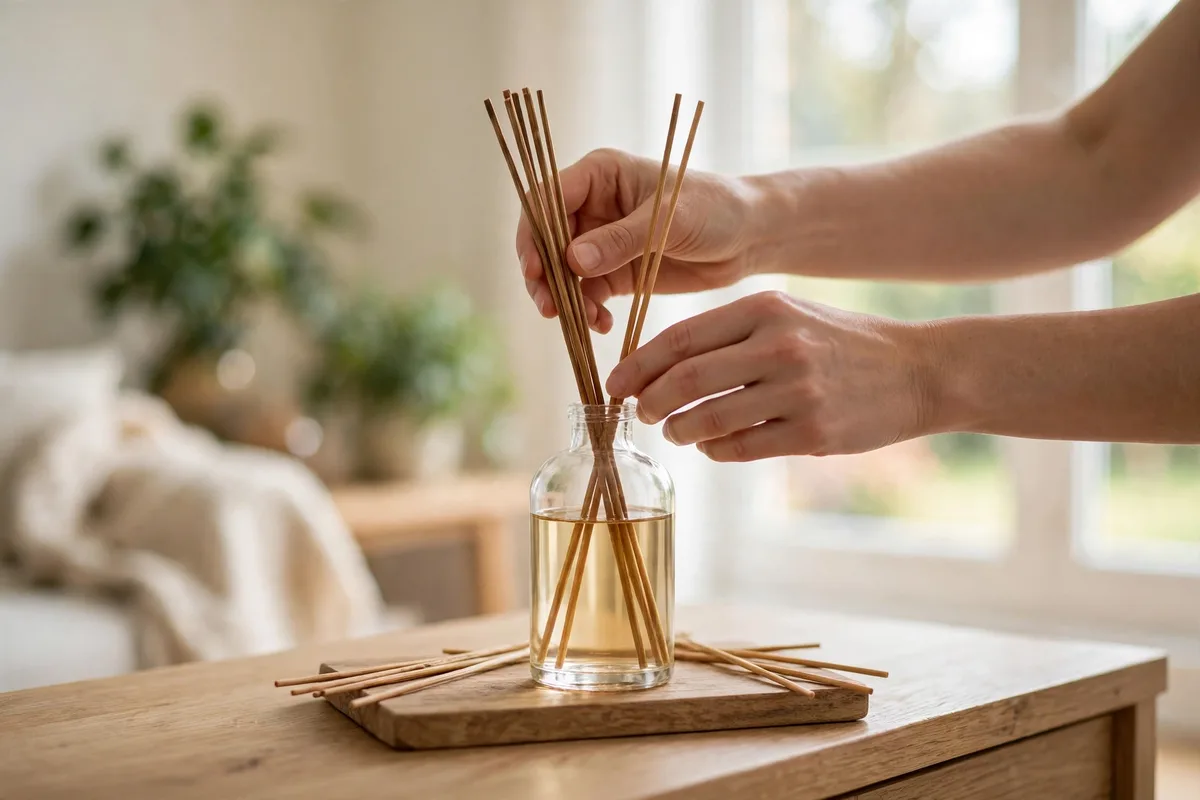
Quick answer: Take the stopper out, put the reeds in, fan them out, and give them time. Protect the surface underneath first, because spilled diffuser oil marks wood and stone. Use all the reeds for a strong scent or fewer for a gentle one, flip the reeds every one to two weeks, keep the bottle out of sun and away from radiators, and refill it with fresh reeds when the oil runs low. A 100ml diffuser usually lasts six weeks to three months in a normal UK home. This guide covers the whole system: setup, reed counts, placement, the weekly routine, lifespan, refills, troubleshooting and safety, with a link to the matching in-depth guide at each step instead of repeating it.
A reed diffuser is the simplest home fragrance product there is. There is no flame, no plug, no switch and nothing to turn on. It works all day, every day, on its own. That simplicity is also why so many diffusers disappoint. People set one up in the wrong spot, with too few reeds, in a room too big for it, and then decide diffusers do not work. Used properly, a reed diffuser gives a steady, gentle background scent for weeks. This guide shows you how, from the first unboxing to the last refill, for the rooms UK homes actually have.
What a Reed Diffuser Is, and How It Works
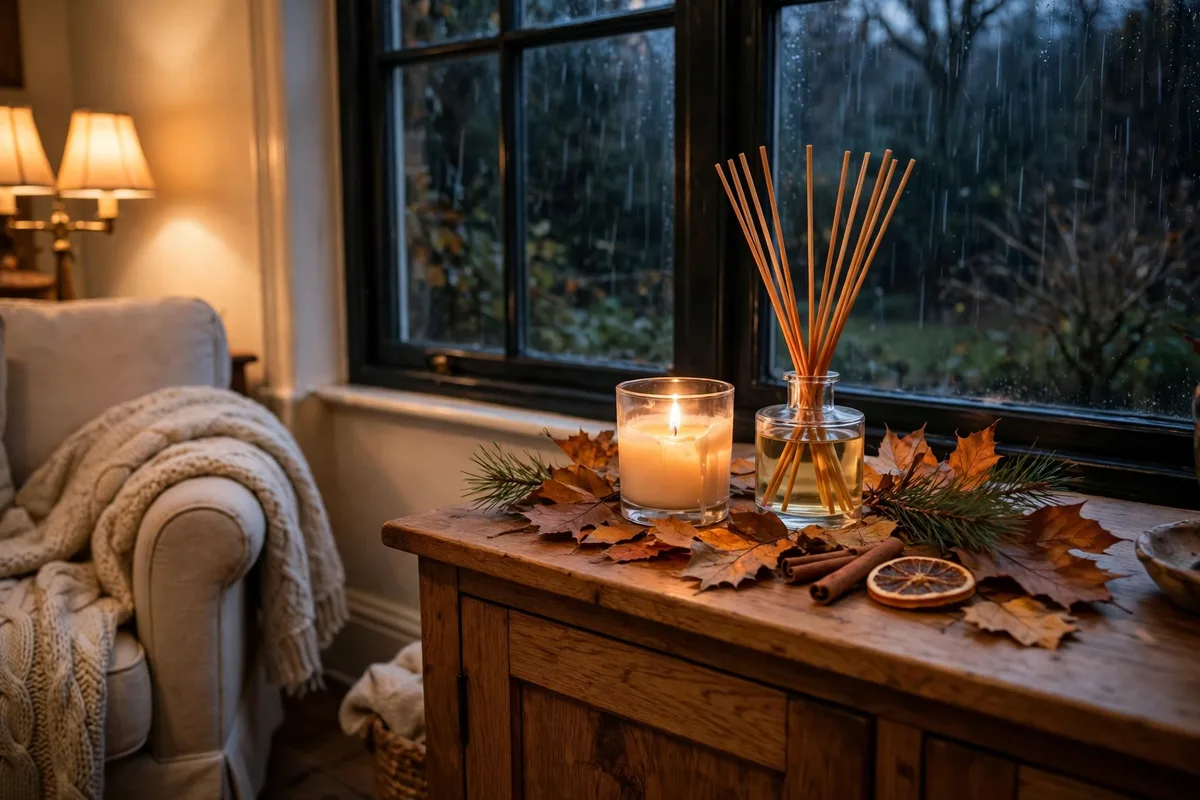
A reed diffuser is a bottle of fragrance oil with a set of porous reeds standing in it. The reeds draw the oil up from the bottle by capillary action, the same process that pulls water up through a plant stem. The oil evaporates slowly off the surface of the reeds, and the fragrance drifts into the room. No heat is involved, which is the whole point: the scent is released steadily at room temperature, all day, with nothing to light, plug in or switch off.
Three things decide how well a diffuser works. The first is the reeds: more reeds, and reeds with more surface area, release more fragrance. The second is the oil: its strength, its base, and how much of it is in the bottle. The third is the air: gentle movement carries the scent around the room, while still air lets it sit in one spot. Everything in this guide comes back to those three things.
A diffuser is not a candle and should not be judged like one. A candle gives a strong scent for a few hours while it burns, then nothing. A diffuser gives a gentle scent all the time. If you want a room to smell noticeable the moment you walk in, a diffuser alone may not do it, and that is normal. If you want a hallway or bedroom to carry a quiet background scent day and night, a diffuser is the right tool. The comparison between diffusers and candles on this site sets out which format suits which room, if you are choosing between the two.
What Comes in the Box
Most reed diffusers arrive as a small kit: a glass bottle filled with fragrance oil, a set of reeds, a stopper or plug sealing the bottle neck, and a decorative collar or cap. Some come with a tray or coaster. Bottle sizes in the UK are usually 50ml, 100ml, 150ml or 200ml, and reed counts are usually 6 to 10 sticks.
Before you buy, check two things. First, the reed type. Rattan reeds are the standard: natural, porous, and reliable. Fibre reeds, usually made from a synthetic material, draw oil faster and can give a stronger scent, but they can also use the oil up faster. Either works; what matters is that the reeds are new and dry, because reeds that have already been used are clogged with old oil and will not draw properly. Second, the base. Most diffuser oils use a light carrier base that evaporates slowly. Cheap diffusers sometimes use a thin, alcohol-heavy base that evaporates fast and fades in a fortnight. A heavier oil base lasts longer and smells steadier.
If you are buying a refill rather than a new bottle, make sure it matches your bottle size, and buy new reeds with it. Old reeds do not revive. They are saturated with the old fragrance and clogged with dust, and reusing them with a new scent mixes the two smells and slows the draw. Fresh reeds with every refill is one of the few hard rules in this guide.
How to Set Up a Reed Diffuser, Step by Step
Setup takes about two minutes, but the order matters, and the first flip matters most of all. Follow the steps below, and the diffuser will be working properly from day one.
- Protect the surface first. Put a coaster, tray, saucer or folded cloth under the bottle before you open it. Diffuser oil drips when reeds are flipped, and it leaves a permanent mark on wood, stone and painted surfaces. This is the step people skip, and the one they regret skipping.
- Choose the spot before you open the bottle. Pick the place using the placement rules in the section below, and set the bottle down there. Moving a full diffuser around the house risks spills, so decide first.
- Take the stopper out. Unscrew the decorative collar, then pull out the inner stopper or plug. Some stoppers are tight; wiggle them out with the handle of a spoon rather than yanking, and do it over the sink or over the tray so any drips land somewhere safe. Throw the stopper away. You will not need it again unless you want to seal the bottle for moving house.
- Put the collar back on. Screw the decorative collar back onto the bottle neck. It hides the opening and keeps the reeds upright and evenly spaced.
- Put the reeds in and fan them out. Push the reeds into the oil and spread them into a loose bouquet shape, with space between the sticks so air can move around each one. Do not bunch them tight. Airflow between the reeds is part of how the scent spreads.
- Wait, then flip the reeds once. Leave the reeds for the first hour or so while the oil travels up them. Makers disagree on exactly how long this takes: some say ten minutes, some say 30 to 40 minutes, some say a full day. The honest answer is that it depends on the reeds and the oil. After the first hour, take the reeds out carefully over the tray, turn them upside down so the oil-soaked ends point up into the air, and put them back. This first flip is what gets the scent going quickly instead of waiting a day for the reeds to saturate on their own.
- Give it up to 24 hours. The scent builds gradually. Do not judge the diffuser in the first hour. After a day, the fragrance should be noticeable when you walk into the room, gentle but present. If it is not, the problem is almost always reed count, placement or room size, not the product, and the troubleshooting section below works through them in order.
How Many Reeds to Use
Reed count is your volume control. More reeds means more surface area, more evaporation, and a stronger scent, and it also means the oil runs out faster. Fewer reeds means a gentler scent and a longer life. Start with the full set the diffuser came with, then adjust after a day. If the scent is too strong, take two or three reeds out and store them somewhere safe; you can put them back later. If it is too faint, add reeds back in, or move the diffuser to a smaller space.
The table below is a starting point for a standard 100ml diffuser. Smaller bottles and stronger oils need fewer reeds; larger rooms need more.
| Room | Reeds to start with | Why |
|---|---|---|
| Small bathroom or cloakroom | 3 to 5 | Small, still space; a full set can be overpowering |
| Bedroom | 5 to 7 | Gentle overnight scent; too many reeds can be too much in a closed room |
| Living room | 7 to 10 | Larger space with more air to fill |
| Hallway or landing | 8 to 10 | Moving air carries the scent; use the full set |
| Large open-plan room | 10, or two diffusers | One bottle rarely fills a big open space on its own |
| Home office | 5 to 7 | A steady background scent without distraction |
Never use reeds from another diffuser, and never top up a bottle with water to make it last longer. Water does not mix with diffuser oil, it stops the reeds drawing properly, and it can turn the oil cloudy. If the oil is running low, the answer is a refill, not a dilution.
Where to Place a Reed Diffuser
Placement is the single biggest factor in how well a diffuser works, and it is also the one people get wrong most often. The rule is simple: gentle moving air at about waist height, out of sun and away from heat.
Good spots are hallway console tables, living room shelves, bedroom dressing tables, bathroom shelves and sideboards, anywhere people walk past and air moves gently. Height matters because fragrance drifts downwards from the reeds, so a diffuser at waist height on a shelf scents a room more evenly than one sitting on the floor.
The places to avoid are radiators, direct sunlight, open windows, strong draughts, fans, open flames and electrical items. Heat and strong airflow make the oil evaporate too fast, so the diffuser smells strong for a week and then dies. Direct sun can also darken the oil and fade the scent. A diffuser beside a radiator is the fastest way to waste a bottle.
The placement guide on this site gives the room-by-room detail, including the never list and how to space two diffusers in an open-plan room, and it is the right next step if you want to get placement exactly right.
The Weekly Routine That Keeps It Working
A reed diffuser needs very little care, but it does need a small routine. Without it, the scent fades gradually and people assume the diffuser has finished, when it has only gone quiet.
Flip the reeds every one to two weeks. Take the reeds out over the tray, turn them over so the dry ends go into the oil and the saturated ends point up, and put them back. This refreshes the scent immediately, because fresh oil is exposed to the air. Wipe any drips off the bottle straight away. If you flip and the scent does not come back, the reeds are probably clogged and need replacing, or the oil is nearly gone.
Check the oil level once a week. The level drops fastest in the first week, while the reeds are soaking up oil, then slows down. If the level has dropped below a third of the bottle, the reeds are not drawing as well, and a refill is due soon. Do not wait until the bottle is empty, because dry reeds stop working and the scent disappears before the oil does.
Dust the reeds now and then. Dust settles on the reeds and blocks the pores. A quick wipe with a dry cloth when you flip them is enough. Never wash reeds. Water ruins them.
Keep the bottle upright and stable. Diffuser oil is slippery and stains. Keep the bottle on a flat, stable surface where it cannot be knocked over, out of reach of small children and pets, and away from the edge of a shelf. If oil spills on a surface, wipe it at once with a damp cloth, and wash your hands after handling the reeds, because the oil can irritate skin.
That is the whole routine: flip, check, dust, keep it upright. Two minutes a fortnight, and the diffuser will scent properly for its full life instead of fading halfway through.
Making It Stronger, or Gentler
If your diffuser smells too faint, work through the fixes in this order before you blame the product. Add reeds, up to the full set. Flip the reeds, over the tray, and see if the scent lifts within the hour. Move the diffuser into gentle moving air, near a doorway or where people walk past, instead of a still corner. Move it to a smaller room, or closer to where you sit, instead of expecting one bottle to fill a large open space. Check that the reeds are not old or clogged, and that the oil has not been sitting open for months. If none of that works, the fragrance itself may be a light one, or the bottle may be a cheap base that evaporates too fast, and the next bottle should be a different product.
If your diffuser smells too strong, the fixes run the other way. Take out two or three reeds and store them. Move the diffuser further from where you sit, or into a larger room. Move it out of moving air into a calmer spot. Do not try to dilute the oil, and do not put fewer reeds in a bottle that is already too strong by cutting the reeds shorter, because cut reeds draw unevenly and can shed fibres into the oil.
The guide to making a diffuser smell stronger on this site works through the faint-diffuser fixes in full, and it is the right next step if your diffuser has gone quiet.
How Long a Reed Diffuser Lasts
A diffuser lasts until the oil runs out, and the time that takes depends on bottle size, reed count, heat, airflow and the oil base. The ranges below are typical for a normal UK home, with a full set of reeds, in a room that is neither hot nor draughty. A diffuser beside a radiator or in strong sun can last half as long. A diffuser in a cool, still room with fewer reeds can last longer.
| Bottle size | Typical lifespan |
|---|---|
| 50ml | About 3 to 4 weeks |
| 100ml | About 6 weeks to 3 months |
| 150ml | About 3 months |
| 200ml | About 3 to 6 months |
The signs that a diffuser is finishing are easy to read: the scent fades even after flipping, the reeds feel dry at the top, the oil level is below a third of the bottle, and the oil has darkened or thickened. Darkening alone is not a fault. Some fragrance oils, especially vanilla, darken naturally with age, and the scent is usually still fine. What matters is whether flipping still brings the scent back.
The lifespan guide on this site gives the full picture, including the six factors that shorten a diffuser’s life and how flipping changes the maths, and it is worth reading if your bottles keep running out faster than the ranges above.
Refill or Replace: The Decision
When the oil runs low, you have two choices: refill the bottle or replace it. Refill if the bottle is in good condition, the glass is clean and undamaged, and you like the scent. Replace the bottle if it is chipped or cracked, if the neck is damaged, or if you want a different scent and do not want to clean the old bottle thoroughly.
To refill, pour out any old oil, wash the bottle with warm soapy water, rinse it well, and let it dry completely. If you are changing scent, wash twice, because old oil clings to the glass and will mix with the new fragrance. Pour in the refill oil, put in a brand new set of reeds, and set it up exactly as you would a new diffuser, including the first flip after an hour. Never reuse old reeds with a refill. They are saturated with the old scent and clogged with dust, and they will not draw the new oil properly.
Refilling is cheaper than buying a new bottle each time, and it wastes less glass, but only if you use proper refill oil. Do not refill with essential oil on its own, and do not mix a refill with the remains of a different scent unless you are happy with the result. The refills guide on this site covers same-scent rules, scent changes, reed replacement timing and bottle cleaning in full.
When You Cannot Smell Your Diffuser
This is the most common diffuser problem, and it is usually not the diffuser’s fault. Work through the causes in this order, and check each one properly before moving to the next.
First, check your nose. Your nose adapts to a constant scent within about twenty minutes and stops noticing it. This is called olfactory fatigue, or nose blindness, and it is normal. Leave the room for ten minutes, close the door, walk back in, and take one breath. If the scent is there when you walk in and gone after half an hour, the diffuser is fine and your nose has adapted.
Second, check the reeds. Are they saturated, clogged or too few? Flip them, and if the scent comes back, the reeds were the problem. If flipping does nothing, replace the reeds with a fresh set.
Third, check the oil. Is the level low, is the oil old, is the bottle nearly empty? A bottle below a third full does not draw well. Refill it with fresh oil and new reeds.
Fourth, check the placement. Is the diffuser in a still corner, on the floor, beside a radiator or in direct sun? Move it into gentle moving air at waist height, away from heat.
Fifth, check the room. Is the room too big, too draughty, or too open for one bottle? A single 100ml diffuser cannot scent a large open-plan living room on its own. Use more reeds, move it closer to where you sit, or add a second diffuser.
The troubleshooting guide on this site works through all of this as a step-by-step diagnosis, with a checklist you can follow in order, and it is the right next step if the checks above do not fix it.
Safety: Pets, Children and Spills
Reed diffusers are safer than candles in one clear way: they have no flame, no hot wax and no heat. But the oil is still a chemical product, and it needs respect, especially in homes with pets and small children.
Keep the bottle on a stable surface where it cannot be knocked over, out of reach of children and pets. The main risk is not the scent in the air, it is the liquid: a spilled bottle can be licked or stepped in, and some fragrance oils are harmful if swallowed. If a child or pet swallows diffuser oil, or gets it in their eyes, call your vet or NHS 111 straight away and take the bottle or label with you. Do not wait to see if symptoms appear.
Cats are more sensitive than dogs, because they groom themselves and their livers process some fragrance compounds slowly. Birds are the most sensitive of all, and a diffuser should not be used in a room where a caged bird lives. Never place a diffuser where a pet can chew the reeds or knock the bottle over, and never use a diffuser in a room with no ventilation.
The safety guide for reed diffusers around pets and children on this site separates dogs, cats, birds and children by age, lists the oils to treat with caution, and gives placement rules and what to do after a spill. Read it before you put a diffuser in a nursery or a pet’s room.
Reed Diffuser or Candle: Which to Use
Most UK homes end up using both, for different jobs. A diffuser suits rooms you want scented all day without thinking about it: hallways, landings, bathrooms, bedrooms overnight. A candle suits the evening, when you want a stronger scent and the light that goes with it, for a few hours, while you are in the room and awake. A diffuser is the background. A candle is the occasion.
Choose a diffuser when you want continuous scent with no flame, no effort and no supervision. Choose a candle when you want a stronger scent for a short time and you will be there to watch it. In a home with small children or pets, the diffuser is the safer default for rooms where nobody is watching. The comparison guide on this site works through the decision by room, safety, cost per month and effort, if you want the full framework.
Frequently Asked Questions
How do you use a reed diffuser for the first time?
Protect the surface, take the stopper out, put the reeds in and fan them out, wait about an hour, then flip the reeds once so the soaked ends point up. Give it up to 24 hours for the scent to fill the room, and do not judge it in the first hour.
How often should you flip reed diffuser sticks?
Every one to two weeks, and once after the first hour when the diffuser is new. Flip over a tray or sink, because oil always drips. If flipping does not bring the scent back, the reeds are clogged and need replacing, or the oil is nearly gone.
Should you use all the reeds in a reed diffuser?
Start with all of them, then adjust. Use the full set for a strong scent in a living room or hallway. Take two or three out for a gentler scent in a bedroom or small bathroom. More reeds means stronger scent and shorter life; fewer reeds means gentler scent and longer life.
Where is the best place to put a reed diffuser?
In gentle moving air at about waist height, on a stable surface, out of sun and away from radiators. Hallway console tables, living room shelves, bedroom dressing tables and bathroom shelves are all good. Never put one on the floor, beside a radiator, in direct sunlight or in a strong draught.
How long does a reed diffuser take to start working?
The reeds need time to draw the oil up, usually the first hour, and the scent needs up to 24 hours to fill the room properly. Flip the reeds once after the first hour to speed this up. If you still cannot smell anything after a day, check reed count, placement and room size before blaming the product.
Why does my reed diffuser have no smell?
Usually your nose has adapted, the reeds are clogged or too few, the oil is low or old, the diffuser is in still air or a room that is too big, or it is beside heat that has burned the oil off too fast. Leave the room for ten minutes and walk back in first, then flip the reeds, then check the oil and the placement. The troubleshooting guide on this site works through the causes in order.
Can you refill a reed diffuser with a different scent?
Yes, but wash the bottle twice with warm soapy water first, let it dry completely, and always use a brand new set of reeds. Old oil clings to the glass and old reeds carry the old scent, so without a proper clean the two fragrances will mix.
Can you reuse reed diffuser sticks?
No. Once reeds have been used they are saturated with fragrance and clogged with dust, and no amount of washing restores them. Always use a fresh set with a new bottle or a refill.
Do reed diffusers evaporate without reeds?
Barely. Without reeds there is almost no surface area for the oil to evaporate from, so the bottle loses very little oil. The reeds are what make the diffuser work, which is why a bottle with too few reeds smells faint.
How many reeds should I use in a small room?
Three to five reeds is usually enough for a small bathroom or cloakroom. Start low, live with it for a day, and add reeds if the scent is too faint. A full set in a small, still room can be overpowering.
Are reed diffusers safe around pets and children?
They are safer than candles because there is no flame, but the oil is the risk, not the scent. Keep the bottle stable, out of reach, and away from where pets can chew the reeds or knock it over. Cats and birds are more sensitive than dogs, and a diffuser should not be used in a room where a caged bird lives. The pet and child safety guide on this site gives the detail by animal and age.
Can I make my own reed diffuser?
Yes. You need a bottle, reeds, a carrier base and fragrance oil, and the process takes about ten minutes. The DIY guide on this site gives UK-available supplies, base ratios and four starter blends, and it is a good next step if you enjoy making things or want to control the scent strength yourself.
The Short Version
A reed diffuser works by capillary action: reeds draw oil up from the bottle and release it slowly into the air, all day, with no flame and no plug. Set it up on a protected surface, fan the reeds out, flip them once after the first hour, and give it a day to fill the room. Use reed count as your volume control, place it in gentle moving air at waist height, away from sun and radiators, and flip the reeds every one to two weeks. A 100ml bottle usually lasts six weeks to three months. Refill it with fresh oil and brand new reeds when it runs low, and never reuse old reeds or top it up with water. If you cannot smell it, check your nose first, then the reeds, the oil, the placement and the room, in that order. Keep it stable and out of reach of children and pets. That is the whole system, and it is the hub every diffuser guide on this site now points back to.
This article is general information, not medical or veterinary advice. It does not diagnose or treat any person or animal. If a pet has a breathing condition, is very young or very old, is pregnant or takes medication, ask your own vet before any scented product comes into the house.