Reed Diffuser Refills: How and When to Refill
Quick answer: Refill a reed diffuser when the oil drops below about a third, the bottle is undamaged, and you still like the scent. Pour in proper refill oil, fit a brand new set of reeds, and give it a day to settle. If you want a different scent, wash and fully dry the bottle first, or the old fragrance will muddy the new one. Replace the whole diffuser instead when the oil has gone stale, the bottle is cracked or stained inside, or fresh reeds and fresh oil still produce no scent.
A refill is the cheapest and least wasteful way to keep a diffuser going, and it is also the most common way to ruin one. Most refill failures are not the fault of the oil. They happen because old reeds are kept, because a new scent is poured on top of an old one, or because a bottle that should have been retired is topped up for a third time. Get those three decisions right and a refill will smell as good as a new diffuser, for a fraction of the price.
When to Refill, and When to Replace
Start with timing. Do not wait until the bottle is completely dry. When the oil drops below a third, the reeds are no longer fully fed, the scent weakens, and the remaining oil has been open to the air for weeks. Plan the refill at that point, with a fresh set of reeds ready, rather than scrambling when the bottle is empty.
Refill when all of these are true:
- The bottle is clean, uncracked, and free of heavy staining inside.
- The oil still smells as it should, not sharp, sour, or stale.
- You like the scent and want to keep it, or you are willing to clean the bottle properly for a change.
- The diffuser has not spent months in strong heat or direct sunlight, which ages oil fast.
Replace the whole diffuser when any of these are true:
- The oil smells off, even after fresh reeds are fitted.
- The bottle is cracked, chipped at the neck, or stained inside in a way washing will not shift.
- The reeds have been replaced and the diffuser still smells of nothing in a small closed room. That points to a product or oil problem, not a refill problem. Our guide to why you can’t smell your reed diffuser walks through that test in full.
- You want a completely different scent and the bottle is a narrow-necked design that is hard to clean and dry properly. A new bottle is cheaper than weeks of a muddled scent.
One refill is straightforward. Two or three refills of the same bottle are usually fine too, provided the bottle is cleaned between scent changes and the reeds are always new. There is no magic number after which a bottle must be retired. Retire it on condition, not on a count: clean glass, good oil, and fresh reeds are what matter.
Same Scent Refills: The Simple Case
Refilling with the same scent is the easiest refill you will ever do, because there is nothing to clean out and nothing to clash. Buy the matching refill oil for your diffuser if you can, or at least the same fragrance from the same maker. Different makers use different bases and fragrance strengths, so a same-name scent from another brand can still behave differently in your reeds.
Follow these steps:
- Work over a sink or on a tray. Diffuser oil stains wood, fabric, and some plastics, so protect the surface before you start.
- Take out the old reeds and throw them away. Do not keep them for later. Old reeds are clogged with dust and dried oil, and fresh oil fed through them will still smell weak. This is the single most common refill mistake.
- If the bottle is nearly empty, wipe the neck clean with a tissue. There is no need to wash the bottle for a same-scent refill, and washing introduces water that must be fully dried before new oil goes in.
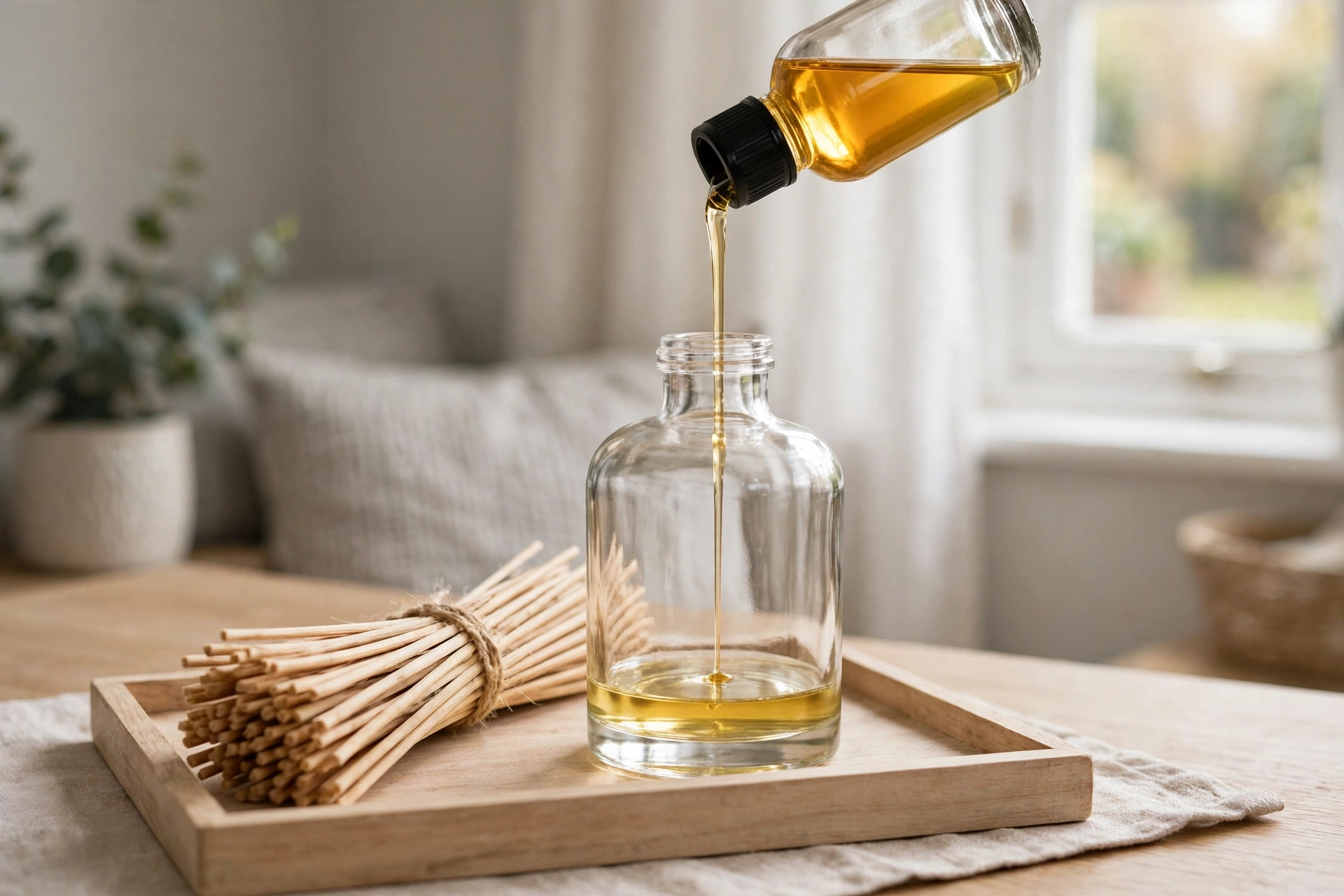
- Pour the refill oil in slowly. Fill to the level the original bottle came with, usually around three quarters full, and never right to the neck. Overfilling leaves no room for the reeds and risks spills when they go in.
- Put in a full set of brand new reeds. Use the number your diffuser came with for the room, usually eight to ten for a living room and four or five for a small bathroom.
- Let the reeds soak for a few hours, then flip them once so the oil-soaked ends face up. Leave the room for an hour and walk back in from outside it for the honest first test. A same-scent refill should smell like the diffuser did when it was new, within a day.
Do not top up a bottle that is still half full just because you have refill oil to hand. Topping up mixes fresh oil with old, partly aged oil and old reeds, and it makes it impossible to tell when the reeds actually need changing. Wait until the level drops below a third, then refill properly with new reeds.
Changing Scent: Clean the Bottle Properly First
Changing scent is where most refills go wrong. Old reeds hold the previous fragrance, and a thin film of old oil coats the inside of the bottle. Pour a new scent straight on top and you will get neither scent properly. You will get a muddle, usually dominated by whichever fragrance is heavier, and it will last for the whole life of the refill.
If you are changing scent, clean the bottle first:
- Empty any remaining old oil. Do not pour it down the sink in large quantities. Wipe the bottle out with tissue and dispose of the tissue with household waste.
- Wash the bottle in warm water with a little washing-up liquid. Use a bottle brush if the neck is narrow. Rinse thoroughly until the water runs clear and no scent remains when you sniff the empty bottle.
- Dry it completely. This step matters as much as the washing. Water left inside will not mix with diffuser base, it can warp natural rattan reeds, and it will weaken the new scent. Leave the bottle upside down on a tea towel for several hours, or overnight, until it is bone dry inside.
- Only then pour in the new refill oil and fit brand new reeds. Never reuse the old reeds with a new scent, even if they look clean. They are saturated with the old fragrance.
Be honest about one case: some bottles are not worth cleaning. A very narrow-necked bottle, a bottle with a decorative stopper that traps oil, or a bottle whose inside you cannot see or reach, may never rinse fully clean. If you can still smell the old scent in the dry, empty bottle, do not refill it with a new scent. Either refill it with the same scent, or retire it and start fresh.
New Reeds Every Refill: Why It Is Not Optional
Reeds are a consumable, not a permanent part of the diffuser. Over weeks, their tiny channels clog with dust and dried fragrance oil, so they draw oil less efficiently and release less scent. A diffuser with old, clogged reeds can look half full while smelling of almost nothing, which is exactly why people blame a refill that was actually fine.
The rule is simple and absolute: new reeds with every refill, without exception. It applies to same-scent refills, scent changes, and top-ups. If flipping stops reviving the scent, the reeds are finished, even if they were only fitted a few weeks ago in a dusty room. For most homes, that means new reeds every two to three months, which lines up neatly with refill timing for a standard 100ml bottle. Our guide to how long do reed diffusers last sets out the lifespan ranges by bottle size, so you can plan refills and reed changes together.
Two practical points about reeds. First, use the right type for your oil. Rattan reeds are the usual choice for oil-based diffuser bases, while fibre reeds suit some alcohol-based bases and tend to release scent faster. If your refill oil came with its own reeds, use those rather than mixing in reeds from another diffuser. Second, do not cut reeds shorter to fit a smaller bottle. Shortened reeds draw oil differently and can split, which blocks their channels. Buy the reed length your bottle was designed for.
How Much Refill Oil, and What Kind
Refill oil is sold in bottles from around 100ml to 250ml, and the right size depends on your diffuser. A 100ml refill suits a standard 100ml diffuser bottle with a little left over for a small top-up later, though topping up is best avoided as a routine. A larger refill bottle makes sense if you run two diffusers in the same scent, or if you refill the same bottle several times a year.
Check three things on the refill label before you buy:
- It is diffuser refill oil, not essential oil and not candle fragrance oil. Neat essential oil is not a diffuser base. It may not climb the reeds properly, it can damage surfaces, and strong undiluted oils can irritate skin. Candle fragrance oil is made for wax, not for reeds. A proper refill oil contains a diffuser base that carries fragrance up the reeds at the right rate.
- It matches your diffuser type. Most home diffusers use an oil-based base. If your diffuser instructions name a specific base or reed type, follow them rather than buying the cheapest refill on the shelf.
- It is the scent you actually want for the room. A light citrus refill in a large living room will feel faint, however well you refill it. A heavier woody or amber scent carries further in the same space. Our guide to how to make a reed diffuser smell stronger covers scent weight and room matching in detail.
Price is worth a quick calculation. Refill oil is usually cheaper than a whole new diffuser, and the saving grows if you refill the same bottle twice. But a refill is only a saving if it works. A cheap refill oil with a poor base, paired with old reeds, is money wasted, because you will end up buying a new diffuser anyway. Spend the saving on proper refill oil and new reeds, not on the cheapest bottle you can find.
Refill Mistakes That Waste Oil
Most of these sound obvious, and all of them happen regularly:
Keeping the old reeds. Fresh oil through clogged reeds still smells of very little. Always fit new reeds.
Adding water. Water does not mix with diffuser base. It sits separately, can warp rattan reeds so their channels swell shut, and turns a weak diffuser into a dead one. Never stretch oil with water.
Adding neat essential oil. It changes how the base climbs the reeds, it may not mix properly, and it can damage surfaces. Use proper refill oil.
Pouring a new scent on top of an old one. The result is a muddle, not a blend. Clean and fully dry the bottle first, or stay with the same scent.
Overfilling. Filling to the neck leaves no room for reeds and guarantees spills. Fill to about three quarters, then add the reeds.
Refilling a damaged bottle. A cracked neck, a chipped rim, or a bottle that has sat in strong sun for months will not be saved by fresh oil. Replace it.
Handling oil carelessly. Diffuser oil is flammable and can irritate skin. Keep it away from naked flames, wash your hands after handling reeds, and keep both oil and reeds out of reach of children and pets. If oil spills on a surface, wipe it up at once and protect polished wood with a tray under the bottle afterwards.
Refill Economics and Waste
Refilling is usually the cheaper and less wasteful option, and it is worth saying why plainly. A new diffuser means a new glass bottle, new reeds, new packaging, and new postage, all for a product whose bottle is still perfectly good. A refill means one bottle of oil and one set of reeds, and the glass stays in use. Over a year, a household that refills a 100ml diffuser twice will typically spend noticeably less than a household that buys three new diffusers, and will throw away far less glass and packaging.
That saving only holds if refills are done properly. A failed refill, one that smells of nothing because the reeds were old, or one that smells muddled because the bottle was not cleaned, usually ends with the bottle being thrown away and a new diffuser bought anyway. The waste argument and the money argument point to the same routine: refill on time, with proper oil and new reeds, and retire the bottle when its condition says so.
There is also a smaller waste point worth noting. Keep the refill bottle itself out of heat and sunlight, with its cap on, and use it within the period the maker suggests. Refill oil that has sat open for many months in a warm room gradually loses strength, just like oil in a diffuser. A stale refill will disappoint exactly like a stale diffuser, and it is easy to blame the bottle when the refill oil was the problem.
After the Refill: Placement Still Decides the Result
A perfect refill in a bad spot will still smell weak. Once the new reeds have soaked and been flipped, check the placement before you judge the refill. The diffuser should sit in gentle moving air at about waist height, out of direct sun and away from radiators, on a stable surface you walk past rather than sit beside all day. Our guide to where to place a reed diffuser covers the room-by-room spots and the places that waste oil, and it is worth re-checking after a refill, because a diffuser often gets moved during cleaning and put back in a worse spot without anyone noticing.
Give a refill a full day before you judge it. New reeds need time to draw oil up and start releasing it evenly. If after a day in a good spot, with new reeds and proper oil, the diffuser still smells of nothing in a small closed room, the problem is the oil or the product, not your refill technique. At that point, replace rather than refill again.
Frequently Asked Questions
Can you refill a reed diffuser?
Yes. Most reed diffusers can be refilled with proper diffuser refill oil and a brand new set of reeds. Refill when the oil drops below a third and the bottle is still in good condition. Replace the whole diffuser when the oil has gone stale or the bottle is damaged.
Should you replace the reeds when you refill a reed diffuser?
Yes, always. Old reeds are clogged with dust and dried oil and will not draw fresh oil properly. Fresh oil through old reeds is the most common reason refills disappoint. Fit a new set with every refill, and at least every two to three months.
Can you refill a reed diffuser with a different scent?
Yes, but only after washing the bottle thoroughly and drying it completely, and only with brand new reeds. Pouring a new scent on top of an old one, or reusing old reeds, will muddle the two fragrances for the whole life of the refill.
Can you refill a reed diffuser with essential oil?
No, not on its own. Neat essential oil is not a diffuser base, it may not climb the reeds properly, and it can damage surfaces and irritate skin. Use proper diffuser refill oil made for reed diffusers.
How many times can you refill a reed diffuser bottle?
As many times as the bottle stays in good condition. There is no fixed limit. Clean it between scent changes, always use new reeds, and retire it when it is cracked, heavily stained inside, or still smells of an old scent after washing and drying.
How much refill oil should I pour in?
Fill to about three quarters full, roughly the level the original bottle came with, and never right to the neck. Overfilling leaves no room for the reeds and causes spills when they go in.
Why does my refilled diffuser not smell?
The usual causes, in order, are old reeds kept from before the refill, a new scent poured on top of an old one without cleaning, stale refill oil, or a bad spot with dead air, heat, or sunlight. Check the reeds first, then the bottle, then the placement.
Is it cheaper to refill or replace a reed diffuser?
Refilling is usually cheaper and less wasteful, provided it is done properly with proper refill oil and new reeds. A failed refill that ends with a new diffuser bought anyway costs more than either option done right first time.
Refill on Time, With New Reeds, and Nothing Else Fancy
Refilling a reed diffuser is not a craft project. It is a three-part routine: refill when the oil drops below a third, use proper refill oil, and fit new reeds every time. Clean and fully dry the bottle when you change scent, and retire the bottle when its condition tells you to. Do that, put the diffuser back in a good spot, and give it a day. The diffuser you already own will smell like a new one, and the money and glass you saved are a bonus, not the reason the routine matters. The reason it matters is simpler: a diffuser that is refilled properly keeps working, week after week, instead of fading into another bottle on a shelf that smells of nothing.