The Handmade Home: Why Artisan Forged Metalwork Creates the Warmest Interiors
I make things for a living, so I’m probably biased. But I genuinely believe there’s a difference between a room that’s simply been furnished and a room that’s also properly lived in. A lot of that difference comes down to whether anything in it was made by hand.
Handmade objects carry something that mass-produced goods don’t. Not just age or imperfection, though both are part of it. It’s more than they have a story behind them. You can see where a decision was made, where a tool left its mark, where the maker’s hand adjusted something. Iron especially. Steel has a memory. The texture a hammer leaves on a surface doesn’t look like anything a machine produces, and over time, it develops a patina that feels earned rather than applied.
The texture you can’t replicate
There’s a quality to hand-forged steel that photographs don’t capture well. You have to touch it. Run your finger along a piece of hammered steel, and you feel the grain of the work, the small undulations where the metal was moved under pressure. A machine-pressed or cast piece is uniform and smooth. A hand-forged piece has topography.
That texture does something to a room. It creates visual weight. A single hand-forged piece on a wall or mantelpiece anchors the space around it, not because it’s large or decorative, but because it looks like it took time.
The warmth of imperfection
Interior design has spent years chasing perfection: clean edges, uniform finishes, everything aligned. There’s a place for that. But the spaces people actually describe as warm tend to have a bit of roughness. A wonky beam. A slightly uneven flagstone floor. A hand-thrown mug that sits slightly differently from the others.
Hand-forged ironwork belongs in that category. Every piece carries the evidence of how it was made. Two hooks made by the same smith on the same day will be similar but not identical. The slight variation between them is what makes them feel alive in a space. It’s the difference between a room that looks like a showroom and a room that looks like someone lives there and cares about what’s in it.
Objects that carry stories
One of the things I notice, running a forge that offers blacksmithing experience days, is what happens after someone makes something. They leave with a knife or a hook or a poker, and it becomes the thing in their house that has a story attached to it. Not just “I bought this” but “I made this.” They remember the heat, the sound of the hammer, the moment it started to look like something. That emotional connection changes how an object sits in a home.
The same applies to pieces you buy or commission from a blacksmith rather than make yourself. When you know who made something, how it was made, and what material was used, the object has depth. It becomes a conversation piece in the truest sense. People pick it up, ask about it, and there’s actually something to say. Compare that to pointing at a shelf bracket and saying, “IKEA, I think.” The object’s story becomes part of the room’s character.
How forged steel ages in a home
Most materials in a home decline with time. Paint chips. Fabric fades. MDF swells. Forged steel does something different: it develops a surface patina, a darkening and slight texture change that actually makes it more attractive. A well-maintained piece of hand-forged ironwork looks better at ten years old than it did new.
The maintenance is minimal. A light wax or oil finish once or twice a year is enough for most indoor pieces. In damp spaces like bathrooms or external doors, a proper exterior finish helps manage weathering. But in general, ironwork is one of the lowest-maintenance materials you can introduce to a home. It doesn’t need repainting, it doesn’t chip, and it doesn’t go out of style because it was never really in style. It just works.
Introducing ironwork without a renovation
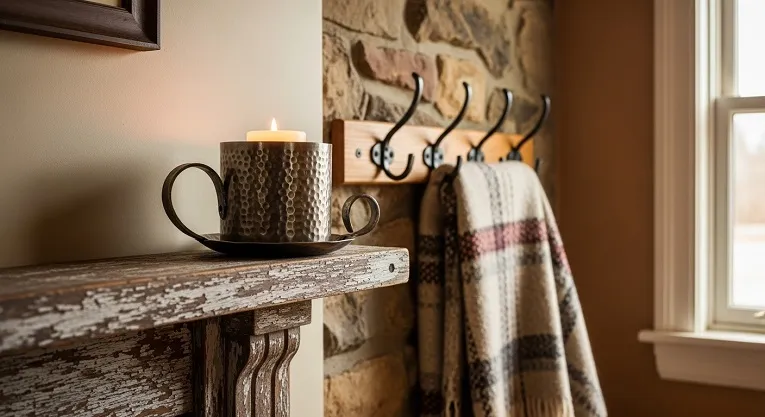
You don’t need to be mid-project to bring handmade ironwork into your home. Some of the simplest swaps make the most difference. Replacing standard coat hooks with hand-forged ones takes ten minutes and changes how your hallway feels. Swapping out generic cabinet handles for blacksmith-made alternatives is a small job with a visible payoff. A single hand-forged candle holder on a mantelpiece does more atmospheric work than a dozen scented candles.
The key is not to overthink it. Ironwork isn’t a design statement that needs to be committed to wholesale. One or two pieces in the right spots tend to elevate everything around them. Start with whatever’s in plain sight and gets used daily.
Making your own: why it changes the relationship
There’s another route worth knowing about. At Soulful Iron, the forge I run in Stroud, I offer knife-making and blacksmithing experience days for complete beginners. People come for the experience and leave with something they made from a bar of raw steel. It’s physical, absorbing work, and the result is a functional object that’s completely individual.
What I’ve found is that people who make something at the forge develop a different relationship with handmade objects generally. Once you’ve felt what it takes to shape steel, you notice the work in other pieces. You appreciate the skill in a hand-forged gate or a wrought-iron railing in a way you didn’t before. The experience recalibrates your sense of value. You start noticing the made things and ignoring the manufactured ones.
Experience days run year-round at soulfuliron.co.uk/experience-days/knife-making-course/, and gift vouchers are valid for 12 months if the hands-on life appeals to someone you know.
Finding quality forged ironwork
The best route to quality ironwork is buying directly from independent blacksmiths. Most will discuss specifications, finishes, and scale to suit your space, and the conversation itself is part of what you’re paying for. Craft fairs and makers’ markets, particularly in areas with a strong making tradition, are good places to find smiths selling direct. Online marketplaces have their place, but nothing replaces seeing and touching the work before you buy.
A home filled with handmade things feels different to be in. Not because it’s expensive or curated, but because every object earned its place. Iron is one of the oldest materials humans have worked with, and it still does something to a room that nothing else quite manages. There’s a warmth to it that has nothing to do with temperature.
About the author: Mike runs Soulful Iron, a real, working forge that offers blacksmithing and knife-making experiences in Stroud, Cotswolds. https://soulfuliron.co.uk/