Where to Place a Reed Diffuser
Quick answer: The best place for a reed diffuser is in gentle moving air at about waist height, out of direct sun and away from radiators, on a stable surface you walk past rather than sit beside all day. A hallway console, a shelf near a doorway, or a sideboard in the path between rooms will scent far better than a windowsill, a spot above a radiator, or a corner where air never moves. One diffuser suits one average room; large open-plan spaces need two, placed at opposite ends.
Placement is the most underrated part of owning a reed diffuser. People blame the oil, the reeds, or the brand when a diffuser smells of nothing, yet the same diffuser moved two metres can suddenly work. That is because a reed diffuser does not throw scent across a room. It releases fragrance slowly from the surface of its reeds, and it relies on the air around it to carry that fragrance further. Put it where air moves gently, and it works. Put it where air stands still, or where it rushes straight outside, and it barely works at all, however good the oil is.
How Diffusion Actually Travels
Understanding one simple idea will make every placement decision in this guide obvious. Fragrance leaves the reeds as vapour, rises gently as it warms, and drifts with whatever air movement is in the room. It does not travel in a straight line to the far wall. It spreads, thins out, and fades with distance, which is why a diffuser scents the area around itself strongly and the far side of a large room hardly at all.
Three things control how well that spread works. The first is airflow: gentle, occasional movement through the room carries scent further than still air, while a strong draught carries it straight out of the window. The second is height: fragrance released at waist height meets people where they breathe and walk, while fragrance released at floor level or on top of a tall bookcase mostly scents the floor or the ceiling. The third is heat: gentle room warmth speeds evaporation a little, while direct sun or a radiator speeds it so much that the bottle empties in weeks and the scent fades early.
Hold those three ideas, airflow, height and heat, and you can judge any spot in your home in seconds.
The Five Rules of a Good Spot
Before the room-by-room guide, here are the five rules that apply everywhere in the house.
1. Gentle moving air, not still air and not a draught. The ideal spot is somewhere air passes through naturally: near a doorway you use often, on a console in a hallway, or on a side table between two rooms. Passing traffic stirs the air just enough. Avoid corners behind doors, the inside of bookcases, and anywhere a fan, vent, or open window blows directly across the bottle.
2. Waist height, roughly. A console table, sideboard, chest of drawers, or bathroom shelf at hip to waist height is ideal. The scent rises from there into the breathing zone. A diffuser on the floor scents your ankles. One on top of a tall wardrobe scents the ceiling. Neither is much use to anyone sitting or standing in the room.
3. Stable, level and out of the way of knocks. Diffuser oil stains wood, fabric and some plastics, and a knocked bottle can ruin a polished surface. Choose a spot that is not on a route where bags, elbows, or pets will catch it, and always stand the bottle on a small tray or coaster. Keep it out of reach of toddlers and pets, who may knock it over or chew the reeds.
4. Cool and shaded. Keep the diffuser out of direct sunlight and away from radiators, fires, and underfloor heating vents. Strong heat makes the oil evaporate far too fast, so the scent peaks for a fortnight and then fades, and the reeds clog sooner. A comfortably warm lived-in room is fine. A sunny windowsill or a radiator shelf is not.
5. Where you pass through, not where you sit all day. This one surprises people. A diffuser beside the sofa, where you sit for hours, will quickly fade from your awareness as your nose adapts to a constant background scent. The same diffuser in the hallway, which you walk through several times a day, will greet you with fragrance every time you enter. If you want to keep noticing your diffuser, put it where you arrive, not where you settle. Our guide to why you can’t smell your reed diffuser explains the nose-adaptation test in full, and placement is half the fix.
Room by Room: Where to Put It
The hallway
The hallway is the single best room for a reed diffuser in most UK homes, and it is no accident that hallway diffusers often seem to smell stronger than lounge ones. Hallways are narrow, people pass through them constantly, and air moves between rooms through them all day. That gentle, regular movement is exactly what a diffuser needs.
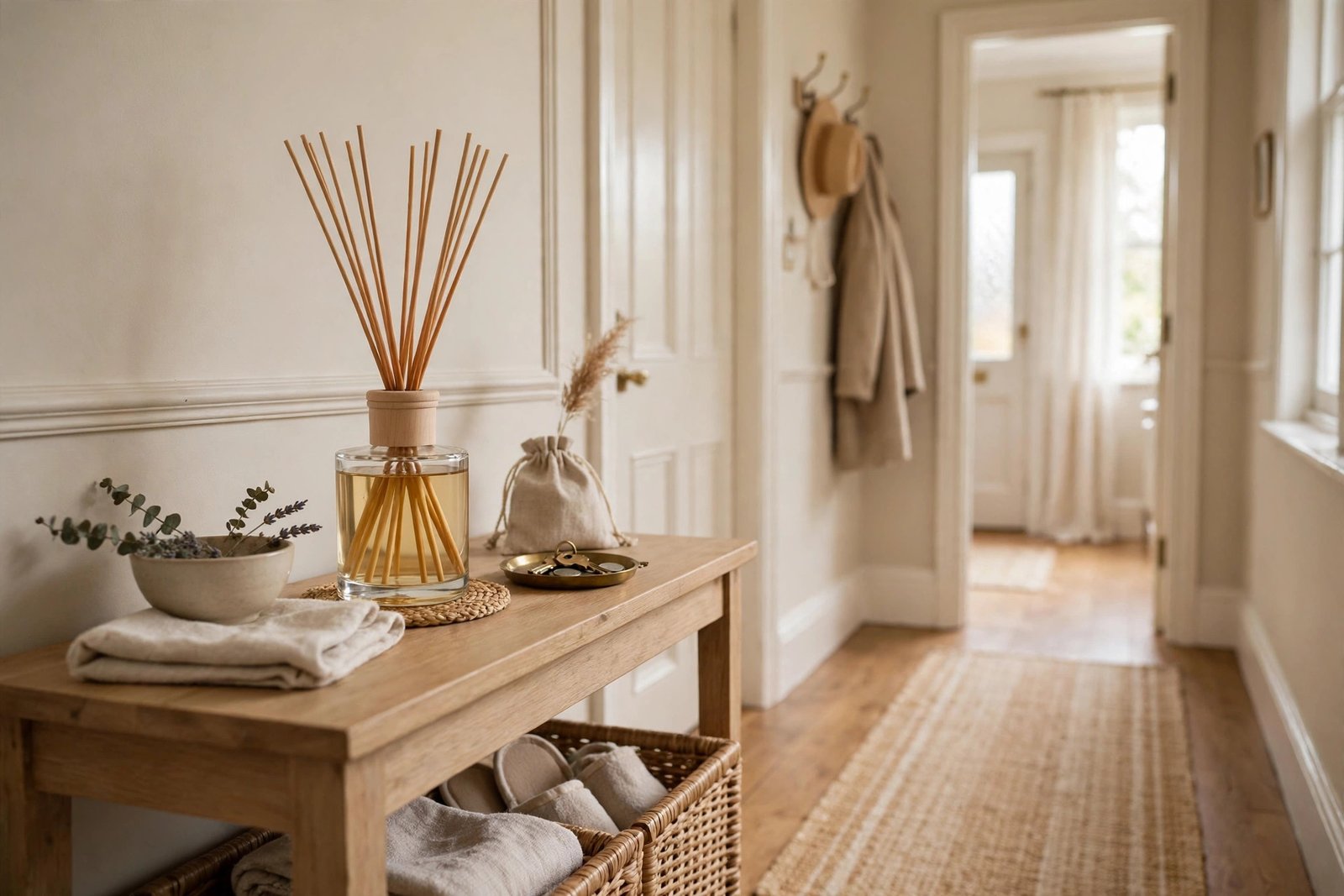
Place it on the console table or hall table, at waist height, a little way from the front door rather than right beside it. A diffuser immediately next to an often-opened front door loses scent outside every time the door opens. A metre or two inside, on a table you pass, gives the fragrance time to build in the hallway and drift into adjoining rooms. A hallway diffuser also does quiet work for the whole house: it is the first scent guests meet, and it softens the smell of the rest of the home without needing a diffuser in every room.
The living room
In the living room, place the diffuser on a sideboard, console, or side table near a doorway or in the path between the door and the seating area, not in the far corner and not beside the television. The corner behind a sofa or armchair is dead air: the scent pools there and never reaches the people sitting in the middle of the room. A side table at the end of the sofa can work, but only if air moves past it, and only if it is not so close to where you sit that the scent becomes overpowering within an hour.
For a large living room or an open-plan kitchen and living space, one diffuser will not fill the whole area well, however well placed it is. Place one diffuser at each end of the space, so each scents its own zone, rather than expecting one bottle to do the whole job. Match the scent strength to the room too: a light citrus scent in a large room will feel faint even in a good spot, while a heavier woody or amber scent will carry further in the same position.
The bedroom
In the bedroom, a diffuser belongs on a chest of drawers or a dressing table away from the bed, not on the bedside table right beside your pillow. A diffuser inches from your face all night is too strong for most people, and it will also fade from your awareness fastest, because you sleep in it for hours. A chest of drawers across the room, or a dressing table near the door, gives a gentle background scent when you walk in, without overwhelming the room overnight.
If you are sensitive to scent at night, or share the room with someone who is, a diffuser in the bedroom may not be the right choice at all. A faint scent in the hallway outside the bedroom door, which drifts in when the door is open, is often a kinder option than a bottle in the room itself. The same applies around pets that sleep in the bedroom: keep the diffuser out of their direct sleeping area and make sure the room can be aired easily.
The bathroom
Bathrooms are small, enclosed, and humid, which makes them one of the easiest rooms to scent well, and one of the easiest to over-scent. A small bathroom needs only four or five reeds, not the full set, and the diffuser should sit on a shelf or the top of a cabinet at waist height or a little above, well away from the shower spray and the edge of the bath.
Do not place a diffuser directly beside the toilet cistern if the spot is also the splash zone, and never place it on the floor. Humidity itself is not a major problem for a diffuser, but direct water splashes will dilute and damage the reeds, and steam from a hot shower will speed evaporation for a short burst each day. A shelf near the door, where air moves in and out as people come and go, is usually the best bathroom spot. In a cloakroom or downstairs WC, the same rule applies: a small room, a few reeds, and a spot near the door rather than behind it.
The kitchen
The kitchen is the hardest room to scent with a reed diffuser, and it is worth being honest about that. Cooking smells, steam, extractor fans, and open windows all compete with and carry away diffuser fragrance. A diffuser placed beside the hob or above the extractor will lose its scent straight up the vent. One placed on a sunny kitchen windowsill will evaporate fast and fade early.
If you want a diffuser in the kitchen, place it on a sideboard, dresser, or shelf at the far end from the hob, away from the extractor and out of direct sun, ideally near the doorway into the dining area. That way it scents the eating end of the kitchen rather than fighting the cooking end. Keep it away from food preparation surfaces, because diffuser oil is not food-safe and a spill near food is a real nuisance. In many homes, the better answer is a diffuser in the adjoining hallway or dining room, which scents the space you eat in without competing with the cooker at all.
The home office and spare rooms
A home office is a small, closed room, which suits a diffuser well, provided you follow the pass-through rule. Place it on a shelf or cabinet near the door, not on the desk beside you. A diffuser on your desk will fade from your awareness within an hour of sitting there, and it may become distracting or headache-inducing at close range over a full working day. Near the door, it greets you when you enter and settles into the background as you work.
Spare rooms that are rarely used are a poor home for a diffuser. A closed, unheated spare room gives the diffuser still, cold air, so it scents weakly, and nobody is there to enjoy it anyway. If you want a guest room to smell welcoming, place the diffuser there a day before guests arrive, on a chest of drawers near the door, and open the door for a few hours so the scent can build. Do not leave a diffuser running for months in a room nobody enters.
Where Never to Put a Reed Diffuser
Some spots actively harm the diffuser, the room, or both. Avoid all of these, whatever the room.
On a sunny windowsill. Direct sun is the fastest way to empty a bottle and fade a scent. The oil heats up, evaporates quickly, and the remaining oil can smell thin and sharp. The same applies to a glass conservatory shelf in summer.
Above or beside a radiator. Radiator heat does the same damage as sunlight, only all winter. A diffuser on a radiator shelf will smell strong for a fortnight and then fade, and it will finish weeks earlier than the same diffuser in a cool spot. Our guide to how long do reed diffusers last sets out how much heat shortens a bottle’s life.
Beside an open window, fan, or air vent. Strong airflow carries fragrance straight outside and empties the bottle fast. A diffuser does not need a breeze. It needs gentle movement, and a vent or fan gives it far too much.
Behind a door, inside a bookcase, or in a corner. These are dead-air traps. The scent pools in a tiny pocket and never reaches the room. If you can only smell the diffuser when you put your nose right next to it, it is in dead air.
On the floor, or on top of a tall bookcase. Floor level scents ankles, and the top of a tall bookcase scents the ceiling. Neither puts fragrance where people breathe.
Near a naked flame, hob, or heat source. Diffuser oil is flammable, and reeds soaked in oil will catch fire if they touch a flame or a very hot surface. Never place a diffuser beside candles, on a fireplace mantel above a lit fire, or near the hob.
Within reach of children or pets. Reeds are tempting to chew and bottles are easy to knock over. Diffuser oil can irritate skin and is harmful if swallowed. Keep diffusers high enough, stable enough, and out of the direct play or sleeping area of children and pets.
On an unprotected polished or painted surface. Always use a tray or coaster. Diffuser oil can stain and damage wood, paint, and some plastics, and the damage often appears only after weeks of slow seepage from the bottle base.
One Diffuser or Two? Spacing Open-Plan Rooms
The question of how many diffusers a home needs comes down to room size and doors. A standard 100ml diffuser suits one small to average room with its doors mostly closed. A large living room, an open-plan kitchen and dining space, or a long hallway with rooms off both ends will need two, placed so their scent zones just meet in the middle rather than overlapping on top of each other.
As a rough guide, place diffusers at least three to four metres apart in an open-plan space, one at each end, each near a doorway or traffic path. Two diffusers side by side in the same spot is a waste: they will scent the same pocket of air twice and empty twice as fast, while the far end of the room stays unscented. If in doubt, start with one well-placed diffuser, live with it for a few days, and add a second only if the far end of the room still smells of nothing. Our guide to how to make a reed diffuser smell stronger covers the other boosts, reed count and flipping, that should be tried before buying a second bottle.
The Placement Test: How to Check Your Spot in a Day
You do not need to guess whether a spot works. Test it in one day.
- Place the diffuser in the spot you have chosen, with fresh reeds if the old ones are more than a couple of months old.
- Flip the reeds once, then leave the room for an hour with the door closed, so the scent can build.
- Walk back in from outside the room, ideally from outdoors or another part of the house, and breathe in as you enter. That first breath is the honest test, because your nose has not adapted yet.
- Repeat the test at the far side of the room, and in the room next door if you want the scent to travel.
If the scent greets you at the door but fades by the far wall, the spot is good and the room is simply large: consider a second diffuser for the far end. If you smell almost nothing even at the door, the spot is wrong: move it into gentler moving air, raise it to waist height, or move it out of sun or heat. If it smells strong at the door but overpowering when you sit down, move it further from the seating area or remove two reeds.
Run the same test again after a week. A spot that works in October, when the heating is on and windows are shut, may work differently in summer, when windows are open and the sun moves across the room. Moving a diffuser with the seasons is normal, not a sign that something is wrong.
Frequently Asked Questions
Where is the best place to put a reed diffuser?
In gentle moving air at about waist height, out of direct sun and away from radiators, on a stable surface you walk past, such as a hallway console or a shelf near a doorway. That combination gives the scent the airflow it needs without wasting oil to heat or draughts.
Should a reed diffuser go high or low?
About waist height is best. Low on the floor scents your ankles, and high on top of a tall bookcase scents the ceiling. A console table, sideboard, or chest of drawers puts the fragrance where people breathe and walk through it.
Can I put a reed diffuser on a windowsill?
It is not recommended if the windowsill gets direct sun. Sunlight heats the oil, empties the bottle fast, and fades the scent. A shaded windowsill in a north-facing room is less harmful, but a console away from the window is still a better spot.
Can I put a reed diffuser near a radiator?
No. Radiator heat evaporates the oil far too quickly, so the diffuser smells strong for a short time and then fades, and the bottle finishes weeks early. Keep diffusers well away from radiators, fires, and heating vents.
Where should I put a reed diffuser in a large room?
Use two diffusers, one at each end of the room, at least three to four metres apart, each near a doorway or traffic path. One diffuser cannot fill a large open-plan space well, however well placed it is.
Is it better to put a reed diffuser in the hallway or the living room?
For scenting the whole home, the hallway usually wins, because air and people move through it all day and the scent drifts into adjoining rooms. For scenting one room where you spend the evening, the living room sideboard near the doorway is the better choice. Many homes benefit from one in each.
Why can I only smell my reed diffuser when I am right next to it?
That is the classic sign of dead air. The diffuser is tucked behind a door, inside a bookcase, or in a still corner, so the scent pools around the bottle and never spreads. Move it into gentle moving air at waist height and test it again the next day.
Can a reed diffuser go in the bathroom?
Yes, and bathrooms scent easily because they are small. Use only four or five reeds, place the diffuser on a shelf near the door at waist height, and keep it away from shower spray and the edge of the bath.
Placement Is the Cheapest Upgrade You Own
A new diffuser costs money. Moving the one you already own costs nothing, and it is often the difference between a bottle that smells of nothing and a home that smells faintly lovely every time you walk in. Start with gentle moving air at waist height, keep it cool and shaded, put it where you pass through rather than where you sit, and keep it away from sun, radiators, vents, and dead corners. Test the spot for a day, move it if the test fails, and let the seasons move it again when the light and the heating change. The diffuser has not changed. The air around it has, and that is the whole secret.