Quick answer: The right home fragrance depends on the room, not the bottle. A scent that feels welcoming in a hallway can feel too strong in a small bathroom, and a scent that calms a bedroom can disappear in a large open-plan kitchen. The rule that runs through this whole guide is simple: choose the scent family for what the room does, choose the format for how long the scent needs to last, and match the strength to the size of the room. The table below gives the whole answer in one place. The sections after it explain why each room gets what it gets, how to move between rooms without clashes, and how to choose without buying six products you do not need.
Most homes get scented the wrong way round. A candle is bought because it smells lovely in the shop, it is put in the nearest room, and then it is blamed when the room smells of nothing, or smells of too much. The candle was never the problem. The room was. A scent is not a property of a product. It is a property of a product in a room, in a size of room, with a level of airflow, at a time of day. Change any one of those and the same candle behaves differently. That is why this guide is organised by room, not by product, and why the room guides on this site go deeper into each room. This pillar is the map. The room guides are the detail.
This guide is written for UK homes specifically: small rooms, flats and terraces, rented homes where you cannot change the ventilation, draughty hallways, small bathrooms with no window, and open-plan kitchen diners where one room has to do two jobs at once. The scent families and the room-by-room consensus in this guide restate the consensus of the five room guides checked on 16 November 2026: Clarky Candles, Wisp House, Supplies for Candles, Soulful Candles UK and Plum & Ashby. Where a source describes a scent in a particular way, that is reported here as the source’s description, not as a fact this site has tested. No seller’s own product picks are presented here as recommendations. Only scent families and notes are used.
Why One Scent for the Whole House Does Not Work
The most common mistake in home fragrance is also the most understandable one. A scent is found that smells wonderful, several of the same are bought, one goes in every room, and the house ends up smelling of nothing in particular. Wisp House puts it plainly in the guide checked for this article: a house where every room smells of the same fig and vanilla is a house where nothing smells of anything in particular. The nose adapts to a scent that never changes, and after an hour the scent that was lovely on arrival has faded into the background. That is not a fault in the product. It is how noses work. A scent that is always there stops being noticed, and a scent that is never noticed is wasted money.
The second reason is that rooms do different jobs, and the job decides the scent. A hallway has to make a first impression in five seconds. A bedroom has to help a person wind down at the end of the day. A kitchen has to sit next to food without fighting it. A bathroom has to feel clean in a small, humid space. One scent cannot do all four jobs, because the jobs pull in opposite directions. A scent strong enough to greet a visitor at the front door is too strong for a small bathroom. A scent soft enough for a bedroom is too quiet for a large kitchen diner.
The third reason is that rooms are different sizes, with different airflow. A scent that is balanced in a sitting room may be too strong in a cloakroom and too delicate in a large kitchen diner, as Soulful Candles UK notes in the guide checked for this article. British homes make this worse, because the same house can hold a tiny box bedroom, a draughty hallway and a large open-plan kitchen diner, all within a few steps of each other. The scent has to be chosen room by room, because the rooms themselves are not the same.
Fragrance zoning, the term Plum & Ashby use in the guide checked for this article, is the answer. It means giving each room its own scent job and letting the scent change as a person moves through the house, from kitchen freshness in the morning to a lavender hush in the bedroom at night. The change is the point. A house that smells slightly different in each room feels deliberate and cared for. A house that smells the same everywhere feels like one candle left burning too long.
The Room-by-Room Matrix
The table below is the whole guide in one place: the scent families that suit each room, the format that delivers them best, and the strength to aim for. The sections after the table explain each row, and the room guides linked from each row go deeper into that room alone.
| Room | Best scent families | Best format | Strength |
|---|---|---|---|
| Hallway | Citrus, black pepper, cedar | Reed diffuser | Medium, welcoming on arrival |
| Living room | Warm woods, amber, sandalwood, vetiver, fig | Reed diffuser for the day, candle for the evening | Medium to full |
| Bedroom | Lavender, chamomile, sandalwood, cedar, tonka, soft musk | Reed diffuser overnight, candle for the hour before bed only | Light, less than you think |
| Bathroom | Eucalyptus, mint, cypress, sea salt | Reed diffuser | Light to medium, fresh and airy |
| Kitchen | Citrus, herbs, greens (lemon, rosemary, basil, tomato leaf, eucalyptus) | Reed diffuser for the day, wax melt or spray after cooking, candle after the meal only | Light for the day, strong for the after-cooking reset |
| Home office | Bergamot, grapefruit, rosemary, cedar | Reed diffuser | Light, steady background |
Two things to notice in the table before reading on. First, the same scent family can appear in more than one room, but the format and the strength change. Citrus in a hallway is a bright welcome. Citrus in a kitchen is everyday freshness. The family is the same. The job is different. Second, the reed diffuser is the best format in more rooms than any other, because it works all day without a flame, and its strength can be set precisely by adding or removing reeds. That does not make it the only format worth owning. It makes it the format to start with.
Hallway: The First Impression
The hallway is the room most people forget when they scent their home, and it is the room that matters most for first impressions. It is the first air a visitor breathes, and it is the first air you breathe when you come home. The guides checked for this article agree on the families: citrus, black pepper and cedar, a bright first impression that says the house is cared for without saying anything more.
A hallway is usually narrow, with doors opening off it and air moving through it every time a door opens. That moving air is useful, because it carries scent, and it is also a problem, because it carries scent away. A reed diffuser on a console table or a shelf at about waist height, near the front door but not right beside it, works best. The air that moves past it when the door opens will carry the scent into the hall, and the diffuser will keep working between visits.
The strength to aim for is medium. The scent should be noticeable when you walk in and forgettable once you are in the next room. If it greets you at the door and then fades as you move into the living room, it is doing its job. If it follows you into the living room and fights the scent there, it is too strong. Hallways in British homes are often draughty, especially in older houses, so a hallway diffuser may need one or two more reeds than the same diffuser would need in a bedroom. Start with the full set of reeds, live with it for a day, and remove one or two if the scent reaches the next room.
Living Room: The Room That Does Everything
The living room is the room where scent has the most freedom, because it is the largest room in most homes and the room where people spend the most waking hours. The guides checked for this article agree on the families: warm woods, amber, sandalwood, vetiver and fig. These are scents with depth, the ones that make a room feel settled and lived in, and they suit a living room because the room is big enough to hold them without them becoming overwhelming.
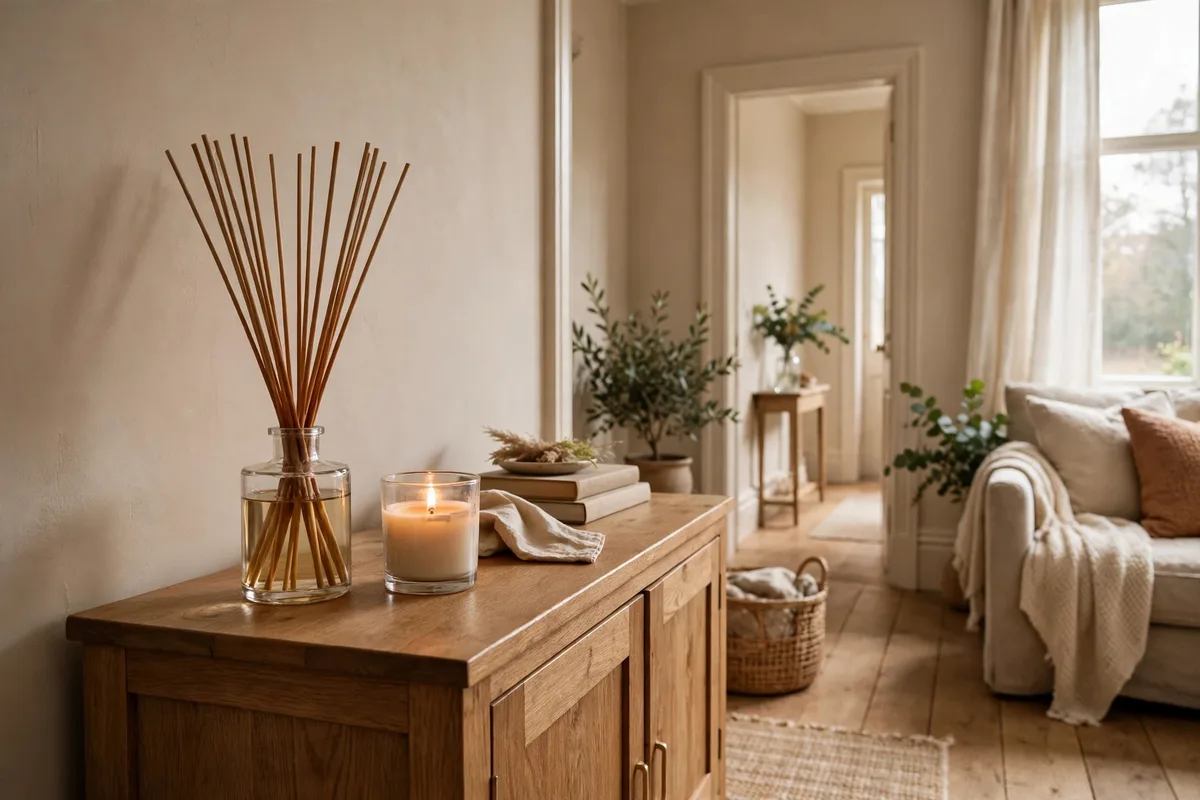
The format question in a living room is really a question about time of day. A reed diffuser is best for the day, because it works all day without needing to be lit or watched, and it gives a steady background scent that builds slowly. A candle is best for the evening, because the flame and the warm light add to the mood of a dark evening in a way a diffuser cannot, and the scent can be blown out when the evening ends. Many homes use both: a diffuser for the day and a candle for the evening, in the same family, so they do not fight each other.
The strength to aim for is medium to full, because the living room is usually the largest room and the scent has more air to fill. In a small lounge, the same rules as a small kitchen apply: start light and add strength only if the room still smells of nothing after an hour. In an open-plan living room that runs into the kitchen, two small diffusers in the same family, one at each end of the space, will scent the room more evenly than one large candle in the middle. The full guide to this room, including the choice between cosy, fresh and polished moods, is in our guide to the best scents for the living room.
Bedroom: Less Than You Think
The bedroom is the room where most people use too much scent, and the guides checked for this article agree on the families and on the warning that goes with them: lavender, chamomile, sandalwood, cedar, tonka and soft musk, used more lightly than you think. A bedroom is a small, still room, and it is the room where you spend eight hours breathing the same air. A scent that is pleasant for an hour in a living room can become cloying over a whole night in a bedroom.
The format rule for the bedroom is the most important format rule in this guide. A reed diffuser is the format for overnight, because it has no flame and nothing to watch. A candle is for the hour before bed only, lit while you wind down and blown out before you sleep, never left burning overnight. The bedroom guide on this site covers the candle safety rule in detail, and it is not repeated at length here, because the rule is simple: a candle in a bedroom is a pre-bed ritual, not an overnight scent.
The strength to aim for is light. Fewer reeds than you would use in a living room, a smaller candle, and a scent family that is soft rather than bright. If you can smell the diffuser clearly when you lie down, it is too strong. The test is the morning test: if you wake up and the room still smells gently of the scent, it is right. If you wake up and the scent is the first thing you notice, it was too strong. The full guide to this room, including the calm scent families and the diffuser-over-candle logic for overnight, is in our guide to the best scents for the bedroom.
Bathroom: Small, Humid, Easy to Overdo
The bathroom is the smallest room in most homes, and it is the easiest to over-scent. The guides checked for this article agree on the families: eucalyptus, mint, cypress and sea salt, airy and clean scents that suit a room whose job is freshness. A bathroom scent should make the room smell clean when you walk in. It should not try to do anything more.
The format is a reed diffuser, because it works all day without a flame, and because a bathroom is a room used in short bursts, where a scent needs to be there when you walk in rather than only when you remember to light something. The strength is light to medium, and the reed count matters more here than anywhere else. A small bathroom needs three or four reeds, not the full set. A diffuser with all ten reeds in a small bathroom will overwhelm the room within minutes, and the scent will follow you out into the hallway.
Humidity is the other factor that makes bathrooms different. Steam from a shower or a bath will carry scent, and it will also make a scent feel stronger than it is. A diffuser placed away from the shower, on a shelf or a windowsill where it is not in the direct path of steam, will last longer and scent more evenly. The full guide to this room, including the humidity rules and the warning against using scent to cover damp, is in our guide to the best scents for the bathroom.
Kitchen: Freshness First, Food Second
The kitchen is the hardest room in the house to scent well, because it is the only room where scent has to do two jobs that pull in opposite directions. It has to cut through strong cooking smells, which calls for something fresh and assertive, and it has to sit comfortably next to food, which calls for something light and unobtrusive. The guides checked for this article agree on the families: citrus, herbs and greens, lemon, rosemary, basil, tomato leaf and eucalyptus, and they agree on the warning that goes with them. Keep sugar and vanilla out of the kitchen, because they fight cooking smells rather than clearing them.
The format depends on the time of day, more than in any other room. A reed diffuser is best for everyday background freshness, because it works all day without a flame. A wax melt or a room spray is best for the hour after cooking, because it releases scent fast and clears the air after frying or garlic. A candle is best as a post-meal ritual, lit after the cooking is done and never while food is on the hob. The strength is light for the day and strong for the after-cooking reset, which is the only room in this guide where the strength changes by the hour.
The full guide to this room, including the three jobs scent does in a kitchen, the decision table by situation, and the cleaning-first rule for a kitchen that smells wrong, is in our guide to the best scents for the kitchen.
Home Office: Light and Steady
The home office is the room most guides forget, and it is the room where the wrong scent causes the most trouble, because it is the room where you sit still for hours. The guides checked for this article agree on the families: bergamot, grapefruit, rosemary and cedar, light and steady scents that sit in the background rather than demanding attention. The strength is light, and the format is a reed diffuser, because it works all day without needing to be lit or watched, and because a candle in a room full of paper and cables is a risk that is not worth taking.
The rule for a home office is that the scent should be noticeable when you walk in and forgettable once you sit down to work. If you can still smell the diffuser clearly an hour into a work session, it is too strong. Rosemary is the family most often named for a home office in the guides checked for this article, usually listed with bergamot and grapefruit as the scents for a room where focus matters, and it suits a home office because it is fresh without being bright. A citrus that is too sharp will distract. A warm wood that is too heavy will make the room feel sleepy. Light and steady is the aim.
How to Read Fragrance Notes: Top, Heart and Base
A scent is not one smell. It is three smells that arrive at different times, and understanding that is the difference between choosing a scent and guessing at one. The guides checked for this article agree on the layers, and Wisp House and Soulful Candles UK both describe them in the same way.
Top notes are the first smell, the one you notice in the first five minutes. Citrus, bergamot and mint are the top notes most often named in the guides checked for this article. They are bright and light, and they fade first, usually within an hour. A scent that smells wonderful in the shop and of nothing an hour later is usually a scent that is mostly top notes.
Heart notes are the middle smell, the one that arrives after the top notes fade and stays for a few hours. Rose, jasmine, lavender and fig are the heart notes most often named. They are the character of the scent, the part that tells you whether it is floral, fruity or herbal.
Base notes are the last smell, the one that stays on the skin or in the room for hours. Cedarwood, sandalwood, vetiver, amber, vanilla, musk and oud are the base notes most often named. They are the depth of the scent, the part that makes a warm wood candle smell cosy long after the flame is out.
The practical use of this is simple. When you test a scent, do not judge it on the first sniff. The top notes are doing the talking then, and they will be gone within an hour. Live with the scent for a day, and judge it on what is left in the evening, because that is the heart and the base, and that is the scent you will actually live with. The same rule applies to a room. A scent that smells bright in the first five minutes and of nothing by the evening is a top-note scent in a room that needs a base.
Format Matters as Much as Scent
The same notes in a different format give a different room, as Wisp House notes in the guide checked for this article, and that is the point most people miss. A lavender candle and a lavender diffuser are not the same scent in the room, because the format changes how the scent is released, how long it lasts, and how strongly it fills the space.
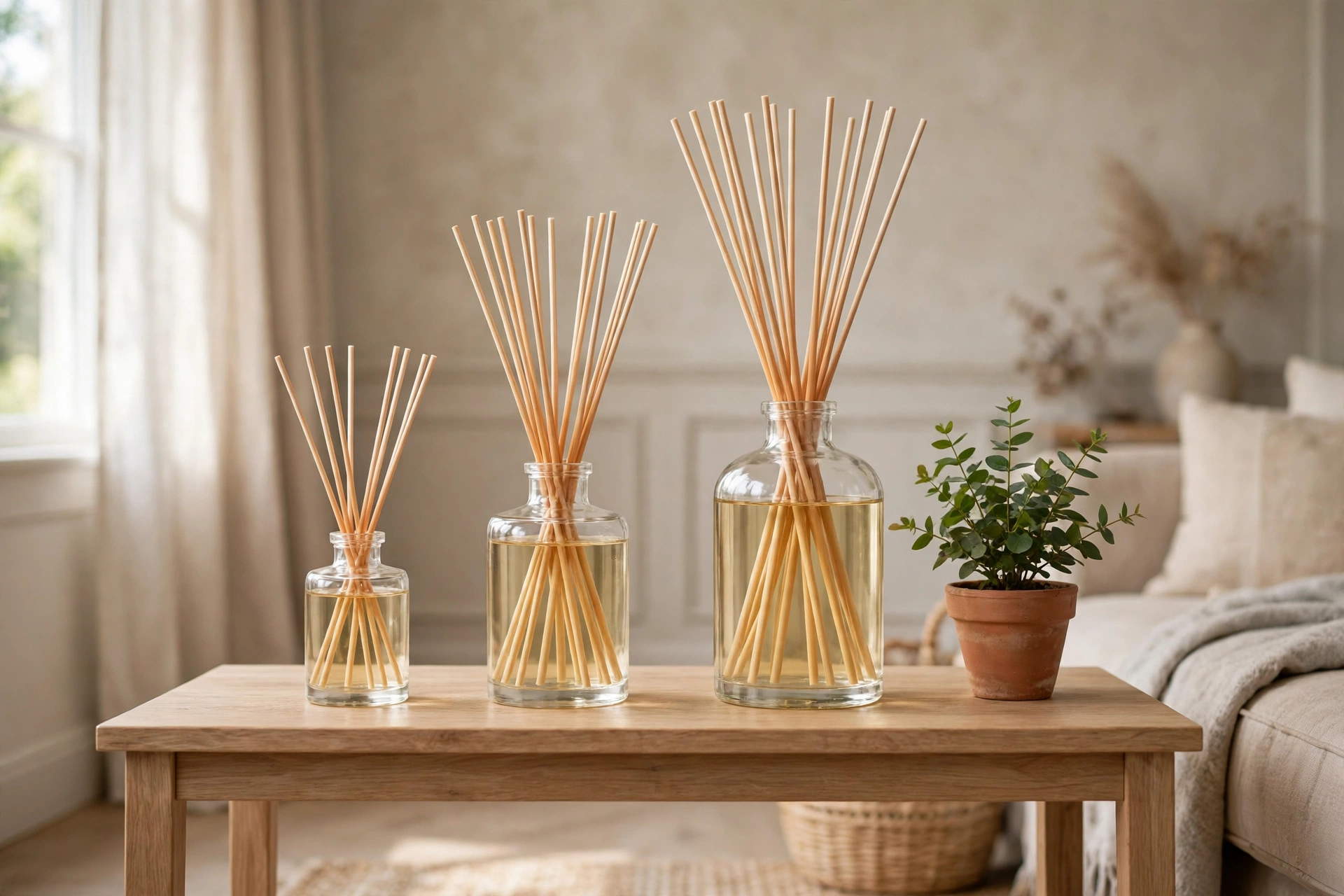
A reed diffuser gives a steady, continuous scent, all day and all night, without a flame. Its strength can be set precisely: more reeds for a stronger scent, fewer for a lighter one. It is the best format for rooms that need background scent all day, the hallway, the living room, the bedroom overnight, the bathroom and the home office. Its weakness is that it cannot be switched off quickly, and in a small room it can build into something too strong if it has too many reeds.
A scented candle gives a stronger scent for a shorter time, with a flame that adds warmth and light. Its strength depends on the size of the candle and the size of the room, and it needs time to work: the scent builds as the melt pool grows, which takes twenty or thirty minutes. It is the best format for an evening ritual, a calm hour before bed, or a cold evening in the living room. Its weakness is that it needs watching, it must never be left burning in an empty room, and it must never be left burning overnight. The full buying guide, including size against room and how to judge hot throw, is in our guide on how to choose a scented candle.
Wax melts give the fastest scent of any format, because the warmer heats the wax quickly and releases the fragrance in a burst. They are the best format for a short, strong reset, the hour after cooking in a kitchen, or a room that needs scent quickly before guests arrive. Their weakness is that they release scent faster than a candle, which can be too much in a very small room, and they need to be switched off.
A room spray gives a burst of scent that fades fast, usually within an hour. It is the best format for a top-up, a quick refresh before guests arrive, or the after-cooking reset in a kitchen. Its weakness is that it fades too fast to be the main scent in any room, and it must never be sprayed over food, plates or cooking surfaces.
The combination that works best in most homes is a diffuser for everyday background scent, a candle for the evening in the living room or the bedroom, and a wax melt or a spray for the short resets. The three should be the same family, or from the same mood, so they do not fight each other. A citrus diffuser, a citrus wax melt and a citrus and basil candle is a coherent set. A citrus diffuser and a spicy candle is not.
Intensity: Match the Strength to the Room Size
Room size decides intensity more than any other factor, and the guides checked for this article give a useful rule of thumb, from Clarky Candles, written for wax melts but true for every format: small rooms need one or two pieces, medium rooms need two or three, and large or open-plan rooms need a full snap bar or more. The same scaling applies to reeds and to candle size.
For a reed diffuser, the rule is simple: three or four reeds for a small room, such as a bathroom or a small bedroom, four to six for a medium room, such as a kitchen or a home office, and the full set for a large room, such as a living room or a hallway. Fewer reeds also make the diffuser last longer, which matters in a warm room where evaporation is faster. Start with fewer reeds than you think you need, and add one or two only if the room still smells of nothing after a day. It is much easier to add scent than to remove it.
For a candle, the rule is size against room. A small candle suits a small room. A large candle suits a large room. A candle that is too small for the room will smell of nothing, because the melt pool is too small to fill the air. A candle that is too large for the room will overwhelm it, because the scent has nowhere to go. The size-to-room maths, including candle sizes by room, is in our guide on how to choose a scented candle.
Ventilation matters as much as size. A draughty hallway needs more scent than a still bedroom of the same size, because the air carries the scent away. A room with an extractor fan running, such as a kitchen, needs a stronger format for the reset, because the fan pulls the scent out of the room. A room with no window needs a lighter hand, because the scent has nowhere to go. The test is always the same: walk into the room from another room, and notice what you smell in the first five seconds. That is the strength that matters, not the strength you smell when you stand next to the diffuser.
Moving Between Rooms: Transitions and One Family Across the Home
A home is not six separate rooms. It is one journey, from the front door to the bedroom, and the scent should change as a person moves through it. Plum & Ashby call this fragrance zoning, and the idea is that the scent should follow the day: kitchen freshness in the morning, a bright hallway when guests arrive, a warm living room in the evening, and a lavender hush in the bedroom at night. The transitions are the point, because a change in scent marks a change in the day, and the nose notices a change far more than it notices a scent that never varies.
The simplest way to do this is the one-family system. Choose one scent family, such as citrus, and use a different expression of it in each room: a citrus and basil diffuser in the kitchen, a citrus and black pepper diffuser in the hallway, a citrus and fig candle in the living room, and a citrus and lavender diffuser in the bedroom. The family is the same, so the rooms do not clash, but the expression is different, so each room has its own character. The nose notices the change, and the home smells deliberate rather than confused.
The mistake to avoid is mixing two moods in the same room, or in rooms that open into each other. A fresh citrus diffuser in a kitchen and a heavy spicy candle in the living room next door will fight each other across the open-plan space, and the house will smell confused. One family per room, or one family across the home with different expressions of it, is the rule that keeps a home smelling deliberate. The room guides on this site cover the one-family rule in more detail, and the layering guide that follows this pillar will cover it in full.
The Mistakes That Waste Money and Scent
Most disappointing home fragrance is not bad fragrance. It is good fragrance chosen for the wrong room, used in the wrong strength, or placed where the air destroys it. These are the mistakes to avoid.
Choosing by name, not by family. A scent called Winter Spice or Citrus Burst could be anything. Choose by the family underneath the name, and by the job you want, not by the prettiest name on the jar. The label usually lists the notes, and the notes tell you the family.
Buying too strong for a small room. A heavy sweet candle, or a diffuser with all the reeds in, will overwhelm a small bathroom or a small bedroom within minutes. Match the strength to the room, and start light. In a small room, the cost of too strong is a room that smells cloying every time you walk in.
Placing the diffuser where the air destroys it. Heat speeds up evaporation and the scent disappears in days rather than weeks. A diffuser next to a radiator, in direct sunlight, or under an extractor fan will waste oil. Place it where the air moves gently past it, at about waist height, away from heat and away from the fan.
Lighting a candle and leaving the room. This is not a mistake about scent. It is a safety mistake, and it is the one mistake in this guide that can cause real harm. Always blow the candle out when you leave the room, even if you are only going to be gone for a few minutes. If you are the kind of person who forgets, use a diffuser instead of a candle, and save the candle for an evening when you are sure you will stay in the room.
Using scent to cover a smell that needs cleaning. Scent masks a smell. It does not fix a greasy extractor filter, a full bin, a blocked drain, a damp bathroom or a dirty oven, and a stronger scent on top of a stale smell makes the room smell worse, not better. Find and fix the cause first, then add scent. The kitchen guide on this site covers the cleaning-first rule in detail.
Mixing two moods in the same room. A fresh citrus diffuser and a heavy spicy candle burning in the same room will fight each other. One family per room, or one family across the home with different expressions of it, is the rule that keeps a home smelling deliberate rather than confused.
Choosing in Four Steps
If the table and the sections above feel like too much to hold at once, the choice can be reduced to four steps, in this order. Get the order right and the name on the jar stops mattering very much.
Step one: pick the room, not the scent. Start with the room you want to scent, and ask what the room does. A hallway greets. A bedroom winds down. A kitchen sits next to food. A bathroom stays fresh. The job decides everything else.
Step two: pick the family for the job. Use the matrix table above. Citrus, black pepper and cedar for a hallway. Warm woods, amber and fig for a living room. Lavender, chamomile and soft musk for a bedroom. Eucalyptus, mint and sea salt for a bathroom. Citrus, herbs and greens for a kitchen. Bergamot, grapefruit and rosemary for a home office.
Step three: pick the format for how long the scent needs to last. A reed diffuser for all-day background scent. A candle for an evening ritual. A wax melt or a spray for a short reset. The format decides how strongly, how long, and how safely the scent is delivered.
Step four: match the strength to the room size. Three or four reeds for a small room, four to six for a medium room, the full set for a large room. A small candle for a small room, a large candle for a large room. Walk into the room from another room and notice what you smell in the first five seconds. That is the strength that matters.
Start with one room, live with it for a week, and notice when you reach for it and when you do not. The right scent for a room is the one you stop noticing after ten minutes and still enjoy when you walk back in from outside. That is the scent that suits your room, and no list can choose it for you.
Frequently Asked Questions
What is the best home fragrance for each room?
There is no single best scent, because the right scent depends on the room. The matrix table at the top of this guide gives the short answer for each room: citrus, black pepper and cedar for the hallway; warm woods, amber, sandalwood, vetiver and fig for the living room; lavender, chamomile, sandalwood, cedar, tonka and soft musk for the bedroom; eucalyptus, mint, cypress and sea salt for the bathroom; citrus, herbs and greens for the kitchen; bergamot, grapefruit, rosemary and cedar for the home office. Start with the job the room does, then the family, then the format, then the strength.
Should I use the same scent in every room?
No. A house where every room smells of the same scent is a house where nothing smells of anything in particular, because the nose adapts to a scent that never changes. Use one family across the home with a different expression in each room, so the rooms do not clash but each room has its own character, and let the scent change as you move through the house, from kitchen freshness in the morning to a softer scent in the bedroom at night.
Reed diffuser or candle: which is better for a room?
It depends on how long the scent needs to last. A reed diffuser is best for all-day background scent, because it works without a flame and its strength can be set by adding or removing reeds. A candle is best for an evening ritual, because the flame and the warm light add to the mood, and the scent can be blown out when the evening ends. A candle must never be left burning in an empty room and never left burning overnight. A wax melt or a room spray is best for a short reset, such as the hour after cooking.
How strong should the scent be in a small room?
Light. A small room needs three or four reeds in a diffuser, or a small candle, in a light family such as citrus or eucalyptus. Start with fewer reeds than you think you need, and add one or two only if the room still smells of nothing after a day. If you can smell the diffuser clearly when you sit down in the room, it is too strong. The test is to walk into the room from another room and notice what you smell in the first five seconds.
What scent should I put in my hallway?
Citrus, black pepper and cedar, in a reed diffuser on a console table or a shelf at about waist height, near the front door but not right beside it. The scent should be noticeable when you walk in and forgettable once you are in the next room. If it follows you into the living room and fights the scent there, it is too strong.
Why does my whole house smell of nothing even though I have diffusers everywhere?
Because the nose adapts to a scent that never changes, and because a scent that is the same in every room stops being noticed. Change the scent family from room to room, or use a different expression of one family in each room, so the nose notices the change as you move through the house. Also check the placement: a diffuser next to a radiator, in direct sunlight, or under an extractor fan will waste oil and scent the room badly.
Can I use a candle in the bedroom overnight?
No. A candle must never be left burning overnight, and never left burning in an empty room. In a bedroom, a candle is for the hour before bed only, lit while you wind down and blown out before you sleep. A reed diffuser is the format for overnight, because it has no flame and nothing to watch.
What is the best scent for a home office?
Bergamot, grapefruit, rosemary and cedar, in a reed diffuser, used lightly. The scent should be noticeable when you walk in and forgettable once you sit down to work. If you can still smell the diffuser clearly an hour into a work session, it is too strong.
Sources
The room-by-room consensus in this article restates the consensus of the five room guides checked on 16 November 2026: Clarky Candles, “Home Fragrance: Perfect Wax Melt Scent for Each Room”; Wisp House, “The British Scent Glossary: How to Read Fragrance Notes for Your Home”; Supplies for Candles, “The Best Fragrance to Match Each Room in Your Home”; Soulful Candles UK, “How to Choose Room Spray”; and Plum & Ashby, “Fragrance Zoning”. The room-size intensity guidance is restated from Clarky Candles. The room guides on this site, linked above, were checked against the same sources for the room detail this pillar links out to. No claim here is presented as our own survey or test, and no volume or keyword difficulty figure is stated, because none has been verified.