
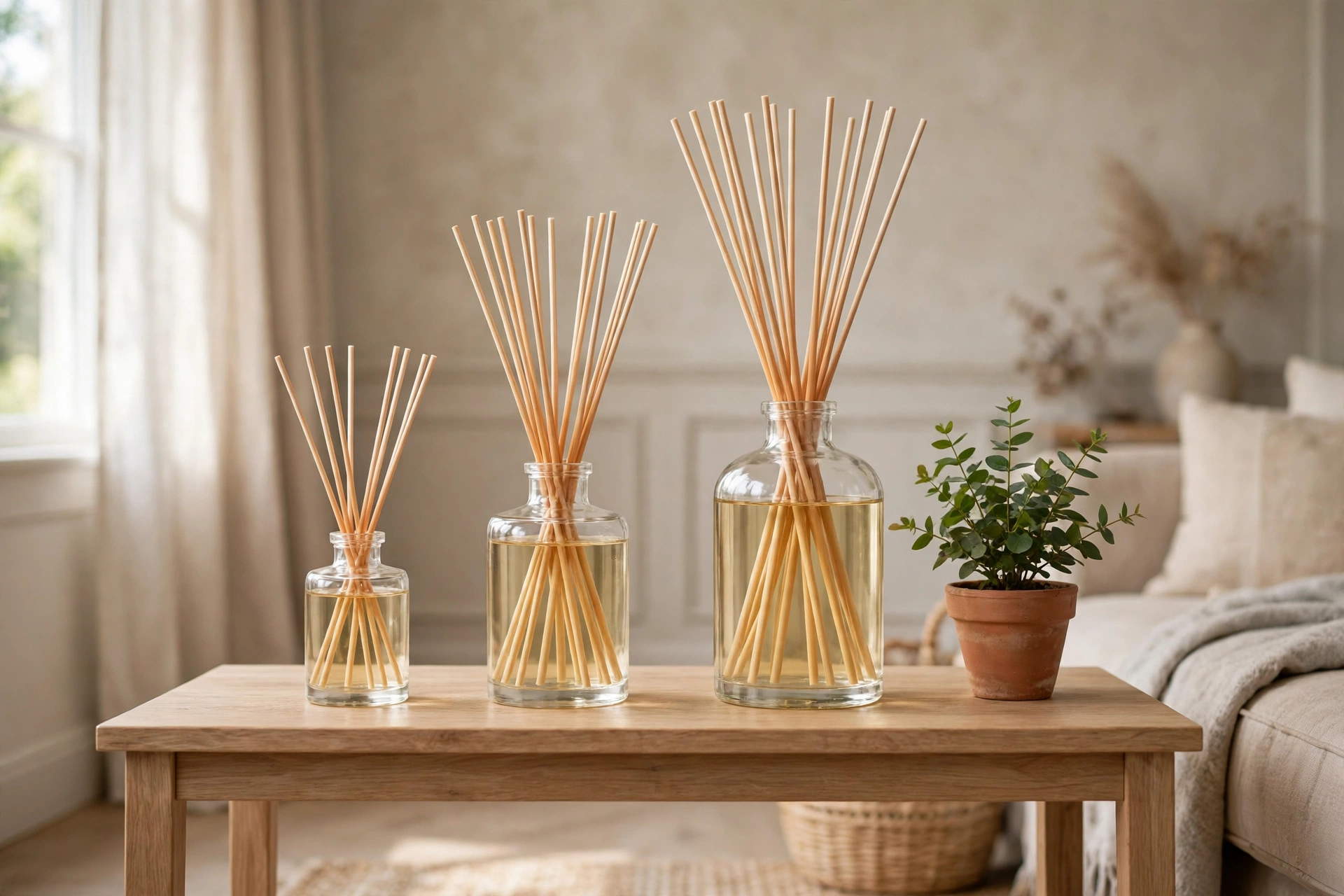
Quick answer: The best reed diffuser for a UK home is not one product, it is the right size, reed count and scent weight for the room it sits in. A small flat needs a 50 to 100ml bottle with four to six reeds and a light to medium scent. A larger living room needs 100 to 200ml, eight to ten reeds, and a heavier scent family such as woody or amber. Bedrooms suit gentle scents and fewer reeds, bathrooms suit fresh scents in a small bottle, and hallways suit a medium bottle near the front door where air moves. Price matters far less than fit: a well-chosen budget diffuser in the right room will outperform an expensive one in the wrong room every time.
Most disappointing reed diffusers are not bad products. They are good products bought for the wrong room, or bought without checking the label for the three things that decide whether a diffuser will actually scent a space: bottle size, reed type and count, and fragrance strength. This guide works through the choice room by room, explains what to check before you pay, and sets out when it is worth spending more and when it is not.
What “Best” Means in a Small UK Home
UK homes are not like the homes in most diffuser marketing. Rooms are smaller, ceilings are lower, many homes are flats with limited airflow between rooms, and draughts from older windows and doors move air in ways a diffuser has to work with, not against. A diffuser designed to scent a large open-plan American living room will be too strong in a small British lounge, and one made for a hotel lobby will disappear entirely in a draughty hallway.
So “best” here means three things, in this order:
- It scents the room it is actually in. A diffuser that is too weak for the space is wasted money, however nice the bottle looks. A diffuser that is too strong for the space will be moved to a cupboard within a week.
- It keeps scenting for a sensible length of time. A bottle that fades after two weeks is not a bargain at any price, because you will replace it four times as often.
- It fits the room and the household. A nursery, a home with cats, a rented flat with a no-naked-flame rule, and a bathroom with no window all point to different choices, and the best diffuser respects those constraints rather than fighting them.
Everything in this guide follows from those three tests. There is no single winner, because the right answer for a hallway is the wrong answer for a bedroom. What follows is the best type for each room, and the label checks that separate a good buy from a disappointing one.
Best Reed Diffuser for the Hallway
The hallway is the hardest room in the house to scent well, and the one where a diffuser earns its keep most visibly, because it is the first scent a visitor meets. Hallways are narrow, they usually have a front door that opens and closes all day, and they often have stairs pulling warm air upwards. That moving air is both the problem and the solution: a diffuser placed where air passes will scent the whole hallway, while one tucked in a still corner will scent nothing.
Best type for a hallway: A medium bottle, 100ml, with eight to ten reeds, in a medium-weight scent such as a woody, amber or spiced family. Lighter citrus scents tend to get carried away by the draught from the door before they settle, while very heavy scents can feel overpowering in a narrow space when the door is closed.
Where it works: On a console table or shelf near the front door but not directly beside it, at about waist height, where people walk past and air moves. Avoid putting it on the floor, where the scent stays low, or on top of a radiator, where heat will evaporate the oil far too fast.
What to avoid: A small 50ml bottle with four reeds will struggle in a hallway with a draughty front door. A very tall, narrow bottle is also a poor choice here, because it is easy to knock over in a space people pass through with coats and bags.
A hallway diffuser is also the one most worth refilling rather than replacing, because it runs through oil faster than any other room in the house. Our guide to reed diffuser refills explains when to refill and when to retire the bottle, which matters more in a hallway than anywhere else.
Best Reed Diffuser for the Living Room
The living room is where most people buy their first diffuser, and where the most common mistake happens: buying too small. A typical UK living room is larger than a bedroom or bathroom, it usually has a sofa, soft furnishings that absorb scent, and doors to other rooms that are often left open. A small diffuser in that space will smell lovely if you stand right next to it and smell of nothing from the sofa.
Best type for a living room: A 100 to 200ml bottle with eight to ten reeds, in a medium to heavy scent family. Woody, amber, spiced and warm floral scents carry best across a larger room. If the room is open plan and joins a kitchen or dining area, go to the larger end of that range, or use two smaller diffusers spaced apart rather than one large one in a corner.
Where it works: On a side table or shelf in the part of the room where air moves, ideally near a doorway or a spot people walk past, at waist height. Our guide to where to place a reed diffuser covers the room-by-room spots in detail, and it is worth checking before you decide where the living room diffuser will live, because placement decides the result as much as the product does.
What to avoid: Do not buy a living room diffuser for its bottle alone. A beautiful bottle with four short reeds and a light scent will look wonderful and scent almost nothing. Count the reeds, check the size, and choose the scent family for the room size, not for the packaging.
If the living room is small, a typical British lounge rather than an open-plan space, then a 100ml bottle with six to eight reeds and a medium scent will be plenty. The point is to match the diffuser to the room you actually have, not the room in the photograph.
Best Reed Diffuser for the Bedroom
The bedroom is the room where restraint matters most. A diffuser here works while you sleep, and a scent that is too strong will be noticed all night, while a scent that is too heavy can make a small, closed bedroom feel stuffy. The goal is a gentle background scent, not a perfumed room.
Best type for a bedroom: A small to medium bottle, 50 to 100ml, with four to six reeds, in a light to medium scent family. Lavender, soft floral, clean linen style and light woody scents suit bedrooms best. Avoid very sweet or very heavy scents, which tend to feel stronger as the room warms overnight and the door stays closed.
Where it works: On a chest of drawers or bedside table away from the bed itself, not on the bedside table right next to your pillow. Give it a little distance and a little airflow, and use fewer reeds than the bottle came with if the scent feels too strong. You can always add reeds, and taking reeds out is the simplest way to turn a diffuser down.
What to avoid: Do not use a large bottle with ten reeds in a small bedroom. Do not place a diffuser on a windowsill in direct sun, where heat will push the scent out too fast and shorten the life of the bottle. And if anyone in the bedroom has asthma or a sensitivity to fragrance, keep the reed count low and the room ventilated, and choose a lighter scent family.
A bedroom is also the room where a diffuser beats a candle most clearly, because there is no flame to worry about overnight. If you are choosing between the two formats for a bedroom, a diffuser is the safer and more practical choice, and it will scent the room all day rather than only while it is lit.
Best Reed Diffuser for the Bathroom
Bathrooms are small, humid and usually windowless or nearly so, which makes them the easiest room in the house to scent and the easiest to over-scent. A diffuser that would be faint in a living room can be overpowering in a bathroom, so the best choice here is deliberately small and light.
Best type for a bathroom: A small bottle, 50ml, with four to five reeds, in a fresh scent family: citrus, green, herbal or clean marine style scents. Fresh families suit bathrooms because they read as clean rather than perfumed, and they work with the humidity rather than fighting it.
Where it works: On a shelf or windowsill away from direct water splashes, and away from the shower steam if possible. Steam will not ruin a diffuser, but constant damp air can clog reeds faster, so give it a spot that stays reasonably dry. Keep it out of reach of small children, and never on the edge of a bath.
What to avoid: Do not put a large bottle with ten reeds in a small bathroom. It will be too strong, it will evaporate faster in the warm, humid air, and you will end up removing reeds to tame it. A small bottle with few reeds is the right tool for this room, and it will last longer too, because it is releasing scent into a small space.
Bathrooms are also the room where the lifespan of a diffuser is most affected by conditions. Warmth and humidity speed up evaporation, so a bathroom bottle will usually finish faster than the same bottle in a cooler room. Our guide to how long do reed diffusers last sets out the lifespan ranges by bottle size and the factors that shorten them, so you can judge whether a bathroom bottle is finishing early or behaving normally.
What to Check on the Label Before You Buy
Most diffuser disappointment could be avoided at the shelf by reading the label properly. Five checks cover almost everything that matters.
1. Bottle size in millilitres. This is the single most useful number on the label. It tells you how much oil you are buying and, roughly, how long it will last. For reference, a 50ml bottle typically lasts four to eight weeks, a 100ml bottle six weeks to three months, and a 200ml bottle three to six months, depending on the room and the conditions. If the label does not state the size clearly, treat that as a warning sign.
2. Reed type and count. Look for how many reeds are included and what they are made of. Rattan reeds are the standard for oil-based diffuser bases, while fibre reeds suit some bases and tend to release scent faster. A bottle that comes with four reeds will scent a smaller space than one that comes with ten, and a bottle that comes with no reeds at all is not a complete product. If you need more reeds than the bottle came with, buy a spare set rather than splitting one set across two bottles.
3. Fragrance strength and family. Labels describe scent in different ways, so look for the family rather than the marketing words. Citrus and green families are light, floral and herbal families are medium, woody, amber and spiced families are heavy. A light family in a large room will disappoint, and a heavy family in a small room will overwhelm. Match the family to the room size first, and your personal taste second.
4. Base type. Most home diffusers use an oil-based base, and the label should say so or name the base. If the label does not name a base at all, or describes the product only as “fragrance oil” without saying it is made for reed diffusers, be cautious. Neat essential oil is not a diffuser base, and a product made for a different purpose may not climb the reeds properly.
5. Safety and care information. A proper diffuser label will carry basic safety guidance: keep away from naked flames, keep out of reach of children and pets, and avoid contact with polished wood and fabric. The absence of any safety information is a warning sign about the maker, not a sign the product is safe.
Two more practical checks before you pay. First, look at the bottle itself: a wide, stable base is better than a tall, narrow one, especially in a hallway or a home with children or pets. Second, check whether refills are sold for the same scent. A diffuser with a matching refill available is cheaper to run over a year than one you have to replace whole every time, and it is less wasteful too.
Sizes and Real Longevity: What a Bottle Actually Lasts
Longevity is where marketing and reality part company most often. A label that promises “lasts up to six months” may be technically true in a cool, still room with four reeds, and completely untrue in a warm hallway with ten reeds. The honest ranges, for a typical UK home, are:
- 50ml bottle, four to six reeds: about four to eight weeks. Best for bathrooms, small bedrooms and as a trial size for a new scent.
- 100ml bottle, six to ten reeds: about six weeks to three months. The standard size, and the best fit for most living rooms, hallways and larger bedrooms.
- 200ml bottle, eight to twelve reeds: about three to six months. Best for large living rooms and open-plan spaces, where a smaller bottle would need replacing too often.
Three factors move a bottle to the short end of its range. Heat, from a radiator, a sunny windowsill or a warm room, speeds up evaporation. Airflow, from a draughty door or an open window, carries scent away faster and uses oil faster. And reed count: more reeds mean a stronger scent and a shorter life, because more reeds are drawing oil at once. That is a trade-off, not a fault. If your diffuser smells too faint, adding reeds is the right fix, and the shorter life is the price of it.
The practical point for buying is this: a larger bottle is usually better value per millilitre, but only if the room is large enough to need it. A 200ml bottle in a small bathroom will be too strong long before it is empty, and you will have paid for oil you cannot use. Buy the size for the room, not the size that looks like the best deal on the shelf.
Budget vs Luxury: What the Money Actually Buys
Reed diffusers in the UK range from a few pounds at a supermarket or discount shop to fifty pounds or more from a luxury brand, and the price difference is real but it does not buy what most people assume it buys.
Budget, roughly £5 to £15: Supermarket, discount and own-brand diffusers. The oil and reeds are usually perfectly serviceable, and the scent is often simpler, with fewer layers and less staying power. The bottle is usually plain glass and refills may not be available. For a bathroom, a hallway or a first try of a new scent family, a budget diffuser in the right size is often all you need, and the money saved is real.
Mid-range, roughly £15 to £35: Specialist home fragrance brands, department store own brands, and smaller UK makers. This is where the best value usually sits. The scent is typically more complex and longer lasting, the reeds and base are better matched to each other, and refills are often available for the same scent. For a living room or a bedroom you use every day, this is the range to aim for.
Luxury, roughly £35 and above: Premium and designer brands. What you are mainly paying for is the bottle design, the packaging, the brand name and a more complex fragrance, often blended by a named perfumer. The scent may be genuinely richer, and the bottle may be worth keeping and refilling, but the diffuser will not scent a room any better than a mid-range diffuser of the same size with the same number of reeds. Luxury buys beauty and complexity, not coverage.
The honest rule is: spend the most on the room you spend the most time in, and spend the least on the room where the diffuser works hardest and gets replaced fastest, which is usually the hallway. A mid-range diffuser in the living room, a budget diffuser in the bathroom, and a refillable mid-range bottle in the hallway will serve most homes better than one luxury bottle in the wrong room.
And if a diffuser you already own smells of nothing, do not assume it is a bad buy and replace it with a more expensive one. The cause is usually fixable: too few reeds, a bad spot, clogged reeds or a room too large for the bottle. Our guide to why you can’t smell your reed diffuser works through those causes in order, and it is worth reading before you spend more money on a replacement.
When a Reed Diffuser Is the Wrong Choice
A reed diffuser is not the right answer for every room or every household, and it is worth saying so plainly. If you need scent only for an hour, for guests arriving, then a candle or a room spray will do the job faster and with less waste. If the room is very large, open plan and draughty, a single diffuser will struggle however large it is, and two diffusers or a different format may be needed. If the room has no airflow at all, a diffuser in a still corner will scent only the air immediately around it.
Households with cats or small children need extra care. Diffuser oil is not safe to drink, and a knocked-over bottle is a spill that stains and needs cleaning up at once. Keep diffusers out of reach, on stable surfaces, and never on the floor or on a low table where a toddler or a cat can reach them. If that is not possible in a particular room, choose a different format for that room, or no fragrance product at all.
Renters should also check one thing before buying a large diffuser: the oil stains. A bottle placed directly on polished wood, painted furniture or fabric without a tray or coaster can leave a mark that costs more than the diffuser to repair. Always put a diffuser on a tray, a coaster or a washable surface, and keep it away from walls and soft furnishings.
A Simple Buying Checklist
Before you pay, run through this list. It takes a minute and it prevents most bad buys.
- The bottle size matches the room: 50ml for a bathroom or small bedroom, 100ml for a living room or hallway, 200ml for a large or open-plan room.
- The reed count matches the room: four to six for small rooms, eight to ten for larger ones.
- The scent family matches the room size: light for small rooms, medium to heavy for larger ones.
- The label states the size, the reed count and the base, and carries basic safety information.
- Refills are available for the same scent, so the bottle can be kept and reused.
- The bottle has a wide, stable base and will sit on a tray or coaster, not directly on polished wood.
- You have a spot in mind for it: gentle moving air, about waist height, out of direct sun and away from radiators.
If a diffuser passes that list, it is very likely to work well in your home, at whatever price you paid for it.
Frequently Asked Questions
What size reed diffuser is best for a living room?
A 100 to 200ml bottle with eight to ten reeds suits most UK living rooms. Use 100ml for a typical lounge and 200ml, or two smaller diffusers spaced apart, for a large or open-plan room. Choose a medium to heavy scent family such as woody or amber so the scent carries across the space.
What is the best reed diffuser scent for a bedroom?
Light to medium scent families work best in a bedroom: lavender, soft floral, clean linen style and light woody scents. Use a small to medium bottle with four to six reeds, and keep the diffuser away from the bed itself so the scent stays gentle overnight.
Are cheap reed diffusers any good?
Yes, often. A budget diffuser in the right size, with the right reed count and scent family for the room, will outperform an expensive diffuser in the wrong room. Where budget diffusers fall short is usually scent complexity and staying power, not coverage, so they suit bathrooms, hallways and trial purchases particularly well.
How many reeds should a reed diffuser have?
Four to six reeds suit small rooms such as bathrooms and small bedrooms. Eight to ten reeds suit larger rooms such as living rooms and hallways. More reeds mean a stronger scent and a shorter bottle life, so start with the full set and remove reeds if the scent is too strong, rather than starting with too few.
Do reed diffusers work in large rooms?
Yes, but a single small diffuser will not scent a large or open-plan room on its own. Use a 200ml bottle with ten or more reeds, or two smaller diffusers placed apart so each covers part of the room. If the room is very draughty, check the placement first, because a diffuser in still air will scent only the space around it.
How long does a reed diffuser last?
A 50ml bottle usually lasts four to eight weeks, a 100ml bottle six weeks to three months, and a 200ml bottle three to six months, depending on heat, airflow and reed count. A full explanation of the factors is in our guide to how long reed diffusers last.
Should I buy a reed diffuser or a candle?
It depends on the room and how you use it. A diffuser scents a room continuously with no flame, which suits bedrooms, hallways and homes with children or pets. A candle gives a stronger scent for a short period and suits an evening in the living room. Most homes use both, in different rooms, for different jobs.
Can I refill a reed diffuser instead of buying a new one?
Yes, if the bottle is in good condition and you use proper refill oil with a brand new set of reeds. Our guide to reed diffuser refills covers the same-scent rules, how to change scent safely, and when to replace the bottle instead.
Buy for the Room, Not for the Bottle
The best reed diffuser for a UK home is the one that fits the room it will sit in: the right size, the right number of reeds, and a scent family heavy enough to carry across the space without overwhelming it. A hallway wants a medium bottle where air moves. A living room wants the largest bottle the room justifies. A bedroom wants a gentle scent and few reeds. A bathroom wants a small bottle and a fresh scent. Read the label, check the size and the reed count, and spend the most where you spend the most time. Get those choices right, and even a modest diffuser will scent your home well for months.