Best Scents for the Bathroom
Quick answer: The best scents for a bathroom are fresh and clean, not warm or heavy. For everyday freshness, choose citrus (lemon, bergamot, grapefruit or lemongrass), linen or cotton, sea salt, eucalyptus or mint. For a relaxing bath, choose lavender, chamomile or a soft floral such as lilac or peony. For a guest bathroom, keep it lightest of all: cotton or linen, and nothing else. The format matters as much as the scent: a reed diffuser is the natural bathroom format because it works without a flame and keeps scenting between uses, while a candle is for an attended bath only and must never be left burning. Go lighter than you would in the living room, because steam lifts scent fast and a small, steamy bathroom amplifies anything heavy or sweet.
The bathroom is the room where scent has the hardest job and the least room for error. It is usually the smallest room in the house, it is steamy, it is used by everyone, and it is the room where a bad smell is noticed first. That combination makes the choice of scent more important here than anywhere else, and it also makes the most common mistake easy to make: choosing a scent that smells lovely in the shop and then finding it cloying, soapy or overwhelming in a small, damp room. The bathroom does not need a statement scent. It needs a clean one.
Most advice about bathroom scents starts with a list of fragrance names, and the lists checked for this article agree on the same names again and again: citrus, linen, sea salt, eucalyptus, lavender. A list is a useful starting point, but it cannot tell you which job the scent is doing. Freshness for everyday use, relaxation for a bath, and a light welcome for guests are three different briefs, and they need different scents. The right order is job first, family second, format third. Decide what you want the scent to do, then choose the family that does it, then choose the format that survives steam and humidity. Get those three decisions right and the name on the jar stops mattering very much.
This guide is written for UK bathrooms specifically: small bathrooms in flats and terraces, bathrooms with no window, en-suites, family bathrooms, and downstairs cloakrooms. It is written for buyers, not makers, and it draws on the scent families that the bathroom guides checked for this article agree on, organised by job so you can choose rather than guess. Where a source describes a scent as antibacterial or mould-fighting, that is reported here as the source’s claim, not as a fact this site has tested. Scent masks a smell; it does not fix damp, mould or drainage, and a section near the end of this guide deals with exactly that.
The Job Scent Does in a Bathroom
Before choosing a scent, it helps to be clear about what the scent is actually for in this room. A bathroom has three jobs for scent, and they are different enough that one scent cannot always do all three.
The first job is everyday freshness. This is the job people mean when they ask for the best scent for the bathroom, and it is the job the room does most of the time. The scent should make the room smell clean when you walk in, and it should keep working between uses without needing to be lit, sprayed or remembered. It should be fresh and light, not warm or sweet, because a bathroom is a small room and anything heavy builds fast. Citrus, linen, sea salt and eucalyptus are the families for this job.
The second job is relaxation, for a bath. A bathroom in the evening is also a room for unwinding, and the scent for a bath is different from the scent for everyday freshness. It should be calm and soft: lavender, chamomile, a soft floral. This is a scent for the hour of the bath, not for the whole day, and it is usually delivered by a candle lit while you are in the bath, then blown out when you get out.
The third job is a light welcome for guests. A guest bathroom, a downstairs cloakroom, or a bathroom used by visitors needs the lightest touch of all. The scent should be barely there: clean, neutral, inoffensive. Cotton or linen is the safest choice, because it smells clean without smelling of anything in particular, and it is the least likely scent to divide opinion. A guest who walks into a bathroom that smells strongly of anything, even something pleasant, will notice the strength before the scent.
One scent can sometimes do two of these jobs. Eucalyptus does everyday freshness and a spa bath well, because it is fresh in both. Lavender does relaxation and a guest welcome well, because it is calm and familiar in both. But no scent does all three equally well, and the mistake most people make is buying one strong candle and expecting it to do everything. A better approach is to let a diffuser carry the everyday freshness, and to add a candle or a wax melt for the bath, in a family that sits comfortably next to the diffuser scent.
The Steam Rule That Comes First
Everything else in this guide follows from one fact about bathrooms, so it is stated here before any scent family is discussed. Steam lifts scent fast, and a small bathroom amplifies it. A scent that is pleasant in a living room will smell stronger in a bathroom, and a scent that is strong in a living room will smell overwhelming in a bathroom. That is why the first rule of bathroom scenting is to go lighter than you think you need: fewer reeds in the diffuser, a smaller candle, a lighter family, and a shorter burn.
Steam also shortens the life of a scented product. Heat and humidity speed up evaporation, so a diffuser in a steamy bathroom will run out faster than the same diffuser in a bedroom, and a candle will burn faster and less evenly. This is not a reason to buy a stronger product. It is a reason to place the product away from the steam, and to accept that a bathroom diffuser will need replacing a little sooner than one in a drier room. The placement section below covers where to put it.
Two more rules follow from the steam. The first is about candles. A candle in a bathroom is for an attended bath only. Light it while you are in the bath, enjoy it while you soak, and blow it out when you get out. Never leave a candle burning in an empty bathroom, and never leave a lit candle unattended near water. The second is about water itself. A diffuser and a candle both need to sit away from the shower and the bath, where they cannot be splashed, knocked into the water, or soaked by steam. Diffuser oil in bath water is not safe, and a candle that gets wet will not burn properly. The safety rules that apply to every candle, in every room, are in our complete scented candles guide.
The Best Scent Families for a Bathroom, in Detail
The families below are the ones the bathroom guides checked for this article agree on, and they are the ones that work in real British bathrooms. Each family is described by what it does in the room, which job it suits, and where it goes wrong, because knowing the failure mode is as useful as knowing the strength.
Citrus: lemon, bergamot, grapefruit and lemongrass
Citrus is the most recommended bathroom scent family in every guide checked for this article, and it is the one most often named first. Lemon, bergamot, grapefruit and lemongrass all do the same job: they make a room smell clean, bright and freshly aired, which is exactly what a bathroom needs. Citrus is the family that most people mean when they say a bathroom smells fresh, and it is the safest first choice for everyday freshness.
What citrus does in a bathroom is cut through the stuffiness that a small, steamy room builds up. It is a bright, clean scent that does not linger heavily, and it suits a bathroom used by the whole household, because it is one of the least divisive families. It suits a bathroom with no window especially well, because it makes the room feel aired even when it is not. It also suits a morning bathroom, because it is an energising scent that wakes the senses up rather than calming them down.
The failure mode for citrus is that it is a light scent, and in a larger bathroom, or a bathroom with the extractor fan running, it can disappear. It is also a scent that fades fast, so a citrus candle that smells wonderful for the first hour may smell of nothing by the third. The fix is to use citrus in a diffuser rather than a candle for everyday freshness, because a diffuser scents continuously and gives a light scent more time to build, and to choose a citrus blended with something that gives it staying power, such as citrus with sea salt, citrus with mint, or lemongrass with eucalyptus.
Linen and cotton: the cleanest bathroom scent
Linen and cotton are the second most recommended bathroom family in the guides checked for this article, and they are the ones most often named for guest bathrooms. They smell of clean laundry, fresh sheets and aired rooms, which is the closest a fragrance can get to smelling of nothing at all while still smelling good. That is why they are the safest choice for a bathroom shared with guests, or for a household where someone is sensitive to scent.
What linen does in a bathroom is make the room smell clean without making it smell perfumed. It suits the everyday freshness job and the guest welcome job, and it suits a bathroom where the household wants one scent for the whole home, because linen works in a bedroom as well as a bathroom, and a linen diffuser in the bathroom with a linen candle in the living room gives the home a coherent smell. Our guide to the best scents for the living room covers linen in that room in more detail.
The failure mode for linen is faintness. On its own it is a very quiet scent, and in a bathroom with a strong extractor fan, or a bathroom that is used often, it can disappear. If you love linen, choose a blend that gives it a partner, such as linen with sea salt, linen with citrus, or cotton with eucalyptus, rather than a pure linen candle that will be too quiet to notice.
Sea salt and ocean: fresh without being floral
Sea salt, ocean breeze and marine scents are the fresh family that suits a bathroom best after citrus and linen. They smell clean and slightly mineral, like air by the sea, and they do not smell sweet or floral, which makes them a good choice for a bathroom shared with someone who finds florals too sweet. They are the family most often named in wax melt guides for bathrooms, and they suit a modern bathroom with white tiles, chrome and glass, because the scent matches what the room already looks like.
Sea salt suits the everyday freshness job, and it suits a bathroom used in the morning, because it is a bright, clean scent that wakes the room up. It also suits a bathroom where the household wants a scent that reads as clean rather than perfumed, which is why it is a popular choice for downstairs cloakrooms and guest bathrooms.
The failure mode for sea salt is that it can smell thin or watery if it is a cheap version of the scent, and it is a light family that needs a good diffuser or a well-made candle to carry it. The fix is to choose a sea salt blended with something that gives it body, such as sea salt with citrus, sea salt with eucalyptus, or ocean breeze with cucumber, rather than a pure sea salt candle that will smell of very little.
Eucalyptus, tea tree and mint: the fresh herbal family
Eucalyptus, tea tree and mint are the fresh herbal family for bathrooms, and they are the ones most often named for a spa-style bathroom. Eucalyptus is the most recommended of the three, usually listed alongside citrus and lavender. It is a clean, slightly medicinal scent that makes a bathroom feel fresh and aired, and it is the scent most often associated with a spa, a sauna and a steam room, which is why it suits a bathroom so well.
What eucalyptus does in a bathroom is make the room smell clean and clear. It suits the everyday freshness job and the spa bath job, and it suits a bathroom with no window, because it makes the room feel less stuffy. It also suits a bathroom in winter, when colds are going round the household, because it is the scent most people reach for when they want the room to feel clear and fresh, though no scent is a treatment for a cold or for breathing problems.
Tea tree and mint are the secondary members of this family. Tea tree is described by some sources as antibacterial, and eucalyptus is described the same way by others; those claims are reported here as the sources state them, not as facts this site has tested. Mint is the lightest of the three, and it suits a bathroom where eucalyptus feels too strong, because it is fresh without being medicinal. The guides checked for this article also name peppermint and cucumber as wax melt scents for bathrooms, and both suit a small bathroom well because they are light and clean.
The failure mode for this family is that it can smell medicinal or like a cleaning product if it is too strong, or if it is a cheap, sharp version of the scent. A eucalyptus candle that smells of a chemist’s shop is a bad candle, not a bad family. The fix is to use the family lightly: a diffuser with four to six reeds, a smaller candle, or a blend that pairs the herbal scent with something softer, such as eucalyptus with lavender, eucalyptus with sea salt, or mint with citrus.
Lavender and soft florals: the spa and bath family
Lavender and soft florals are the relaxing second family for bathrooms, and they are the ones for a bath rather than for everyday freshness. Lavender is the most recommended spa scent in the guides checked for this article, usually listed with eucalyptus and chamomile as the spa trio. Lilac and peony are the soft florals most often named for bathrooms, and they suit a bathroom where the household wants the room to feel gentle and welcoming rather than bright and clean.
What lavender does in a bathroom is make the room feel calm. It suits the relaxation job, for a bath in the evening, and it suits a bathroom shared with a partner, because it is one of the least divisive scents. It also suits a bathroom where the household wants one scent across the home, because lavender works in a bedroom as well as a bathroom. Our guide to the best scents for the bedroom covers lavender in that room in more detail.
The failure mode for lavender in a bathroom is that it is a calm scent in a room that usually needs a fresh one, and a lavender diffuser left running all day in a bathroom can make the room smell sleepy rather than clean. The fix is to use lavender for the bath, not for everyday freshness: a lavender candle lit while you soak, blown out when you get out, and a fresh diffuser for the rest of the day. If you want lavender all day, choose a lavender blended with something fresh, such as lavender with eucalyptus or lavender with bergamot, rather than a pure lavender that will make the room feel heavy.
Warm woods and amber: use with care in a bathroom
Warm woods, amber and vanilla are the families that suit a bathroom least, and the guides checked for this article agree on this point. A bathroom amplifies sweetness and heavy scents, so a warm, sweet fragrance that smells cosy in a living room can feel too strong in a small, steamy bathroom. Vanilla, amber and sandalwood are the families most likely to smell cloying in a bathroom, and they are the ones to avoid for everyday freshness.
That does not make them bad scents for a bathroom altogether. A warm wood or amber candle, lit for a bath in winter, can make the room feel cosy and special, and a vanilla and sandalwood candle is a good choice for a long evening bath when the room needs to feel warm rather than fresh. The rule is to use them for the bath only, in a small candle, for a short time, and never as the everyday diffuser scent. If the bathroom is large, with a big window and good ventilation, a warm family will work better than it does in a small, windowless bathroom, but it will still need a lighter hand than it does in a living room.
The Scents to Avoid in a Bathroom
The guides checked for this article agree on which families do not belong in a bathroom for everyday use, and the agreement is useful because it is a contrast that makes the right choice clearer.
Heavy gourmand scents, such as strong bakery, chocolate, caramel or coffee, are a poor everyday choice for a bathroom. They are cheerful in a living room on a weekend afternoon, but in a small, steamy bathroom they can smell artificial and cloying within minutes, and they clash with the clean the room needs. A bathroom that smells of cake does not smell clean. It smells confused.
Strong spice, such as cinnamon or clove on its own, is also a poor everyday choice, for the same reason. It is a scent for an autumn evening in a living room, not for a small bathroom in the morning, because it is too warm and too heavy for a room that needs to feel fresh. If you love spice, use it in a blend, such as cinnamon with vanilla, and use it for a bath in winter only, not as the everyday scent.
Very sweet florals, such as a heavy rose or a strong jasmine, can also overwhelm a small bathroom, though a soft floral such as lilac or peony will usually work. The rule for the bathroom is that the scent should be lighter than the scent you would choose for the living room, not stronger, and that a scent that smells wonderful in the shop will smell twice as strong in a steamy bathroom.
Best Format for a Bathroom: Diffuser, Candle or Wax Melts
The scent family decides what the room smells of. The format decides how strongly, how long, and how safely. Three formats suit bathrooms, and each one has a job it does best.
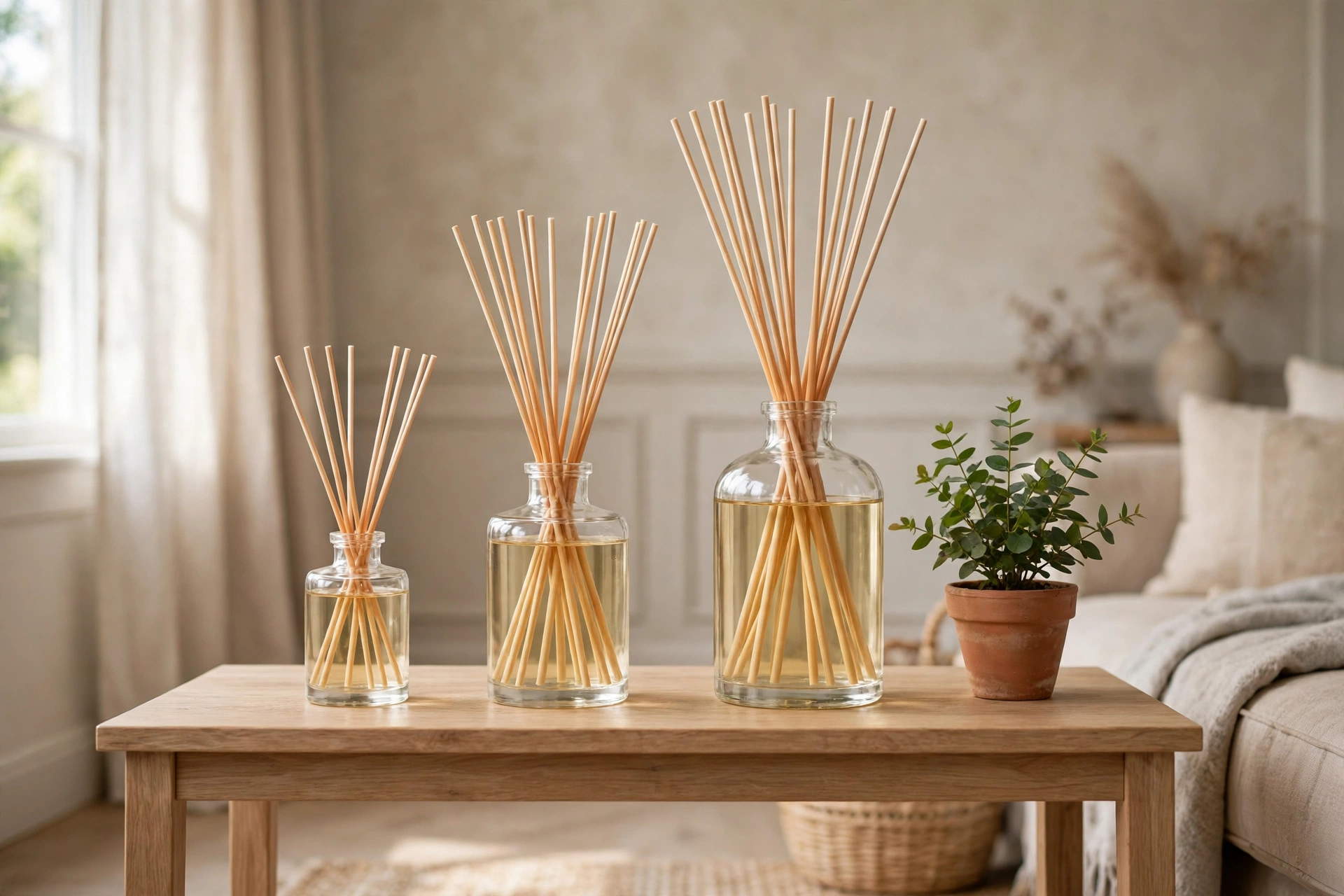
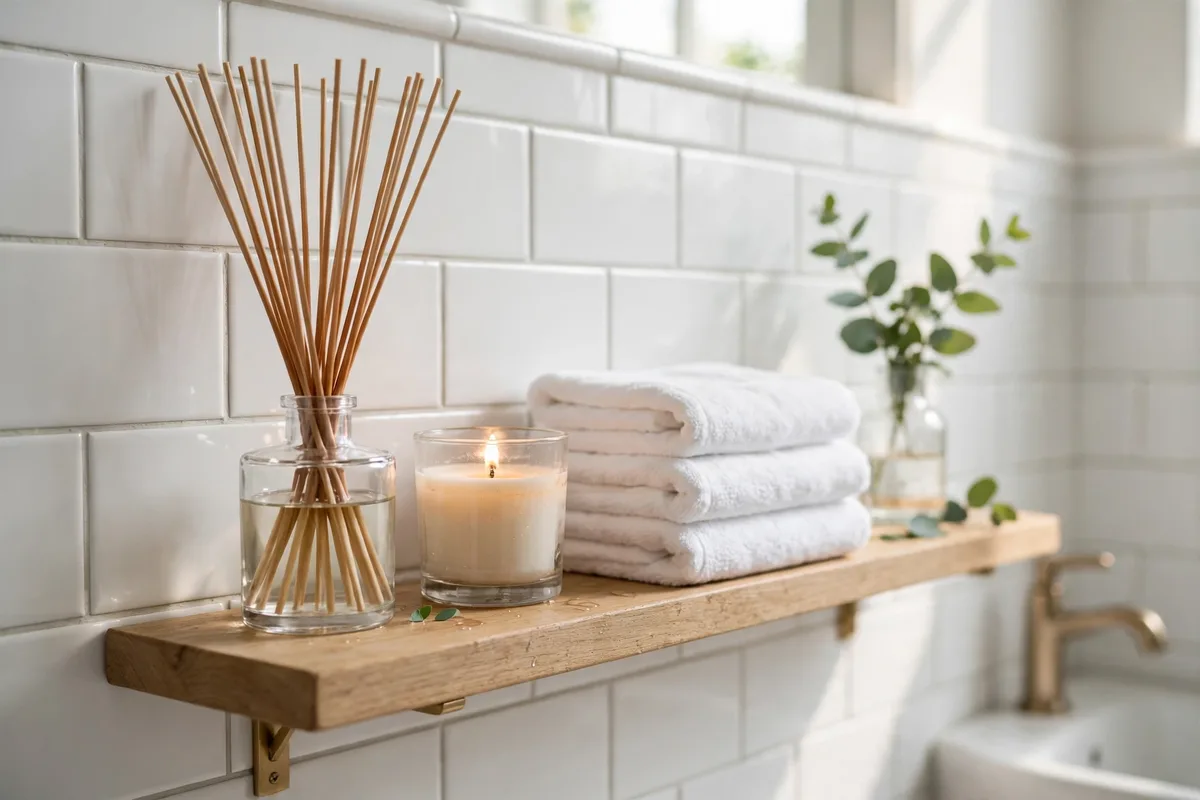
A reed diffuser is the best format for a bathroom, and it is the natural choice for everyday freshness. It works all day and all night, without a flame, without needing to be lit or watched, and it gives a steady, even scent that builds slowly. That steadiness is exactly what a bathroom needs, because the room is used in short bursts through the day and the scent needs to be there when you walk in, not only when you remember to light something. A diffuser also suits a bathroom shared with a household, because its strength can be set precisely: four to six reeds for a small bathroom, which is what the diffuser guides checked for this article recommend for small rooms, and the reeds can be removed entirely if the room needs a break. Our guide to the best reed diffusers for UK homes and flats covers sizes, reed counts and label checks by room, including the bathroom.
A scented candle is the best format for a bath. The flame, the warm light and the scent together make the room feel different in a way a diffuser cannot, and that is why candles suit a bath, when the room is used for relaxing, and why they suit a spa-style evening. A candle also gives you control: light it when you want scent, blow it out when you do not, and the scent fades within an hour. The trade-off is the safety rule stated above: a candle must be lit only while you are in the room, and it must never be left burning in an empty bathroom. A candle also needs time to work, so light it ten or fifteen minutes before you get into the bath, not as you step in, and enjoy it while you soak. The full buying guide, including size against room and how to judge hot throw, is in our guide on how to choose a scented candle.
Wax melts are the third option, and they suit a bathroom well because they release scent fast in a small room. A wax melt warmer, used for an hour before a bath or while you get ready in the morning, will fill a small bathroom quickly, and the scents most often named for bathroom wax melts in the guides checked for this article are eucalyptus, ocean breeze, cucumber and peppermint, all light and clean families. The trade-off is that wax melts need to be switched off, and they release scent faster than a candle, which can be too much in a very small bathroom. If you use them, use them for a short time, and switch the warmer off well before you leave the room.
Room sprays and electric diffusers are less suited to a bathroom as the main format. A room spray gives a burst of scent that fades fast, and it needs to be used every time the room is used, which makes it a good second format for guests but not usually the first one to buy. An electric diffuser needs power and water, and it releases scent in bursts that can be too strong for a small, steamy room. If you use either, use it as a top-up, not as the main scent, and keep it away from water.
The combination that works best in most bathrooms is a diffuser for everyday freshness and a candle for the bath. The diffuser keeps the room gently scented all day, and the candle adds warmth and presence for a soak. The two should be the same family, or from the same mood, so they do not fight each other. A eucalyptus diffuser and a lavender and eucalyptus candle is a coherent pair. A citrus diffuser and a spicy candle is not.
Placement: Where the Scent Goes in a Bathroom
A good scent in the wrong place is wasted, and in a bathroom the wrong place can also be unsafe. Scent travels on moving air, and in a bathroom the air moves in ways that are easy to miss. The diffuser or candle should sit where the air moves gently past it, not where the air is still and not where it is blasted by steam or by the extractor fan.
The best spot in most bathrooms is a shelf or a windowsill at about waist height, away from the shower and the bath, and in the path of the gentle air that moves through the room. A diffuser on a shelf near the door, on the opposite side of the room from the shower, will scent the room well, because the air moves from the door towards the extractor fan and carries the scent with it. A candle on a shelf or a stool beside the bath, lit while you soak and blown out when you get out, works for the bath, provided it is stable, on a heatproof surface, and out of reach of water.
Three places waste scent and should be avoided. The first is right next to the shower or the bath, where the steam and the splashing will soak the reeds or the wick, dilute the oil, and make the product run out in weeks rather than months. The second is directly under the extractor fan, where the fan will pull the scent straight out of the room before it has a chance to spread. The third is beside a radiator or a heated towel rail, where the heat speeds up evaporation and the scent disappears in days rather than weeks, and where the heat can also make a candle burn unevenly.
One more placement rule matters for safety. A diffuser should never sit where it can be knocked into the bath or the sink, because spilled diffuser oil stains wood and fabric and is not safe to swallow, and a candle should never sit where water can splash onto it, where it can be knocked over by a towel, or where a child can reach it. A candle should never be placed on the edge of the bath itself, where it can be knocked into the water, and a diffuser should never sit on the floor, where it can be kicked over in the dark.
In a bathroom with no window, placement matters even more, because the extractor fan is the only air movement in the room. A diffuser near the door, where the air enters, will scent the room better than a diffuser next to the fan, where the scent is pulled out. In a bathroom with a window, the diffuser should sit away from the window, on the opposite side of the room, where the air is calmer, because a draught from an open window will carry the scent out of the room.
UK Bathrooms: Small Rooms, No Windows and En-Suites
British bathrooms are not all the same, and the differences change the scent choice. Four types come up again and again, and each one needs a slightly different approach.
Small bathrooms in flats and terraces are the most common British bathroom, and they are the easiest to over-scent. A small bathroom needs a light touch: a small diffuser with four to six reeds, a small candle, or a light family such as citrus, linen or sea salt. A heavy sweet candle, or a large diffuser with all ten reeds in, will overwhelm a small bathroom within minutes, and the scent will become cloying rather than clean. If your bathroom is small, start with the lightest option you think might work, and add strength only if the room still smells of nothing after an hour. It is much easier to add scent than to remove it, and in a bathroom, where the steam amplifies everything, that matters more than anywhere else.
Bathrooms with no window are common in British flats, and they need a fresh scent more than any other bathroom, because the room never gets fresh air. A citrus or eucalyptus diffuser is the best choice here, because it makes the room feel aired even when it is not. A linen diffuser is the second best choice, because it smells clean without smelling perfumed. Avoid warm, sweet families in a windowless bathroom, because they will build up in the still air and make the room feel stuffy. Keep the extractor fan running for twenty minutes after a shower, and let the diffuser do the rest.
En-suites have a different problem: the bathroom pulls air and scent away from the bedroom, and the humidity from the bathroom can make the bedroom feel damp. A diffuser in the bedroom and a small diffuser in the en-suite, in the same family, will scent both spaces more evenly than one large candle in the bedroom. A fresh family, such as eucalyptus or a light citrus, suits the en-suite in the morning, while a calm family, such as lavender or sandalwood, suits the bedroom at night. The two should not fight each other, so keep the en-suite scent light and let the bedroom scent lead. Our guide to the best scents for the bedroom covers the bedroom side of this pairing in more detail.
Family bathrooms and downstairs cloakrooms are the bathrooms used by the most people, and they need the most neutral scent. A family bathroom needs a fresh, clean scent that everyone can live with, such as citrus, linen or sea salt, and it needs a diffuser rather than a candle, because a candle in a room used by children is a risk that is not worth taking. A downstairs cloakroom, used by guests, needs the lightest touch of all: a small diffuser with three or four reeds, in cotton or linen, and nothing else. A cloakroom that smells strongly of anything, even something pleasant, will be noticed for the strength before the scent.
Choosing by Situation: A Decision Table
The job and the family are only half the decision. The situation changes the choice, because the same bathroom needs a different scent for a morning shower than it does for a relaxing bath. The table below covers the situations that come up most often, and the choice that suits each one.
| Situation | Best job | Best families | Best format |
|---|---|---|---|
| Everyday freshness | Fresh | Citrus, linen, sea salt, eucalyptus | Reed diffuser, 4 to 6 reeds |
| A relaxing bath | Spa | Lavender, eucalyptus, chamomile | Candle lit while you soak, then blown out |
| A guest bathroom | Welcome | Cotton, linen | Diffuser with 3 to 4 reeds |
| A bathroom with no window | Fresh | Citrus, eucalyptus | Diffuser, 4 to 6 reeds, fan on after showers |
| A small flat bathroom | Fresh | Citrus, linen, sea salt | Diffuser with 4 reeds, or wax melts for an hour |
| A family bathroom | Fresh | Citrus, linen, sea salt | Diffuser only, no candle with children around |
| An en-suite | Fresh | Eucalyptus, light citrus | Small diffuser, same family as the bedroom |
| A cold autumn or winter bath | Spa | Lavender, eucalyptus, warm wood blend | Candle for the bath, diffuser for the day |
| A warm summer morning | Fresh | Citrus, mint, cucumber | Diffuser with fewer reeds, window open |
| A downstairs cloakroom | Welcome | Cotton, linen | Diffuser with 3 to 4 reeds |
Two points in the table deserve a closer look. The first is a family bathroom, where children are using the room. A candle in a family bathroom is a risk that is not worth taking, because children can knock it over, reach it, or leave it burning. A diffuser is the safe format for a family bathroom, and it is also the format that suits the room best, because it works all day without needing to be lit or watched. If you want a candle for a bath, save it for a bath when the children are not in the room, and blow it out before you leave.
The second point is a bathroom with no window. The temptation is to buy a stronger scent to make up for the lack of fresh air, but that is the wrong instinct. A strong scent in a small, windowless room will build up and become cloying, and it will make the room feel stuffier, not fresher. A light, fresh scent, in a diffuser with four to six reeds, is the right strength for a windowless bathroom, and the extractor fan, run for twenty minutes after a shower, does more for freshness than any scent can.
If It Still Smells: Scent Is Not a Fix
This is the section the seller pages checked for this article do not give plainly, and it is the most important section in this guide for a bathroom that smells wrong. Scent masks a smell. It does not fix the cause of it, and a bathroom that smells of damp, mould or drains will keep smelling of damp, mould or drains no matter how strong the diffuser is. A stronger scent on top of a damp smell does not make a clean bathroom. It makes a bathroom that smells of damp and lavender, which is worse.
If the bathroom smells musty, find the cause before you buy a scent. Check for damp around the bath and the shower, for mould on the sealant and the grout, for a leak under the sink or behind the toilet, and for a blocked or slow drain. Clean the mould, fix the leak, clear the drain, and let the room dry. Run the extractor fan for twenty minutes after every shower, and leave the bathroom door open after a bath so the steam can escape. Only then, when the room smells of nothing, should a scent be added, and then a light, fresh one will be enough.
If the smell is coming from the drains, the cause is usually a dry trap or a blocked pipe, and no scent will fix it. Run water down every drain in the room, including the bath and the sink, and if the smell does not go, call a plumber. If the smell is damp, the cause is usually poor ventilation, and the fix is to improve it: a better extractor fan, a window opened after showers, or a dehumidifier in a bathroom that never dries. Scent is the last step in a bathroom that smells right, not the first step in a bathroom that smells wrong.
The Mistakes That Waste Money and Scent
Most disappointing bathroom scents are not bad scents. They are good scents chosen for the wrong job, used in the wrong strength, or placed where the steam destroys them. These are the mistakes to avoid.
Choosing by name, not by family. A scent called Ocean Paradise or Spa Retreat could be anything. Choose by the family underneath the name, and by the job you want, not by the prettiest name on the jar. The label usually lists the notes, and the notes tell you the family.
Buying too strong for a small, steamy room. A heavy sweet candle, or a diffuser with all the reeds in, will overwhelm a small bathroom within minutes, and the steam will amplify it further. Match the strength to the room, and start light. In a bathroom, the cost of too strong is a room that smells cloying every time you walk in, which is a higher price than in any other room.
Placing the diffuser next to the shower or under the fan. Steam soaks the reeds and dilutes the oil, and the fan pulls the scent straight out of the room. Place the diffuser near the door, away from the shower and away from the fan, where the air moves gently past it.
Leaving a candle burning in an empty bathroom. This is not a mistake about scent. It is a safety mistake, and it is the one mistake in this guide that can cause real harm. Always blow the candle out when you get out of the bath, even if you are only going to be gone for a few minutes. If you are the kind of person who forgets, use a diffuser for the bathroom instead of a candle, and save the candle for a bath when you are sure you will stay in the room.
Using a scent to cover a damp or drainage smell. Scent masks a smell. It does not fix damp, mould or a blocked drain, and a stronger scent on top of a damp smell makes the room smell worse, not better. Find and fix the cause first, then add scent.
Mixing two moods in the same room. A fresh citrus diffuser and a heavy spicy candle burning in the same bathroom will fight each other. One family per room, or one family across the home with different expressions of it, is the rule that keeps a home smelling deliberate rather than confused. Our guide on how to choose a scented candle covers the one-family-per-room rule in more detail.
Never trimming the wick. A long wick burns hot and fast, soots the glass, and shortens the candle’s life. Trim to about 5mm before every burn. The full care routine is in our guide on how to make a scented candle last longer.
Choosing a scent that fights your household’s preference. A bathroom is shared, and a scent that one person loves and the other hates will cause more trouble than it is worth. Choose a scent everyone can live with, even if it is not your first choice. Citrus and linen are the two families most households can agree on.
Starter Combinations for a Bathroom
If you are starting from nothing and want a combination that works, the three below are safe, tested starting points. Each one is a single family across the room, with a diffuser for everyday freshness and a candle for the bath, and each one suits a different kind of bathroom.
The fresh starter: citrus and sea salt. A citrus and sea salt diffuser for everyday freshness, with four to six reeds, and a citrus candle for a bath, lit while you soak and blown out when you get out. This suits a bathroom used mainly for showers and mornings, a small bathroom, a bathroom with no window, and a household where freshness matters more than atmosphere. It is the safest combination in this guide, and the one to choose if you are unsure.
The spa starter: eucalyptus and lavender. A eucalyptus diffuser for everyday freshness, with four to six reeds, and a lavender and eucalyptus candle for a bath. This suits a bathroom used for relaxing baths, a room where you want the scent to feel calm as well as clean, and autumn and winter. It is the best combination for a bathroom that needs to feel like a spa on a cold evening.
The guest starter: linen and cotton. A linen diffuser for everyday freshness, with three or four reeds, and no candle at all, or a linen candle for a bath only. This suits a guest bathroom, a downstairs cloakroom, a bathroom shared with someone sensitive to scent, and a household where the scent should be barely there. It is the lightest combination in this guide, and the one to save for the rooms where the scent should be noticed least.
Each starter can be adjusted. If the room is small, use fewer reeds in the diffuser and a smaller candle. If the room is large or has a big window, use more reeds, or a larger candle, or a second diffuser on the far side of the room. If the season changes, rotate the family: fresh and light in spring and summer, warm and calm in autumn and winter, and a soft linen all year round for guests. Store the diffuser or candle you are not using with the lid on in a cool cupboard, and it will keep its scent for months.
Seasonal Starting Points for November
November is the month when British bathrooms change. The evenings are dark, the heating is on, and the bath is used more in the evening than it was in summer. The scent should change with it. The fresh families that suited the room in June, citrus and linen, will still work in November, because a bathroom always needs freshness, but the bath scent should get warmer: lavender with eucalyptus, a soft amber blend for a long evening bath, or a warm wood candle lit while you soak.
For November specifically, the families to start with are the fresh ones for the day and the calm ones for the bath: a citrus or eucalyptus diffuser for everyday freshness, and a lavender and eucalyptus candle for the bath. A candle suits November better than a diffuser for the bath, because the flame adds to the mood of a dark evening, though a diffuser is still the format that carries the scent through the day. If you have been using a fresh scent all summer, do not throw it away. Keep it for the daytime, and add a warmer candle for the bath, and the room will feel seasonal without needing a different scent for every month.
The seasonal rotation does not need to be complicated. One fresh family for the day, one calm family for the bath, and one soft family for guests all year round is enough. The rotation keeps the home feeling seasonal without needing a different scent for every month, and it stops the household going nose blind to a single scent that never changes, which is the reason many people stop noticing their own home scent altogether.
Frequently Asked Questions
What is the best scent for the bathroom?
There is no single best scent, because the right scent depends on the job. For everyday freshness, citrus, linen, sea salt or eucalyptus. For a relaxing bath, lavender, eucalyptus or chamomile. For a guest bathroom, cotton or linen. Start with the job, then the family, then the format. If you need one safe answer, citrus is the safest bathroom scent, because it is the most recommended fresh scent in the guides checked for this article, and it is one of the least divisive scents.
Should I use a candle or a diffuser in my bathroom?
Both, for different jobs. A reed diffuser is best for everyday freshness, because it works without a flame and gives a steady, even scent all day. A candle is best for a bath, because the flame and the scent together make the room feel calm and special. Use a diffuser for the day and a candle for the bath, in the same family so they do not fight each other, and always blow the candle out when you get out of the bath. Our guide to the best reed diffusers for UK homes and flats covers sizes and reed counts by room.
Can I leave a candle burning in the bathroom?
No. Never leave a candle burning in an empty bathroom, and never leave a lit candle unattended near water. Light it while you are in the bath, enjoy it while you soak, and blow it out when you get out. A reed diffuser is the safe option for scent that carries on through the day, because it has no flame and nothing to watch.
Why does my bathroom scent smell too strong?
The most common reason is that the room is small and steamy, so the scent has nowhere to go and the steam amplifies it. A diffuser with too many reeds, or a candle that is too large for the room, will build into something cloying within minutes. The other common reason is placement next to the shower, where the steam soaks the reeds and the scent comes off in bursts. Move the diffuser to the far side of the room, near the door, remove two or three reeds, and open the window or run the fan for ten minutes after a shower to let the room air.
How many reeds should I use in a bathroom diffuser?
Four to six reeds for a small bathroom, which is what the diffuser guides checked for this article recommend for small rooms. Start with four, and add one or two only if the room still smells of nothing after a day. Fewer reeds also make the diffuser last longer, which matters in a steamy room where evaporation is faster. The size-to-room maths, including reed counts by room, is in our guide to the best reed diffusers for UK homes and flats.
What scent is best for a small bathroom?
A light, fresh scent, in a small format. Citrus, linen or sea salt suits a small bathroom best, because they do not overwhelm a small space. Use a small diffuser with four reeds, or a small candle for a bath only, and start with the lightest option you think might work. A heavy sweet candle or a large diffuser will overwhelm a small bathroom within minutes, and the steam will amplify it further. The size-to-room maths, including candle sizes by room, is in our guide on how to choose a scented candle.
What scent is best for a guest bathroom?
Cotton or linen, in a diffuser with three or four reeds, and nothing else. A guest bathroom needs the lightest touch of all, because the scent should be barely there: clean, neutral, inoffensive. A guest who walks into a bathroom that smells strongly of anything, even something pleasant, will notice the strength before the scent. A linen diffuser, running for a day before guests arrive, gives the room time to fill gently, and the scent will be at its best when they walk in.
My bathroom still smells after I add scent. What should I do?
Find the cause before you buy a stronger scent. Check for damp around the bath and the shower, for mould on the sealant and the grout, for a leak under the sink or behind the toilet, and for a blocked or slow drain. Clean the mould, fix the leak, clear the drain, and let the room dry. Run the extractor fan for twenty minutes after every shower. Scent masks a smell. It does not fix damp, mould or drainage, and a stronger scent on top of a damp smell makes the room smell worse, not better.
Choose the Job, Then the Family, Then the Format
The best scent for a bathroom is not a name on a jar. It is a decision in three steps, and the order matters. Pick the job first: everyday freshness, a relaxing bath or a light welcome for guests. Then pick the family that does that job: citrus, linen, sea salt and eucalyptus for freshness; lavender, chamomile and soft florals for a bath; cotton and linen for guests. Then pick the format that survives steam and humidity: a diffuser for everyday freshness, a candle for an attended bath only, and wax melts for a quick burst of scent before a bath.
Match the strength to the room, not to the jar. A small bathroom needs a light touch, a bathroom with no window needs a fresh family and a fan that runs after every shower, and an en-suite needs a scent in both spaces in the same family. Place the diffuser or candle where the air moves gently, away from the shower, away from the extractor fan, and away from radiators and heated towel rails, and keep to one family per room so the home smells deliberate rather than confused.
Start with one of the starter combinations above, live with it for a week, and notice when you reach for it and when you do not. The right bathroom scent is the one you stop noticing after ten minutes and still enjoy when you walk back in from outside. That is the scent that suits your room, and no list can choose it for you.
Sources
The scent-family consensus in this article restates the consensus of the six bathroom guides checked on 14 Nov 2026: Bathing Solutions, “8 Best Scents for Your Bathroom”; In The Wash, “Best Air Fresheners for the Bathroom”; Mira Showers, “Bathroom Scents Guide”; Affinati Living, “Best Reed Diffusers for UK Homes and Flats”; Fairmoore, “How to Make Your Bathroom Smell Like a Spa”; and Aroma Desire, “Best Reed Diffuser Scents for Every Room UK”. The antibacterial claims about tea tree and eucalyptus are attributed to those sources, not presented as this site’s own findings. The room-size guidance, reed-count guidance and care routine are cross-checked against our own live guides on this site, linked above. No claim here is presented as our own survey or test, and no volume or keyword difficulty figure is stated, because none has been verified.