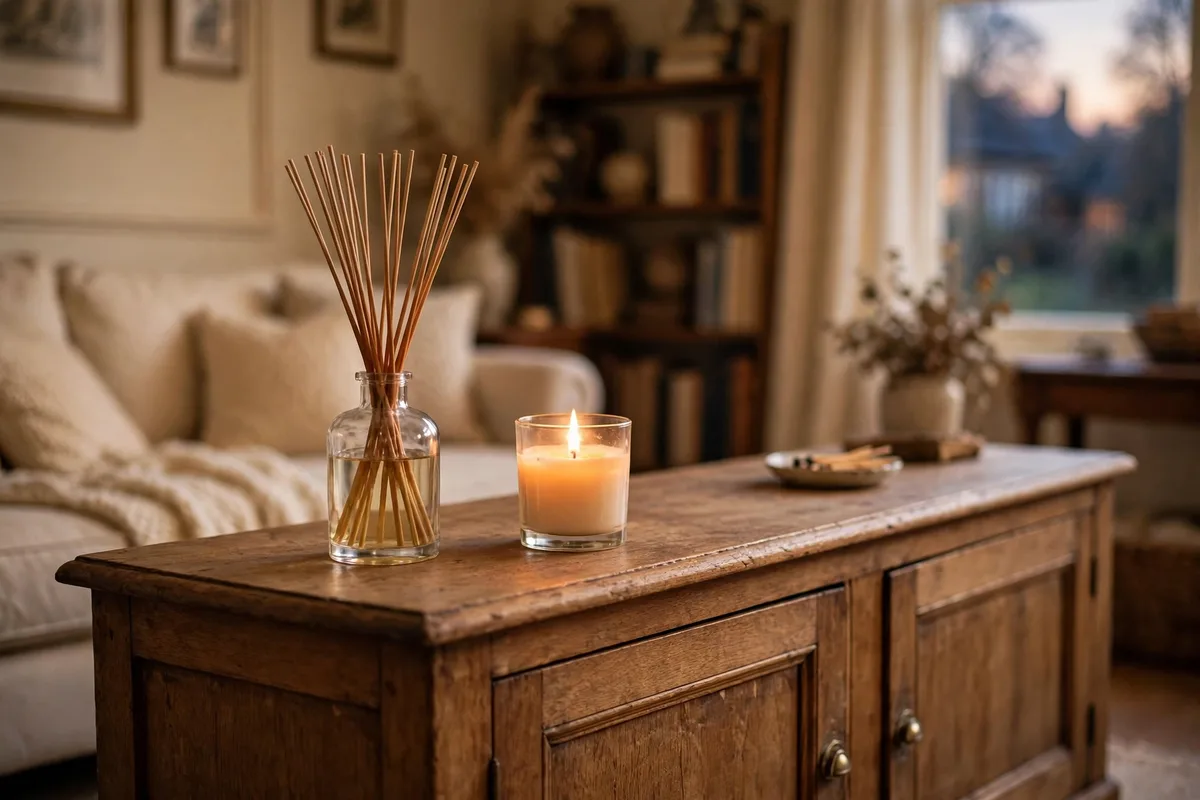
Quick answer: A reed diffuser and a scented candle do different jobs, and that is the whole answer in one line. A reed diffuser scents a room continuously, all day and all night, with no flame and no effort, but gently. A scented candle scents a room strongly and only while it is lit, and it adds light and atmosphere no diffuser can match. Neither one is better in general. A diffuser is better for background scent, for rooms you walk through, for homes with children or pets, and for anyone who wants scent without a task. A candle is better for an evening, for a large room, for a special occasion, and for anyone who wants scent they can feel the moment it is lit. Most homes end up using both, in different rooms and at different times of day, and this guide shows how to decide room by room, what each one costs per month, and how to use them together without the two scents fighting.
Walk into any home fragrance shop in the UK and you will face the same choice, and it is a choice most people make by habit rather than by thinking. A candle is bought because it smells wonderful in the shop, it is lit in a room that is too big for it, and then it is blamed when the room smells of nothing. Or a diffuser is bought because it looks elegant on a shelf, it is placed in a draughty hallway, and then it is blamed when it empties in a month and smells of almost nothing. The product was never the problem. The job was, and the job was never matched to the format. This guide matches them, and it is built on the consensus of the guides checked on 20 November 2026: Chantic Home, Matty’s Candles, Suffolk Candles and The Urban Escape. Where a source describes a product or a rule in a particular way, that is reported here as the source’s description, not as a fact this site has tested. No seller’s own product picks are presented here as recommendations. Only scent families, formats and the maths are used.
The One-Line Difference: Continuous vs Occasion
The difference between the two formats is a difference in time, and once that is clear, every other difference follows from it. A reed diffuser works all the time. Fragrance oil travels up the reeds by capillary action and evaporates into the room, hour after hour, whether anyone is in the room or not, whether anyone remembers it or not. It has no switch, no flame and no timer. It is a background. A scented candle works only while it is lit. The flame melts the wax, the warm wax releases the fragrance, and the moment the flame is blown out, the scent begins to fade. It is an occasion. That is the whole difference, and it is the difference that decides everything else: strength, cost, safety, effort and which room each one suits.
Think of it the way the guides checked for this article describe it. The Urban Escape puts it plainly: a diffuser is the welcoming note that is already there when you come home, and a candle is more like drawing the curtains, putting your phone aside, and giving the evening a little more attention. Chantic Home makes the same point in their comparison: candles give a strong scent and ambience for a set period, while diffusers give a steady, subtle scent that maintains a consistent atmosphere all day. Suffolk Candles add the practical consequence: a diffuser releases scent all day rather than only when lit, so if the only goal is to keep a loved scent in the home, a diffuser may be the better choice, while a candle is the better choice when the goal is atmosphere for an evening.
The time difference also explains the strength difference. A candle is strong because it is concentrated: all of its scent is released in the hours it burns, carried on warm air rising from the flame. A diffuser is gentle because it is spread out: the same amount of fragrance is released slowly, over weeks, into the same room. Neither one is faulty for behaving this way. A diffuser that smells subtle is doing its job. A candle that stops scenting a room when it is blown out is doing its job. The disappointment comes only when a buyer expects one format to behave like the other, and the fix is to choose the format for the job, not to blame the product for its nature.
There is a second difference worth stating early, because it shapes the whole decision: a candle changes a room in two ways, and a diffuser changes it in one. A candle gives scent and light, and the light matters. The flicker of a flame changes the mood of a room in a way no diffuser can replicate, and for many buyers that is the real reason they buy candles at all. A diffuser gives scent only, and it gives it quietly, without drawing attention to itself. That is not a weakness. It is the reason a diffuser suits rooms where the scent should be noticed on arrival and forgotten once you sit down, and the reason a candle suits rooms where the evening itself is the event.
Head to Head: The Whole Comparison in One Table
The table below is the whole guide in one place. The sections after it explain each row, because the rows interact with each other, and a single row read on its own can mislead. A diffuser wins on lifespan, but a candle wins on strength. A diffuser wins on safety, but a candle wins on ambience. The table is the starting point. The decision comes from the rooms and the life that follows it.
| What matters | Reed diffuser | Scented candle |
|---|---|---|
| How it works | Reeds draw oil up and release scent continuously, no heat, no flame | A lit wick melts wax and releases scent only while burning |
| Scent strength | Gentle, steady background scent | Strong, fast, fills a room while lit |
| Best space size | Small to medium rooms; struggles in large open-plan spaces | Medium to large rooms; a small candle can overwhelm a tiny room |
| Lifespan | 6 weeks to 3 months per 100ml bottle, continuous use | 20 to 50 hours of burn time per standard candle |
| Cost per month | Roughly £5 to £12 a month (worked example below) | Roughly £8 to £30 a month, depending on how often it is lit (worked example below) |
| Effort | Almost none: flip reeds weekly, replace reeds with each refill | Trim the wick to 5mm, first burn 2 to 4 hours, never leave unattended |
| Safety | No flame; oil is flammable, keep away from lit candles and out of reach of children and pets | Open flame; never leave burning unattended, never burn overnight, keep away from curtains, children and pets |
| Ambience | None: scent only | Warm flickering light, the main reason many people choose candles |
| Flexibility | One scent per bottle for weeks; changing scent means a new bottle or a clean and refill | Easy to change: a different candle each evening, or each week |
| Best for | Hallways, bathrooms, bedrooms overnight, home offices, background scent | Living rooms in the evening, occasions, guests, large rooms |
Three things to notice in the table before reading on. First, the two formats win different rows, and the rows they win are the rows that matter for different jobs, which is why the question “which is better” has no single answer. Second, cost per month depends far more on how often a candle is lit than on the price of the candle, because a candle that is lit every evening costs several times more per month than a candle lit twice a week, while a diffuser costs the same every month whatever you do. Third, the safety row is not a tiebreaker to be read once and forgotten. It is the row that decides the answer for any home with small children, pets, or rooms where nobody is watching, and it is covered in full later in this guide.
Scent Strength: Strong Burst vs Steady Background
Scent strength is the row most buyers care about first, and it is the row most often misunderstood, because strength and presence are not the same thing. A candle has the stronger throw. The heat from the flame melts the wax and disperses fragrance molecules into the air quickly, and a candle lit in a room will be noticeable within minutes, as Chantic Home note in the guide checked for this article, and as Matty’s Candles describe when they call the candle’s scent throw intense and immediate. A diffuser has the steadier presence. It releases fragrance gently and continuously, and it is there when you walk in, without any action at all. The strength it gives is the strength of a room that always smells faintly of something pleasant, not the strength of a room that suddenly smells of something wonderful.
The practical consequence is about room size. A diffuser suits a small to medium room, because its gentle release is enough to fill a small volume of air, and it can be set precisely by adding or removing reeds. A bathroom needs three or four reeds, not the full set. A bedroom needs three or four reeds, and a hallway needs the full set, because a hallway is draughty and the scent has to hold its own against the air that comes in every time the door opens. A candle suits a medium to large room, because its strong throw can fill a larger volume of air while it burns, and a standard candle of 180g to 220g suits an average living room, while a large open-plan space will usually need a large candle of 300g or more, or two standard candles burning at opposite ends of the room. The full size-to-room maths for candles is in our complete guide to scented candles, and the reed-count maths for diffusers is in our guide on how long reed diffusers last.
There is also a test that settles the strength question for any room, and it is the test every guide checked for this article agrees on: walk into the room from another room, and notice what you smell in the first five seconds. That is the strength that matters, not the strength you smell when you stand next to the diffuser or lean over the candle. A diffuser that is noticeable on arrival and forgettable once you sit down is at the right strength. A candle that fills the room within half an hour of lighting and is still pleasant after two hours is at the right strength. If you can smell the diffuser clearly when you sit down in the room, it is too strong, and the fix is to remove one or two reeds. If a candle smells of nothing after an hour of burning, the room is too big for it, and the fix is a larger candle, a second candle, or a switch to a diffuser for that room.
One more point about strength is worth making, because it is the point the guides checked for this article return to most often: a diffuser cannot be turned up for an occasion, and a candle cannot be turned down to background. A diffuser that is too subtle for a dinner party cannot be made stronger in an hour. It can have its reeds flipped for a burst, but the burst is small and short. A candle that is too strong for a small room cannot be made gentler except by blowing it out, or by choosing a smaller candle next time. That is why the decision matters before the purchase, and why the room table later in this guide is the most useful part of it.
Lifespan: Weeks of Background vs Hours of Occasion
Lifespan is the row where the two formats look most different, and it is the row where the comparison is most often stated wrongly, because the two lifespans are measured in different units. A diffuser is measured in weeks. A standard 100ml reed diffuser usually lasts between six weeks and three months in an average UK home, with smaller 50ml bottles lasting around four to six weeks and larger 200ml bottles stretching to three or four months. A candle is measured in hours. A standard candle gives around 20 to 50 hours of burn time, depending on its size and wax, and the hours are only used while it is lit. A diffuser that lasts two months has been working for more than 1,400 hours. A candle that lasts 40 hours has been working for 40 hours. The diffuser lasts longer in the calendar, and the candle gives more scent per hour. Both statements are true, and the useful question is not which lasts longer, but which kind of lasting the room needs.
The factors that decide a diffuser’s lifespan are heat, sunlight, draughts, reed count, reed condition, fragrance type and room size, and the full detail, including the lifespan table by bottle size and the six factors that shorten a bottle’s life, is in our guide on how long reed diffusers last. The short version is that a diffuser on a sunny windowsill or above a radiator evaporates far faster than one in a cool, shaded spot, and a diffuser with the full set of reeds in a draughty hallway will empty noticeably faster than the same diffuser on a still shelf. A candle’s lifespan is decided by its size, its wax and how it is burned, and the full care routine, including the first burn, the wick trim and the session length, is in our complete guide to scented candles. The short version is that a candle given a full first burn of two to four hours, with its wick trimmed to about 5mm before each burn and sessions kept under four hours, will last its full stated burn time, while a candle burned in short sessions will tunnel, waste wax, and finish early.
The practical rule for choosing on lifespan is simple. If the room needs scent every day, all day, a diffuser is the format that gives it, because it works while nobody is thinking about it, and it needs replacing only every few months. If the room needs scent for a few hours at a time, a candle is the format that gives it, because it can be lit for the evening and blown out when the evening ends, and it will still be there next week, ready to be lit again. A diffuser in a room that is used once a week is wasted money, because it keeps evaporating whether anyone is there or not. A candle in a hallway that needs scent all day is a poor choice, because it would have to be lit all day, which is neither safe nor practical.
Cost Per Month: Worked Examples, Not Promises
Cost is the row where a worked example is worth more than a general claim, because the answer changes so much with how the products are used. The figures below are illustrative worked examples, using typical UK price ranges and the lifespans the guides checked for this article agree on. They are not a survey, and they are not prices for any particular brand. Prices vary by maker, by size and by where they are bought. The maths shows the method. Put in the prices of the products you actually buy, and the method gives your answer.
A reed diffuser, worked example. Take a typical 100ml diffuser costing £15 to £25, lasting two to three months in an average room. At two months, that is £7.50 to £12.50 a month. At three months, it is £5 to £8.30 a month. So a diffuser costs roughly £5 to £12 a month, and the range is set mostly by how long the bottle lasts, which is set mostly by where it is placed. A diffuser in a cool, shaded hallway at the long end of its life costs about half as much per month as the same diffuser in a warm, sunny living room at the short end. The other cost is the reeds: a fresh set with every refill, usually a pound or two, and the refill oil itself, which is usually cheaper than a whole new diffuser. Refills are covered in our guide on how long reed diffusers last, including when to refill and when to replace the bottle instead.
A scented candle, worked example. Take a standard 180g to 220g candle costing £15 to £30, with 40 to 50 hours of burn time. How much it costs per month depends entirely on how often it is lit, and that is the point. Lit for two hours, five evenings a week, it burns about 40 hours a month, which is one candle a month, or £15 to £30 a month. Lit for two hours, three evenings a week, it burns about 24 hours a month, which is one candle every two months, or roughly £7.50 to £15 a month. Lit for two hours, one evening a week, it burns about 8 hours a month, which is one candle every five or six months, or roughly £3 to £6 a month. So a candle costs anywhere from £3 a month to £30 a month, and the difference is not the price of the candle. It is the habit of the person lighting it.
The comparison, honestly stated. A diffuser costs roughly the same every month, whatever you do, because it works all the time. A candle costs as much as your evenings cost, because it works only when you light it. For a home that wants background scent in a hallway or a bathroom all day, every day, a diffuser is usually the cheaper format, because one bottle covers two or three months of continuous scent for £5 to £12 a month. For a home that wants a candle lit two or three evenings a week in the living room, a candle is usually no more expensive than a diffuser, and it gives light and atmosphere the diffuser cannot. For a home that lights a candle every evening for three or four hours, the candle will be the more expensive format by a clear margin, and that is a fair price to pay for an evening ritual, but it should be a price paid knowingly, not discovered afterwards.
Two cautions belong with the maths. First, a cheap candle is not a cheap month. A candle that tunnels because its first burn was too short, or that soots because its wick was never trimmed, wastes wax and finishes early, and a candle finished early is a candle bought again sooner. The care routine in our complete guide to scented candles is what makes the worked example come true. Second, a diffuser that is placed badly is not a cheap month either. A diffuser on a radiator or in direct sun can empty in weeks instead of months, and a bottle emptied in a month costs two or three times as much per month as the same bottle placed well. Placement is covered in our guide on where to place a reed diffuser, and it is the cheapest saving in home fragrance.
Effort and Maintenance: Set and Forget vs A Small Ritual
Effort is the row where the two formats are furthest apart, and it is the row that decides the answer for busy people more than any other. A diffuser asks almost nothing. Once it is placed, it works. The routine is to flip the reeds about once a week, turning them so the oil-soaked ends face up, which gives a burst of fragrance and keeps the scent steady. Reeds need replacing every two to three months, or with every refill, because their tiny channels clog with dust and dried oil, and a diffuser with old, clogged reeds can look half full while smelling of almost nothing. That is the whole routine, and it takes about a minute a week. Suffolk Candles describe it plainly in the guide checked for this article: reed diffusers require less maintenance than candles, as they only need to be flipped or replaced occasionally.
A candle asks for a small ritual, and the ritual is the price of the stronger scent. Before each burn, the wick is trimmed to about 5mm, because a long wick makes a tall, flickering flame that smokes and soots. The first burn of a new candle should last two to four hours, long enough for the melt pool to reach the edges of the container, because a first burn that is too short leaves a ring of unmelted wax that the candle will never recover from, and the candle will tunnel for the rest of its life. Sessions should be kept under four hours, because a candle burned too long overheats its jar, destroys its fragrance in the heat, and soots. The candle must be watched while it burns, and blown out when the room is left empty, and that watching is not a chore to be resented. It is the format. A candle is a small ritual, and a buyer who does not want a ritual should buy a diffuser.
The practical consequence is about routine. A diffuser suits a person who wants scent without a task: someone who works long hours, someone who travels, someone who wants the hallway to smell pleasant without thinking about it. A candle suits a person who enjoys the ritual: someone who lights a candle when they come home, who trims the wick and watches the flame, and who treats the lighting as part of the evening. Neither routine is better. They are different ways of living with scent, and the honest question is which one fits the life that is actually being lived, not the life that is imagined on a quiet Sunday.
Safety: The Row That Decides for Many Homes
Safety is the row where the two formats differ most sharply, and it is the row that should be read first by any home with small children, pets, or rooms where nobody is watching. The rule for candles is simple and absolute: a candle must never be left burning in an empty room, and never be left burning overnight. A candle is an open flame, and an open flame near curtains, bedding, paper, or a pet that jumps onto a table is a risk that is not worth taking. A candle must be placed on a stable, heat-resistant surface, away from draughts that make the flame flicker and smoke, away from anything that can catch, and out of reach of children and pets. It must be blown out when the room is left, when the evening ends, and before sleep. The bedroom rule follows from this directly: a candle in a bedroom is for the hour before bed only, lit while winding down and blown out before sleep, never left burning overnight.
A diffuser has no flame, and that is its great safety advantage. It can be left running in a hallway, a bathroom or a bedroom all day and all night, and it needs no watching. But a diffuser is not free of safety rules, and the rules are worth stating plainly, because they are less well known. Diffuser oil is flammable, so a diffuser must never be placed close to a lit candle, and never on the same shelf or the same table as one. Keep at least a metre between a lit candle and a diffuser. A diffuser must be placed on a stable, level surface where it cannot be knocked over, because spilled oil stains wood and fabric, and it is harmful if swallowed, so a spill must be wiped up at once, and a diffuser must be kept out of reach of small children and pets. The oil must never be poured down a drain or into a sink, and the bottle must be kept upright. The placement rules, including the never list of radiators, direct sun, vents and doors that slam, are covered in full in our guide on where to place a reed diffuser.
For homes with pets, the safety comparison needs care rather than a blanket claim. A candle is a flame risk and a soot risk, and a pet that knocks a candle over, or that breathes soot from a poorly trimmed wick, is at risk. A diffuser is a spill and ingestion risk, and a cat that grooms oil from its paws, or a dog that chews a reed, is at risk. Neither format is risk free, and neither format should be declared safe in general. The honest rule is that a diffuser is the safer format for a room where nobody is watching, because there is no flame to knock over, and a candle is the format that needs a person in the room, watching it, for as long as it burns. The full pet safety guidance, separated by dogs, cats and birds, with sourced advice and a vet disclaimer, is coming in the safety guides later in this series, and this article does not replace it. Until those guides are published, the rule above is the safe rule to follow.
For homes with babies and small children, the same logic applies. A diffuser placed high, on a stable shelf out of reach, is the safer background format for a nursery, because it has no flame and nothing hot to touch. A candle should not be burned in a nursery or in a room where a small child is sleeping, and it should never be left where a child can reach it. For allergy and asthma sensitive homes, neither format can be declared safe in general, and anyone with a respiratory condition should test a new scent briefly, in a ventilated room, before committing to it, and should stop using a product that causes symptoms. That caution applies to both formats equally, and it is not a reason to prefer one over the other. It is a reason to test before buying in quantity.
The Decision, Room by Room
The table below is the most useful part of this guide, because it turns the comparison into a decision for a real house. The rooms are the rooms of a typical UK home, and the recommendation for each room follows from the rows above: the size of the room, how long the scent needs to last, whether anyone is watching, and what the room is for. The full room-by-room matrix of scent families, formats and strengths is in our guide to home fragrance by room, and the detail below is the format decision laid over that matrix, not a replacement for it.
| Room | The winner | Why | The other format’s job |
|---|---|---|---|
| Hallway | Reed diffuser | Needs scent all day, nobody watches it, draughty, first impression in five seconds | A small candle for guests only, lit while they are there |
| Living room | Both, at different times | Diffuser for the day, candle for the evening, same family so they do not fight | Neither is the loser: they take turns |
| Bedroom | Reed diffuser | Needs scent overnight, no flame while sleeping, small still room | A small candle for the hour before bed only, blown out before sleep |
| Bathroom | Reed diffuser | Needs scent when you walk in, used in short bursts, small humid room | None: a candle in a bathroom is a risk near water and steam, and it is rarely worth it |
| Kitchen | Reed diffuser | Needs freshness all day, sits next to food, flame near cooking is a risk | A candle after cooking only, never while food is on the hob; a wax melt for the after-cooking reset |
| Home office | Reed diffuser | Light steady background, room full of paper and cables, nobody wants a flame near work | None: a candle in a room full of paper is a risk that is not worth taking |
| Dining room | Candle, for the meal | Atmosphere for a gathering, lit when people sit down, blown out when they leave | A diffuser in the corner, light, for the hours between meals |
| Guest room | Reed diffuser | Needs scent when a guest walks in, nobody is there to light anything | A candle left as a gift for the guest to light themselves, if they wish |
Two things to notice in the table before reading on. First, the diffuser wins more rooms than the candle, because more rooms need background scent than need occasion scent, and more rooms are unwatched than are watched. That does not make the diffuser the better format in general. It makes it the format to start with, and the candle the format to add where the evening matters. Second, the living room is the only room where both formats are the answer, and it is the room where the combination is most rewarding, because a diffuser for the day and a candle for the evening, in the same family, gives a home that smells deliberate all day and special in the evening, without either format having to do a job it is bad at.
The hallway deserves a word of its own, because it is the room where the wrong choice is most common. A hallway is narrow, draughty, and used in passing, and it is the first air a visitor breathes. A diffuser on a console table or a shelf at about waist height, near the front door but not right beside it, with the full set of reeds, is the right answer, because it works all day without anyone thinking about it, and the air that moves past it when the door opens carries the scent into the hall. A candle in a hallway is a poor choice, because a hallway is a room nobody sits in, so a candle lit there would have to be lit all day, which is neither safe nor practical, and a candle blown out after five minutes has wasted wax and given almost no scent. The hallway is a diffuser’s room, and it is the best place in the house to start with a diffuser.
The bedroom deserves a word of its own too, for the opposite reason. A bedroom is a small, still room, and it is the room where you spend eight hours breathing the same air. A diffuser with three or four reeds, in a soft family, is the right answer, because it has no flame and nothing to watch, and it gives a gentle scent all night. A candle in a bedroom is for the hour before bed only, lit while winding down and blown out before sleep, and it should be a small candle, in a soft family, because a scent that is pleasant for an hour in a living room can become cloying over a whole night in a bedroom. The bedroom rule is simple: a diffuser for the night, a candle for the hour before it, and never a candle left burning overnight.
Lifestyle Decisions: Renters, Pets, Children and Time Away
Rooms decide most of the answer, but life decides the rest, and the four situations below are the ones that change the decision most often.
Rented homes. A diffuser is the safer choice for a rented home, because it has no flame, no soot and no wax to spill, and it cannot mark a ceiling, a wall or a shelf the way a candle can. A candle burned in a rented home needs a heat-resistant surface, a tray or a plate underneath it, and care about soot on walls and ceilings, because soot and wax are the marks a landlord notices at the end of a tenancy. A diffuser that spills oil can stain wood too, so it also needs a tray or a coaster, and it should never be placed directly on a polished surface. But a diffuser has no flame, and that is the difference that matters for a deposit. A renter who wants a candle should use one, in the living room, in the evening, on a tray, and blown out when the evening ends. A renter who wants scent all day should use a diffuser.
Homes with pets. The honest answer is that a diffuser is the safer format for a room where a pet is left alone, because there is no flame to knock over, but neither format is risk free, and the safety section above is the rule to follow. A diffuser should be placed where a pet cannot reach it, on a high, stable shelf, and a spill should be wiped up at once. A candle should only be lit when someone is in the room, watching it, and it should be placed where a cat cannot jump onto it and a dog cannot knock it over. The full pet safety guidance, separated by dogs, cats and birds, is coming in the safety guides later in this series.
Homes with small children. The same logic applies. A diffuser placed high, out of reach, is the safer background format, because it has no flame and nothing hot to touch. A candle should not be burned in a room where a small child is sleeping, and it should never be left where a child can reach it. A candle lit in a living room in the evening, while adults are sitting there watching it, is a reasonable choice. A candle left burning in a room where a child is playing unsupervised is not.
Time away from home. A diffuser keeps working when nobody is home, which is both its advantage and its waste. A home left empty for a week will come home to a diffuser that has been evaporating all week, and a bottle that is a week shorter than it needed to be. For a weekend away, that hardly matters. For a holiday of two weeks, it is worth removing the reeds and capping the bottle before leaving, so the oil is not wasted. A candle, by contrast, costs nothing when nobody is home, because it only burns when it is lit, and it is the format that waits patiently for a return. A home that is empty for much of the week, because its people work away or travel often, will spend less on candles than on diffusers, because a diffuser works whether anyone is there to enjoy it or not.
Small flats and open-plan homes. A small flat is a diffuser’s home, because the rooms are small, the air is still, and a gentle continuous scent fills the space without overwhelming it. A large open-plan home is a candle’s challenge and a diffuser’s challenge too, because the air volume is large and the scent has far more air to fill than the room you are sitting in. In an open-plan space, two small diffusers in the same family, one at each end of the space, will scent the room more evenly than one large candle in the middle, and a large candle in the evening, in the same family, will give the occasion the space needs. The combination is the answer for open plan, not either format alone.
The Honest Verdict: Most Homes Use Both, and How
Every guide checked for this article ends in the same place, and it is the honest place to end. Chantic Home conclude that the most effectively scented homes use a combination of methods. The Urban Escape conclude that neither format is automatically the better choice, because they suit different rooms, routines and moments. Suffolk Candles conclude that the choice depends on personal preference and priorities. They are all right, and the reason they are all right is that the two formats do different jobs, and a home has more than one job to do. A home needs background scent and occasion scent, scent for rooms that are watched and scent for rooms that are not, scent for the day and scent for the evening. One format cannot do all of that. Two formats can, if they are given different jobs.
The system is simple, and it is the system our guide to scent layering at home describes in full. Pick one scent family for the whole home, so the rooms do not fight each other. Give the diffuser the background job: a diffuser in the hallway and the living room, with fewer reeds in the bedroom and the bathroom, running all day, every day. Give the candle the heart job: a candle in the living room in the evening, in the same family as the diffuser, or sharing one note with it, lit when the curtains are closed and blown out when the evening ends. Keep at least a metre between a lit candle and a diffuser, and never place them on the same shelf or the same table, because diffuser oil is flammable. Let the diffuser run for a day before adding anything else, so you know what the background smells like on its own, and then add the candle, and notice whether the two together smell like one home, or like two products competing.
Three rules make the combination work. First, one family, or two families that share a note. A citrus diffuser and a citrus and cedar candle share citrus, so they smell like one home. A lavender diffuser and a heavy spicy candle share nothing, and in a small British home they will fight each other across the room. Second, one layer at a time. A room with a diffuser running at full strength and a large candle burning at the same time has two full-strength layers, and it will smell of too much. A room with a light diffuser and a candle that is lit only in the evening has one layer at a time, and it will smell right. Third, change one thing at a time. If the home smells wrong after the two formats are combined, change one element, live with it for a day, and then decide. A layered home is built by adjusting, not by buying, and the right combination is the one you stop noticing after ten minutes and still enjoy when you walk back in from outside.
The decision, reduced to one paragraph, is this. Start with a diffuser, because more rooms need background scent than need occasion scent, and a diffuser is the format that gives it with the least effort and the least risk. Add a candle for the living room in the evening, because the evening is when a home becomes a place to sit in rather than a place to pass through, and a candle is the format that makes an evening feel like an occasion. Keep them in the same family, keep them a metre apart, and let the diffuser do the day and the candle do the evening. That is the verdict, and it is the verdict every guide checked for this article reaches, even when they reach it in different words.
The Mistakes That Waste Money and Scent
Most disappointing home fragrance is not bad fragrance. It is good fragrance used in the wrong format, in the wrong room, and the mistakes below are the ones the guides checked for this article agree on.
Buying a candle for a hallway. A hallway needs scent all day, and nobody sits in it. A candle lit there would have to be lit all day, which is neither safe nor practical, and a candle blown out after five minutes has wasted wax and given almost no scent. A hallway is a diffuser’s room.
Buying a diffuser for a large open-plan room and expecting it to fill it. A diffuser gives a gentle, steady scent, and a large open-plan space has far more air to fill than a small room. One diffuser in a large space will smell of almost nothing. Two small diffusers in the same family, one at each end, or a diffuser for the day and a large candle for the evening, is the answer.
Lighting a candle in a small room at full strength. A small candle in a tiny bathroom or a box bedroom will overwhelm the room within minutes, and the scent will follow you out into the hallway. A smaller candle, a shorter burn, or a diffuser with three or four reeds is the answer for a small room.
Placing a diffuser and a candle on the same shelf. Diffuser oil is flammable, and a diffuser placed next to a lit candle is a risk that is not worth taking. Keep at least a metre between them, and never on the same surface.
Expecting a diffuser to behave like a candle, or a candle to behave like a diffuser. A diffuser that smells subtle is doing its job. A candle that stops scenting a room when it is blown out is doing its job. The disappointment comes only when one format is expected to behave like the other.
Judging a candle by sniffing the jar. A candle has two scents: the cold throw you smell unlit, and the hot throw you smell once it is burning, and they are often very different. Judge a candle by how it performs after a proper burn, in the right room, for long enough. The full explanation of hot and cold throw is in our complete guide to scented candles.
Using scent to cover a smell that needs cleaning. Scent masks a smell. It does not fix a greasy extractor filter, a full bin, a blocked drain, a damp bathroom or a dirty oven, and a stronger scent on top of a stale smell makes the room smell worse, not better. Find and fix the cause first, then add scent.
Frequently Asked Questions
Which lasts longer, a reed diffuser or a candle?
In calendar terms, a diffuser. A 100ml diffuser scents a room continuously for six weeks to three months, while a candle only releases scent while it is lit, and needs replacing after its 20 to 50 burn hours are used up. In scent per hour, a candle gives more, because all of its scent is released in the hours it burns. The full lifespan maths for diffusers, including the table by bottle size, is in our guide on how long reed diffusers last.
Which smells stronger?
A candle, while it is lit. The heat from the flame releases fragrance quickly, and a candle will fill a room within minutes. A diffuser is gentler, and it is meant to be: it gives a steady background scent that is noticeable on arrival and forgettable once you sit down. If a diffuser smells too weak, the cause is usually the room, the reed count or the placement, and the diagnosis is in our guide on why you cannot smell your diffuser, linked from the lifespan guide.
Which is cheaper per month?
It depends on how often the candle is lit, and the worked examples above show the method. A diffuser costs roughly £5 to £12 a month, and the figure is steady, because it works all the time. A candle costs roughly £3 a month if it is lit one evening a week, and roughly £15 to £30 a month if it is lit for two hours every evening. For background scent all day, a diffuser is usually cheaper. For two or three evenings a week, a candle costs about the same, and it gives light as well as scent.
Which is safer around pets and children?
A diffuser is the safer format for a room where nobody is watching, because it has no flame. But neither format is risk free: diffuser oil is flammable and harmful if swallowed, so a diffuser must be kept out of reach, at least a metre from any lit candle, and a spill must be wiped up at once. A candle must only be burned when someone is in the room, watching it, and never overnight. The full pet safety guidance, separated by dogs, cats and birds, is coming in the safety guides later in this series.
Can I use a reed diffuser and a candle in the same room?
Yes, and most homes do. The rules are one scent family, or two scents that share a note; one layer at a time, so the room does not smell of too much; and at least a metre between the lit candle and the diffuser, never on the same shelf. The full system, including the intensity budget by room, is in our guide to scent layering at home.
Which is better for a small flat?
A reed diffuser, for most rooms, because a small flat has small rooms and still air, and a gentle continuous scent fills the space without overwhelming it. A candle is the better choice for the living room in the evening, in a small size, lit for an hour or two and blown out when the evening ends. A large candle in a small flat will overwhelm the room, so the size matters more than the format.
Which is better for a rented home?
A diffuser, for background scent, because it has no flame, no soot and no wax to spill, and it cannot mark a ceiling or a shelf the way a candle can. A candle is still a good choice for the living room in the evening, on a heat-resistant tray, blown out when the evening ends. Both formats need a tray or a coaster under them, because spilled diffuser oil stains wood just as surely as spilled wax does.
Do I need both, or can I choose just one?
You can choose just one, and many homes do. A home that wants scent without a task, and that values safety above atmosphere, can live happily on diffusers alone. A home that wants scent only in the evening, and that enjoys the ritual of lighting a candle, can live happily on candles alone. But most homes have more than one job for scent to do, and two formats, given different jobs, do those jobs better than one format stretched across all of them. The decision is not which format is better. It is which job each format is given.
The Honest Summary
A reed diffuser and a scented candle are not rivals. They are two tools for two different jobs, and the question that matters is not which one is better, but which job each one is given. A diffuser scents a room continuously, gently, with no flame and almost no effort, and it is the format for hallways, bathrooms, bedrooms overnight, home offices and background scent. A candle scents a room strongly and only while it is lit, and it adds light and atmosphere no diffuser can match, and it is the format for living rooms in the evening, for occasions, for guests and for large rooms. A diffuser costs roughly the same every month, whatever you do. A candle costs as much as your evenings cost. A diffuser is the safer format for a room where nobody is watching. A candle is the format that needs a person in the room, watching it, for as long as it burns.
Start with a diffuser, because more rooms need background scent than need occasion scent. Add a candle for the living room in the evening, in the same family as the diffuser, kept at least a metre away from it. Let the diffuser do the day and the candle do the evening, and live with the combination for a week before changing anything. The right answer for a home is the combination you stop noticing after ten minutes and still enjoy when you walk back in from outside. That is the scent that suits your home, and no list can choose it for you. The room-by-room detail, including the scent families for each room and the format that suits each one, is in our guide to home fragrance by room, and the layering system, including the intensity budget and the pairing rules, is in our guide to scent layering at home.