
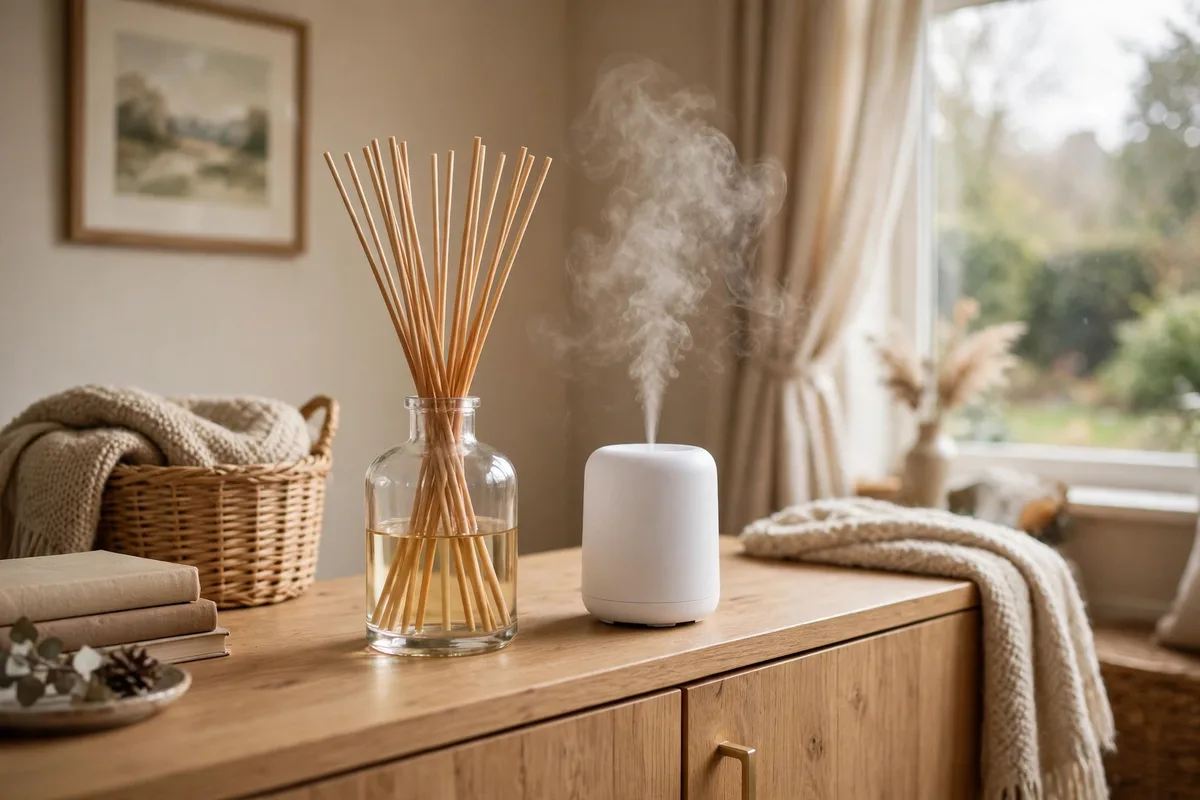
Quick answer: A reed diffuser and an electric diffuser do the same job in two different ways, and the difference is what decides the answer. A reed diffuser is a bottle of scented oil with reeds standing in it, and the reeds draw the oil up and release the scent slowly, all day and all night, with no plug, no switch and no sound. An electric diffuser is a small powered device, usually ultrasonic, that turns water and a few drops of essential oil into a fine cool mist, and you switch it on when you want scent and switch it off when you do not. Reeds are better for steady background scent in small rooms, for places with no socket, and for anyone who wants to set it up and forget it. Electric diffusers are better for stronger scent on demand, for bigger rooms, for changing scent quickly, and for anyone who wants a timer and a mist they can control. Neither one is better in general. Most homes end up using both, in different rooms and at different times, and this guide shows how to decide room by room, what each one costs per month, what looking after each one really involves, and how to use them safely around pets and children.
Walk into any home fragrance shop in the UK and you will face the same confusion, and it is a confusion the word itself causes. “Diffuser” means two different products. One is a bottle with sticks in it. The other is a small machine that plugs in and makes mist. They share a word and almost nothing else, and buyers who do not know that buy the wrong one, use it the wrong way, and then blame the product. A reed diffuser bought for a large open-plan living room will smell of almost nothing, because it was never made to scent a space that big. An electric diffuser bought for a hallway, where nobody passes for hours and there is no socket nearby, will sit unused, because it was never made to be left running in a passage nobody watches. The product was never the problem. The job was, and the job was never matched to the format. This guide matches them, and it is built on the consensus of the guides checked on 22 November 2026: Tara Spa Yarm, Banyan Tree Essentials, FreshKit, Better Living Plan, That Home Feeling, Temple of Desire, Candle Delirium, Lelior and Sosa Home and Body. Where a source describes a product, a price or a rule in a particular way, that is reported here as the source’s description, not as a fact this site has tested. No seller’s own product picks are presented here as recommendations. Only mechanisms, formats and the maths are used.
The One-Line Difference: Passive vs Powered
The difference between the two formats is a difference in how the scent gets into the air, and once that is clear, every other difference follows from it. A reed diffuser is passive. You put reeds in a bottle of scented oil, the reeds draw the oil up by capillary action, and the scent evaporates from the exposed tips into the room. There is no plug, no battery, no switch and no moving part. It works all the time, whether you are thinking about it or not, and it stops only when the oil runs out or the reeds dry up. An electric diffuser is powered. You plug it in, add water and a few drops of essential oil, and a small plate inside vibrates at a high frequency, breaking the water and oil into a fine cool mist that is pushed into the room. It works only while it is switched on, and it stops when you switch it off, when the timer ends, or when the water runs out.
That single difference explains the three things buyers notice first. First, the reed diffuser gives its scent continuously and gently, while the electric diffuser gives its scent in sessions, stronger while it runs and nothing at all once it stops. Second, the reed diffuser needs no socket, no water and no daily attention, while the electric diffuser needs a socket, a water refill and regular cleaning. Third, the reed diffuser cannot be turned up or down except by adding or removing reeds, while the electric diffuser can be set to a timer, an intermittent mode or a mist level. Those three differences, continuous versus session, set and forget versus looked after, and fixed versus adjustable, are the whole comparison in miniature, and the rest of this guide is those three differences worked out in detail.
There is a second difference worth stating early, because it shapes the whole decision: a reed diffuser scents a room, and an electric diffuser scents a moment. A reed diffuser is background, the scent that is there when you walk in and still there when you walk out, and it suits rooms that are used all day. An electric diffuser is an event, the scent you switch on for an evening, a bath, a reading hour or a guest’s arrival, and it suits moments that have a beginning and an end. The two formats are not rivals fighting over the same job. They are two tools for two different jobs, and the honest question is which job each room needs.
What a Reed Diffuser Actually Is
A reed diffuser is one of the simplest home fragrance products there is, and the simplicity is part of the appeal. It is a bottle of scented oil, usually glass, with a set of rattan or fibre reeds standing in it. The reeds soak up the oil and carry it upward, and the scent evaporates from the length of reed that stands above the bottle. There is nothing to switch on, nothing to refill daily, and nothing to plug in. You set it down, and it works.
The routine is almost nothing, and that is the point. Flip the reeds about once a week, so the dry ends go back into the oil and the soaked ends come up into the air. Replace the reeds when they stop carrying scent, which is usually after a few months, and top up or replace the oil when the bottle runs low. That is the whole routine, and it is covered in full in our guides to how long reed diffusers last, where to place a reed diffuser, how to make a reed diffuser smell stronger and reed diffuser refills. This article does not repeat them. It uses what they establish, and it compares the format with the electric one.
The limits of a reed diffuser follow from how it works. It has no power behind it, so the scent travels only as far as the air in the room carries it, and in a still corner it can smell of almost nothing while the same diffuser in a place where people pass smells clearly. It cannot be switched off, so a scent that is too strong in a small room can only be turned down by taking reeds out. And it is a bottle of oil standing open, so it can be knocked over, and the oil can mark a wooden surface, stain fabric, and reach a pet’s fur or paws. Candle Delirium, a US retailer, put the surface risk plainly in the guide checked for this article: reed diffuser oil stains finished wood almost permanently, and a tipped diffuser on a walnut nightstand is a service call to a refinisher, not a wipe-down. Keep it on a glass or stone tray, away from edges, and away from cats with tails. That is practical advice, not a warning to avoid reeds. It is a warning to place them properly, and the placement guide linked above covers it in full.
The Electric Family: Three Machines, Not One
“Electric diffuser” is not one product either, and this is the point most comparison guides skip. There are three kinds of electric diffuser on sale in the UK, and they work differently, cost differently, and suit different rooms. The guides checked for this article agree on the three types, and the names matter, because a buyer who asks for “an electric diffuser” in a shop may be shown any of the three.
Ultrasonic diffusers are the commonest kind, and the kind most people picture when they say electric diffuser. A small water tank holds water and a few drops of essential oil, and a plate underneath vibrates at a high frequency, breaking the water and oil into a fine cool mist. The mist is pushed into the room, and the scent travels with it. Most ultrasonic diffusers have a timer, often two and four hours, an intermittent mode that puffs mist on and off, a mist level control, an LED light that can usually be switched off, and an automatic shut-off when the water runs out. Temple of Desire give the figures for their own model in the guide checked for this article: a 200ml tank that runs up to six hours continuously or twelve in intermittent mode, about 25 decibels, which is quieter than most refrigerators, and three to five drops of essential oil in a full tank. Ultrasonic diffusers are the kind this guide means most often when it says electric diffuser, and they are the kind the comparison tables below describe unless another type is named.
Waterless and nebulising diffusers use no water at all. A waterless diffuser disperses essential oil without mixing it into a tank of water, and a nebulising diffuser uses pressurised air to atomise undiluted essential oil into a powerful mist, with no heat and no water. Tara Spa Yarm describe the waterless kind as the choice for a deliberate fragrance session, when you want the scent to feel like a chosen part of your evening rather than a constant backdrop. Candle Delirium describe nebulising diffusers as the strongest throw of any home diffuser, and the format aromatherapists prefer, but also the smallest part of the home market, because they need pure essential oil, which costs more per millilitre than a reed diffuser bottle. The advantage is a stronger, truer scent, because the oil is never diluted in water and never heated. The cost is the oil itself, and the need to use oils made for the purpose, because a thick or unsuitable oil can clog the device.
Heat and plug-in diffusers are the oldest electric kind, and the simplest. A ceramic bowl with a tealight underneath is the old version, and an electric plug-in wall unit is the modern one. Heat warms the oil until it releases its scent. FreshKit, in the guide checked for this article, give the main drawback plainly: heat can change the oil, and heating an essential oil can change its chemical structure and reduce what the oil gives. Heat diffusers are also the least effective at spreading scent, because the scent does not travel as far or as evenly as with a mist-based diffuser. They are cheap, silent and simple, and they suit a small room where a pleasant smell is enough, but they are not the best choice for anyone who wants a strong or even scent, and they are not the kind this guide recommends first.
One confusion belongs here, because it causes real damage to real machines. An ultrasonic diffuser is not a humidifier, and a humidifier is not a diffuser. FreshKit make the point in the guide checked for this article: an electric diffuser does add a tiny bit of moisture to the air, but its main job is to diffuse oil, while a humidifier’s main job is to add water to the air, with a big water tank designed to tackle dry air. You should never put essential oils in a machine that is only a humidifier. The oil can clog it and ruin the plastic. Many modern diffusers double up as mini-humidifiers, which is a nice bonus, but a machine sold only as a humidifier must never be given oil. The water and humidity section later in this guide returns to this, because it matters for winter rooms and for anyone buying a device for dry air.
Head to Head: The Whole Comparison in One Table
The table below is the whole guide in one place. The sections after it explain each row, because the rows interact with each other, and a single row read on its own can mislead. A reed diffuser wins on simplicity, but an electric diffuser wins on strength and control. A reed diffuser wins on running cost, but an electric diffuser wins on changing scent. The table is the starting point. The decision comes from the rooms and the life that follows it.
| What matters | Reed diffuser | Electric diffuser (ultrasonic) |
|---|---|---|
| How it works | Passive: reeds wick oil up and scent evaporates continuously | Powered: ultrasonic plate turns water and a few drops of oil into a fine cool mist |
| Power | None: no plug, no battery, no switch | Plug-in or USB, typically low wattage |
| Scent strength | Soft and steady, close range | Adjustable, stronger, reaches farther |
| Coverage | One small to medium room, best where air moves | One room, larger rooms possible, mist carries scent further |
| Control | Add, remove or flip reeds | On and off, timers, intermittent mode, mist level |
| Changing scent | Slow: oil lasts weeks, changing means a new bottle or refill | Fast: empty the tank, add water and a different oil, minutes |
| How long it lasts | A 100ml bottle lasts several weeks to a few months | Typically 3 to 8 hours per fill, depending on tank size and mode |
| Noise and light | Silent, no light | Faint hum or bubbling, often an LED light |
| Moisture | None | Adds a little humidity nearby |
| Upkeep | Flip reeds about once a week, fresh reeds now and then | Empty and wipe after use, clean about weekly, descale now and then |
| Spill risk | Open bottle of oil can mark finishes and reach pets | Small water spill, mist can leave residue on nearby surfaces |
| Ongoing supplies | Refill oil and fresh reeds | Essential oils, water, occasional cleaning |
| Best for | Continuous background scent, small rooms, places with no socket | Scent on demand, bigger rooms, evenings and sessions |
Three things to notice in the table before reading on. First, the two formats win different rows, and the rows they win are the rows that matter for different jobs, which is why the question “which is better” has no single answer. Second, the reed diffuser’s advantage is mostly about continuity and simplicity, and the electric diffuser’s advantage is mostly about strength and control, so the decision is really a decision about whether the room needs scent all the time or scent when you choose it. Third, the lifespan row is the one most often stated wrongly, because the two lifespans are measured in different units, and the cost section later in this guide works the maths out properly, with the assumptions stated, instead of repeating a slogan.
Coverage and Control: Which Fills a Room Better?
Scent strength is the row most buyers care about first, and it is the row where the electric diffuser has its clearest advantage, but the advantage needs explaining properly, because it is not the device itself that is stronger. It is the way the scent is pushed into the air. A reed diffuser waits for the air in the room to carry its scent, and in a still room the scent stays close to the bottle. An electric diffuser pushes its scent out in a mist, and the mist carries the scent to the far corner of the room, which is why the guides checked for this article agree that electric diffusers give a stronger, faster and more controllable scent. That Home Feeling put it plainly: pick a reed diffuser for a soft, steady scent in one small, closed room, and pick an ultrasonic diffuser for scent you can switch on and off, a stronger result in a bedroom or living area, and control over how long it runs. FreshKit make the same point: an electric diffuser is more powerful, more immediate, and gives a much stronger dose of the scent when you need it.
The practical consequence is about room size. A reed diffuser suits a bathroom, an entryway or a small bedroom, and it struggles in a large open-plan living room, because the scent has no power behind it and the room has too much air for it. An electric diffuser suits a bedroom, a living area or a studio, because the mist carries the scent across the room, and the strength can be turned up for a large room and down for a small one. That Home Feeling give the room split in their table: reeds for bathroom, entry and small bedroom; ultrasonic for bedroom, living area and studio. The split is not a rule about which rooms are allowed. It is a rule about which rooms each format can actually scent, and a reed diffuser in a room too big for it is a bottle of oil doing nothing, whatever the scent inside it.
But strength is not the whole story, and the honest guide says so. The guides checked for this article agree on the point that matters most: strength depends mostly on the oil and how much of it is in the air, not on the format alone. A reed diffuser with a strong oil, enough reeds and a place where air moves will out-scent a weak electric diffuser with two drops of a faint oil in a large tank, and a well run electric diffuser will out-scent a reed diffuser left in a still corner with three reeds. The format sets the ceiling, and the oil, the reeds or the drops, and the placement decide where under that ceiling a particular setup sits. That is why the advice in this guide is to judge a setup by how it performs in your room, not by its format alone, and to move a reed diffuser into moving air before deciding it is too weak, because the placement guide linked above shows that a diffuser in a still corner will smell like almost nothing while the same diffuser near a door smells clearly.
Control is the row where the electric diffuser wins by the widest margin, and it is the row that decides the answer for a particular kind of buyer: the buyer who wants scent when they want it, and silence when they do not. An electric diffuser can be switched on for an evening and off at bedtime, set to a timer of two or four hours, run in intermittent mode so the mist puffs on and off, and set to a low mist level for a small room or a high one for a large room. A reed diffuser cannot do any of that. It is on all the time, and the only controls are the number of reeds and whether they are flipped. That Home Feeling list the controls side by side: reeds are controlled by adding, removing or flipping reeds; electric is controlled by on and off, timers, intermittent mode and mist level. The difference is the difference between a tap and a river. One you open and close, the other you can only narrow or widen.
There is also a test that settles the coverage question for any room, and it is the test every guide checked for this article agrees on in spirit: walk into the room from another room, and notice what you smell in the first five seconds. That is the coverage that matters, not the coverage you smell when you stand next to the device. A reed diffuser that is noticeable on arrival and forgettable once you sit down is at the right strength. An electric diffuser that fills the room within half an hour of switching on and is still pleasant after two hours is at the right strength. If you can smell the reed diffuser clearly when you sit down in the room, it is too strong, and the fix is to take a reed or two out. If an electric diffuser smells of nothing after an hour of running, the room is too big for it, the oil is too weak, or the tank needs more drops, and the fix is a stronger oil, a higher mist level, or a second device for an open-plan space.
Running Costs: Worked Examples, Not Promises
Cost is the row where a worked example is worth more than a general claim, because the answer changes so much with how the products are used. The figures below are illustrative worked examples, using the sources’ own figures from the guides checked for this article, and the assumptions are stated with each example. They are not a survey, and they are not prices for any particular brand. Prices vary by maker, by size and by where they are bought. The maths shows the method. Put in the prices of the products you actually buy, and the method gives your answer.
A reed diffuser, worked example. The guides checked for this article give a range of lifespans, not a single figure, and the range is the honest range to use. Sosa Home and Body give 6 to 8 weeks for a reed diffuser. Candle Delirium give 2 to 4 months of continuous fragrance on a single fill, and roughly 12 weeks for a 250ml bottle. Lelior give 3 to 6 months. That Home Feeling give several weeks to a few months for a 100ml bottle. Take a typical 100ml reed diffuser costing £15 to £25, and take the middle of the range, about 8 to 12 weeks. That is roughly £1.25 to £3.10 per week, or about £5 to £13 per month of continuous scent. Take a larger 200ml bottle at £25 to £35, lasting about 12 to 16 weeks, and the cost per month is roughly the same, about £7 to £12. The one extra cost is fresh reeds, which are cheap, and refill oil, which is cheaper than a new bottle. The point is that a reed diffuser is bought once and then works for weeks, and the cost per month is set mostly by the price of the bottle and how long it lasts, not by anything you do each day.
An electric diffuser, worked example. An ultrasonic diffuser is bought once, and then it costs three things: electricity, water and oil. The device itself costs from about £15 for a small ultrasonic diffuser to £30 or more for a larger one with a 200ml tank, and it should last for years if it is cleaned and never run dry. The electricity is small, and the maths is worth doing, because it is the cost buyers worry about most and understand least. Take a typical ultrasonic diffuser at 10 watts, running 4 hours a day, and take a round example electricity rate of 25p per kilowatt hour. That is 0.04 kilowatt hours a day, which is 1p a day at the example rate, or about 30p a month, or about £3.65 a year. The rate is an assumption, not a tariff, and the wattage is an assumption, not a measurement of any particular device, but the order of magnitude is the point: the electricity for an ultrasonic diffuser costs pennies a month, and it is not the cost that matters. The oil is the cost that matters. Temple of Desire give the figure in the guide checked for this article: three to five drops of essential oil in a full 200ml tank, running up to six hours continuously or twelve in intermittent mode. A 10ml bottle of essential oil holds roughly 200 drops, and at £5 to £10 a bottle, that is about 2.5p to 5p per drop, or about 8p to 25p per tank fill. A home that runs an ultrasonic diffuser for one session a day, one tank a day, spends about £2.40 to £7.50 a month on oil, plus about 30p on electricity, plus the water, which is free from the tap. A home that runs it twice a day spends roughly double the oil, and a home that runs it for a session a few evenings a week spends a few pounds a month. The waterless and nebulising kinds cost more per month, because they use undiluted oil with no water to stretch it, and Candle Delirium note that nebulising diffusers need pure essential oil at a higher cost per ounce than a reed diffuser bottle. That is the trade for their stronger throw.
The comparison, honestly stated. A reed diffuser is usually the cheaper format per month of continuous scent, because it is bought once and then works all day and all night for weeks, while an electric diffuser is bought once and then costs oil for every session it runs. But the comparison is not the whole story, because the two formats are not bought for the same number of hours. A reed diffuser scents a room for every hour of the day, including the hours nobody is in it, and an electric diffuser scents a room only for the hours it is switched on. A home that wants scent in a hallway all day will spend less on a reed diffuser than on an electric diffuser run all day, because the electric diffuser would need a tank refill every few hours and a bottle of oil every few weeks. A home that wants scent in a bedroom for two hours before sleep will spend less on an electric diffuser than on a reed diffuser, because the reed diffuser is scenting an empty bedroom all day while the electric diffuser is switched on only for the evening. The honest conclusion is that reeds win on cost per month of continuous scent, and electric wins on cost per hour of chosen scent, and the decision should be made on how the room is used, not on price alone.
Two cautions belong with the maths. First, a cheap reed diffuser is not a cheap month if the oil is weak and the bottle finishes in three weeks, and a cheap electric diffuser is not a cheap month if it has to be replaced in a year because it was run dry and the plate failed. A reed diffuser that gives 12 weeks of scent is a better buy than one that gives 6 weeks, whatever the price on the shelf, and an electric diffuser that lasts for years is a better buy than one that fails in a year, whatever the price on the box. Second, the oil is the running cost for both formats, and the buyer who wants to know what a diffuser costs should divide the price of the bottle or the oil by the weeks or the sessions it actually gives, not by the size of the bottle alone.
Maintenance: What Looking After Each One Really Involves
Maintenance is the row where the two formats differ most in daily life, and it is the row that should be read first by any buyer who knows their own habits. A reed diffuser asks for almost nothing, and an electric diffuser asks for a routine, and the buyer who will not do the routine will end up with a device that smells of nothing, or worse, a device that smells of mould.
A reed diffuser needs a flip about once a week, and fresh reeds now and then, and that is nearly all of it. Flip the reeds so the dry ends go back into the oil and the soaked ends come up into the air. Replace the reeds when they stop carrying scent, which is usually after a few months, because old reeds clog and dry out and cannot be revived by flipping. Top up or replace the oil when the bottle runs low, and clean the bottle properly if you change scent, because old oil left in the bottle will fight the new one. The full routine, including the same-scent and new-scent refill rules, is in our guide to reed diffuser refills, and this article does not repeat it. The point here is the scale of the effort: minutes a week, nothing a day, and nothing that needs a socket, a tap or a cleaning cloth.
An ultrasonic diffuser needs a routine, and the routine is not optional. Empty the tank and wipe it after use, or at least once a day if it is used daily, because water left standing in a tank grows mould and leaves a smell that no oil will cover. Clean the tank about weekly, wiping the plate and the inside of the tank, and descale now and then if you live in a hard water area, because limescale coats the plate and dulls the mist. Never run the device dry, because running an ultrasonic diffuser with no water shortens its life dramatically, and Candle Delirium make the point in the guide checked for this article: the water reservoir needs cleaning every few weeks to prevent calcium deposits and bacterial growth, and if you cannot commit to that maintenance, electric is the wrong format for you. Lelior give the same warning in their own list of cons: ultrasonic diffusers need regular cleaning to prevent mould build-up. That Home Feeling give the routine in their table: empty and wipe after use, clean about weekly. The routine takes a few minutes, and it is the price of the mist. A buyer who will not do it will end up with a device that mists weakly, smells stale, or stops working, and the fault will be the routine, not the device.
A waterless or nebulising diffuser needs less cleaning than an ultrasonic one, because there is no water tank to grow mould, but it still needs care: wipe the nozzle, keep the oil chamber clean, and use only oils made for the purpose, because a thick or unsuitable oil can clog it. A heat diffuser needs the least care of the electric kinds, a wipe of the bowl and a new tealight, but it also gives the least scent, and the trade is the same as everywhere else in this guide: the format that asks for the least gives the least.
The honest rule for choosing on maintenance is simple. If you want a fragrance product that asks for nothing, buy a reed diffuser. If you are happy to spend a few minutes a week on a device that gives you stronger scent and more control in return, buy an electric diffuser. If you know you will not clean a water tank weekly, do not buy an ultrasonic diffuser, whatever the shop assistant tells you, because a device that is not cleaned is a device that will disappoint you, and a reed diffuser in the same room would have done the job with no routine at all.
Water and Humidity: What the Mist Does to a Room
Water is the part of the electric diffuser that buyers understand least, and it deserves a section of its own, because it is the part that changes the room itself. An ultrasonic diffuser adds a little moisture to the air, because the mist is water, and the water goes somewhere. That Home Feeling note it in their table: ultrasonic adds a little humidity nearby, and reeds add none. Lelior list it as a pro: an ultrasonic diffuser doubles as a humidifier, and adds a little humidity to the air, which skin will thank you for in winter dryness. FreshKit make the same point, and add the caution that an ultrasonic diffuser does add a tiny bit of moisture, but its main job is to diffuse oil, not to humidify a room.
The practical consequence is small but real. In a dry winter room, with the central heating on full, a little extra moisture is welcome, and an ultrasonic diffuser running for an evening can make the air feel less dry. In a damp British home, in a bathroom that already steams, or in a small room with poor ventilation, extra moisture is not welcome, and an ultrasonic diffuser running all day can leave condensation on a window, damp on a wall, or a musty smell that no oil will cover. The rule is to use an ultrasonic diffuser for sessions, not all day, and to ventilate the room, and to watch for condensation on cold surfaces in winter. A reed diffuser adds no moisture at all, and it is the format for a damp room, a bathroom, or any room where the air is already wet enough.
Three water rules belong here, because they are the rules that protect the device and the room. First, use clean tap water, and change it daily, because water left standing in a tank grows mould and leaves a smell. Second, never put reed diffuser oil in an ultrasonic diffuser, and never put an oil made for reeds into a water tank, because reed oil is not made to be mixed with water and it will coat the tank and dull the mist. Third, never put essential oils in a machine that is only a humidifier, because the oil can clog it and ruin the plastic, and FreshKit state this plainly in the guide checked for this article. The oils for an ultrasonic diffuser are essential oils made for the purpose, a few drops in a full tank, and the oils for a reed diffuser are diffuser oils made for reeds, and the two must never be swapped.
Noise, Light and Sockets: The Practical Details
The practical details are the ones that decide whether a device is lived with or left in a cupboard, and they deserve a short section, because they are the details no comparison table gives in full. A reed diffuser is silent and dark. It makes no sound, gives off no light, and needs no socket, so it can go anywhere: a hallway with no socket, a bathroom shelf, a guest room, a shelf in a rented flat where the landlord has not provided a socket in the right place. An electric diffuser makes a faint hum or bubbling sound, and most models have an LED light that can usually be switched off, and it needs a socket, which means it can only go where a socket is, and the cable has to reach it, and the device has to sit on a stable surface near the socket, not trailing a cable across a walkway.
The noise is small, and the guides checked for this article agree on the scale. Temple of Desire give about 25 decibels for their own model, quieter than most refrigerators, so it can run through a whole meditation without becoming part of it. That Home Feeling describe it as a faint hum or bubbling. For most people, in a living room or a bathroom, the hum is unnoticeable. For a light sleeper, in a quiet bedroom, the hum and the bubbling can be noticeable, and the LED light, if it cannot be switched off, can be a reason to choose a different model, or to choose a reed diffuser for the bedroom instead. The rule is to check the model before buying: can the light be switched off, does it have a timer, does it have an automatic shut-off when the water runs out, and is the tank easy to clean. Better Living Plan list the same checks in the guide checked for this article: choose an ultrasonic diffuser with a timer or intermittent mode, an automatic shut-off when the water runs out, and a tank that is easy to clean.
The socket is the practical limit that matters most. A reed diffuser needs no socket, and it is the format for a hallway, a bathroom, a guest room, a shelf in a rented flat, and any room where the socket is in the wrong place or there is no socket at all. An electric diffuser needs a socket, and it is the format for a bedroom, a living room or a home office where a socket is already nearby, and where the cable can run safely along a wall and not across a floor. The device must be made for UK mains, with a 3-pin plug and the correct voltage, and the maker’s instructions must be followed, and a device bought from an unknown seller, with a two-pin plug and no UK safety marking, should not be used, and the few pounds saved are not worth the risk. That rule applies to every electric fragrance device, and it is the same rule our guide to wax melts vs candles gives for electric warmers.
Safety: Pets, Children and the Oils Themselves
Safety is the row where neither format can be declared safe in general, and it is the row that should be read first by any home with cats, birds, babies or small children. The safety of a reed diffuser and an electric diffuser is different in kind, and the two risks must be understood separately, because a buyer who confuses them will guard against the wrong one.
A reed diffuser has no flame and no electricity, and that is a real advantage, but it is a bottle of concentrated oil standing open, and the risk is the oil itself. A tipped bottle puts concentrated oil on fur, paws and skin, where a pet can lick it off, and on a wooden surface, where it can mark the finish. That Home Feeling state the spill risk plainly in the guide checked for this article: a tipped reed bottle puts concentrated oil on fur, paws and skin, where pets can lick it off. Better Living Plan give the same warning: spills on wooden surfaces, keep away from children and pets. The bottle must sit on a stable surface, on a tray, away from edges, out of reach of children and pets, and a spill must be wiped up at once, and the surface must be checked, because oil left on wood can mark it permanently.
An electric diffuser has no flame either, but it puts oil into the air as a mist, and the risk is the air itself. Cats are more sensitive to many essential oils than people or dogs, and That Home Feeling list the oils commonly flagged as a concern: tea tree, eucalyptus, peppermint, citrus, pine, wintergreen and cinnamon. Birds are the strictest case of all, because their breathing is more sensitive than a mammal’s, and an oil that is harmless to a person can be harmful to a bird in the same room. Babies and young children are more sensitive than adults, and a mist that is pleasant to an adult can be too strong for a baby in a small room. The device must sit where it cannot be knocked over, and it must never be run all day in a closed room with a pet or a baby in it, and it must never be run in a room a pet cannot leave. Better Living Plan give the same rule in the guide checked for this article: for children, keep reed diffuser bottles and essential oil bottles out of reach, as swallowing even small amounts of some oils can be harmful, and place electric diffusers where they cannot be knocked over.
The honest rule is that neither format is automatically safe, and neither format should be declared safe in general. A reed diffuser on a high shelf, on a tray, out of reach, is the safer background format for a room where a pet is left alone, because there is no mist in the air and nothing to knock over at floor level. An electric diffuser run for a short session, in a ventilated room, with an oil checked first, is the safer format for a room where a person is present and watching, because it can be switched off the moment anyone shows discomfort. The full pet safety guidance, separated by dogs, cats and birds, with sourced advice and a vet disclaimer, is coming in the safety guides later in this series, and this article does not replace it. Until those guides are published, the rule above is the safe rule to follow, and anyone with a pet with breathing problems, or a baby in the room, should check the oils they use and ask their vet before running either format for long.
For allergy and asthma sensitive homes, neither format can be declared safe in general, and anyone with a respiratory condition should test a new scent briefly, in a ventilated room, before committing to it, and should stop using a product that causes symptoms. That caution applies to both formats equally, and it is not a reason to prefer one over the other. It is a reason to test before buying in quantity. Look for UK CLP labelling on oils, which tells you what is in the product and what warnings apply, and read it before you buy.
The Decision, Room by Room
The table below is the most useful part of this guide, because it turns the comparison into a decision for a real house. The rooms are the rooms of a typical UK home, and the recommendation for each room follows from the rows above: the size of the room, how long the scent needs to last, whether anyone is watching, whether there is a socket, and what the room is for. The full room-by-room matrix of scent families, formats and strengths is in our guide to home fragrance by room, and the detail below is the format decision laid over that matrix, not a replacement for it.
| Room | The winner | Why | The other format’s job |
|---|---|---|---|
| Hallway | Reed diffuser | Needs strong scent on arrival, nobody watches it, often no socket, draughty passage suits reeds in moving air | An electric diffuser only if a socket is nearby and the hall is large |
| Living room | Both, at different times | Reed for steady background scent in the day, electric for stronger scent in the evening, same family so they do not fight | Neither is the loser: they take turns |
| Bedroom | Electric diffuser for sessions, reed for overnight | Electric for a session before sleep, reed for gentle scent all night with no hum and no light | A reed diffuser for the night, an electric diffuser for the hour before it |
| Bathroom | Reed diffuser | Needs steady scent in short bursts, small humid room, no socket wanted near water, moisture from a mist is not wanted | None: an electric diffuser in a bathroom is a socket near water and extra moisture |
| Kitchen | Reed diffuser | Needs freshness after cooking, sits next to food, a socket near water and heat is a risk, scent can be changed by swapping reeds | An electric diffuser for a session after cooking only, away from the hob and the sink |
| Home office | Electric diffuser | Strong steady scent for working hours, room full of paper and cables, socket already there, timer ends the session when work ends | A reed diffuser for background scent on days the device is not wanted |
| Dining room | Reed diffuser | Needs steady scent between meals, nobody watches it, no socket wanted near a table | An electric diffuser for a gathering, switched on when people sit down |
| Guest room | Reed diffuser | Needs scent when a guest walks in, nobody is there to switch anything on, often no socket in the right place | An electric diffuser left as a gift for the guest to use themselves, if they wish |
Two things to notice in the table before reading on. First, the reed diffuser wins more rooms than the electric diffuser, because more rooms need steady scent without a socket than need strong scent on demand, and more rooms are unwatched than are watched. That does not make the reed diffuser the better format in general. It makes it the format to start with, and the electric diffuser the format to add where a session matters. Second, the living room is the only room where both formats are the answer, and it is the room where the combination is most rewarding, because a reed diffuser for the day and an electric diffuser for the evening, in the same family, gives a home that smells deliberate all day and special in the evening, without either format having to do a job it is bad at.
The hallway deserves a word of its own, because it is the room where the reed diffuser’s advantage is clearest. A hallway is narrow, draughty, and used in passing, and it is the first air a visitor breathes. A reed diffuser on a console table or a shelf at about waist height, near the front door but not right beside it, gives a steady scent all day without anyone thinking about it, and the air that moves past it when the door opens carries the scent into the hall. An electric diffuser in a hallway is a poor choice, because a hallway is a room nobody sits in, so a device switched on there would have to run all day, which wastes oil and water and needs a socket in a passage, and a device switched off is a device doing nothing. The hallway is a reed diffuser’s room, and it is the best place in the house to start with reeds.
The bedroom deserves a word of its own too, for the opposite reason. A bedroom is a small, still room, and it is the room where you spend eight hours breathing the same air. An electric diffuser run for a session before sleep, with a timer, gives a stronger scent for the hour it is wanted, and then it switches itself off. A reed diffuser in the bedroom gives a gentle scent all night, with no hum and no light, and it can be turned down by taking a reed out. The bedroom rule is simple: an electric diffuser for the session before sleep, a reed diffuser for the night, and never an electric diffuser run all night in a closed room, because the mist, the moisture and the oil in the air are not wanted for eight hours in a room where someone is sleeping.
Who Should Choose Which
Rooms decide most of the answer, but life decides the rest, and the five situations below are the ones that change the decision most often.
Renters. A reed diffuser is the safer choice for a rented home, because there is no flame, no socket needed, no mark on the walls, and no risk to a deposit from a knocked-over device or a water spill. An electric diffuser is still fine in a rented home, but it needs a socket, and it must sit on a heat-resistant mat or a tray if the surface is a landlord’s shelf or table, because a water spill or a mist residue can mark a surface. Check the tenancy agreement before buying either format, and keep the device on a tray if the surface is not your own.
Homes with pets. A reed diffuser on a high shelf, on a tray, out of reach, is the safer background format for a room where a pet is left alone, because there is no mist in the air and nothing to knock over at floor level. An electric diffuser needs a person in the room, watching it, for as long as it runs, and it should never be run all day in a closed room with a pet in it, and it should never be run in a room a pet cannot leave. The full pet safety guidance, separated by dogs, cats and birds, is coming in the safety guides later in this series, and this article does not replace it.
Homes with small children. A reed diffuser on a high shelf, on a tray, out of reach, is the safer background format for a family home, because it has no flame, no socket and nothing hot at child height, and the bottle is the only risk, and it can be placed where a child cannot reach it. An electric diffuser should not be run in a room where a small child is sleeping, and it should never be left where a child can reach it, and the water tank must be emptied and cleaned, because a child who opens it can spill water and oil.
Homes on a budget. A reed diffuser is the cheaper format per month of continuous scent, and a home that wants steady scent every day will spend less on reeds than on an electric diffuser run all day, on the worked examples in this guide. But the electric diffuser is the cheaper format per hour of chosen scent, and a home that wants scent for a few evenings a week will spend less on an electric diffuser than on a reed diffuser scenting empty rooms all day. The honest advice is to buy the reed diffuser for the rooms that need scent all day, and the electric diffuser for the rooms that need scent for a session, rather than to judge the two formats by the first month alone.
Buyers who love trying new scents. An electric diffuser is the format for this buyer, without question. A few drops of a new oil in a tank, tried for an evening, and known by bedtime whether it suits the room, is the cheapest and quickest way to learn what suits a home. A reed diffuser buyer who wants to try a new scent has to buy a whole bottle, wait weeks for it to finish, and live with the choice. If the joy of home fragrance is the trying, the electric diffuser is the format, and the reed diffuser is the format for the scents that have already been chosen and loved.
Using Both Together
The honest verdict is the one the guides checked for this article all reach in their own words: most homes use both, in different rooms and at different times, and the combination is better than either format on its own. A reed diffuser for the day and an electric diffuser for the evening, in the same scent family, gives a home that smells deliberate all day and special in the evening. A reed diffuser in the hallway and the bathroom, where no socket is wanted, and an electric diffuser in the living room and the bedroom, where a session matters, gives a home where every room has the right format for its job. The rule for using both together is simple: one scent family at a time, so the two formats do not fight. A woody reed diffuser in the hallway and a woody oil in the electric diffuser in the living room is a home that smells of one thing. A citrus reed diffuser in the kitchen and a spiced oil in the electric diffuser in the living room is a home that smells of two things arguing.
The layering system, one family across the home with different formats in different rooms, intensity budgeted room by room, is covered in full in our guide to scent layering at home, and the reed diffuser and the electric diffuser are the two easiest formats to layer with, because a reed can be added or taken out in seconds and an oil can be swapped in minutes. Start with the reed diffuser, because it is the format that gives steady scent for the least money and the least effort, and add the electric diffuser where a session matters, because it is the format that gives the strength and the control. That is the system, and it is the system this whole series is building towards, one format at a time.
The Verdict
A reed diffuser is better for steady background scent, for small rooms, for places with no socket, for anyone who wants to set it up and forget it, and for cost per month of continuous scent. An electric diffuser is better for stronger scent on demand, for bigger rooms, for changing scent quickly, for sessions with a timer, and for anyone who wants control over when the scent runs and how strong it is. Neither one is better in general, and the buyer who asks which is better has already asked the wrong question. The right question is which job each room needs, and the answer is in the table above, and the system is to use both, in different rooms and at different times, in one scent family, so the home smells deliberate all day and special in the evening.
The other formats in this series are covered in their own guides. Reed diffusers compared with candles are in our guide to reed diffusers vs candles, and wax melts compared with candles are in our guide to wax melts vs candles. The safety guides for pets and children, with sourced advice and a vet disclaimer, are coming later in this series. The complete guide to scented candles, with the care routine that makes a candle last its full burn time, is in our complete guide to scented candles. Start with the reed diffuser, add the electric diffuser where a session matters, and let the home smell of one family, in every room, all day.