Soy vs Paraffin vs Beeswax Candles: Which Wax Is Best?
Quick answer: There is no single best wax, only the best wax for what matters most to you. Paraffin throws the strongest scent and costs the least, but it burns fastest and soots the most. Soy burns slowly and cleanly at a mid-range price, with a gentler throw. Beeswax burns longest and cleanest, but costs the most and its natural honey scent competes with added fragrance. And the label matters as much as the wax: many candles sold as “soy” are soy-paraffin blends, and fragrance load affects scent and soot as much as the wax itself. Read the comparison below, then match the wax to your room and your budget.
Every scented candle you buy in the UK is made from one of three waxes, or a blend of them. The wax decides how long the candle burns, how strongly it scents the room, how much soot it makes, and how much it costs. Yet most candle listings tell you almost nothing about it. They sell you a scent name and a pretty jar, and leave you to find out by burning whether the candle throws well, lasts, or soots.
That is a problem, because the wax is the one choice you cannot fix after you buy. You can trim the wick, you can give the candle a proper first burn, and you can move it to a smaller room, but you cannot change the wax inside the jar. This guide compares the three waxes honestly, side by side, so you can choose before you spend. It is written for buyers, not makers, and it is deliberately neutral: every comparison page that ranks for this question today sells its own wax, and each one picks a different winner. This one does not sell wax at all.
The Three Waxes at a Glance
| Soy | Paraffin | Beeswax | |
|---|---|---|---|
| What it is | Hydrogenated soybean oil, plant based and renewable | A byproduct of crude oil refining | Made by honeybees, minimally processed |
| Scent throw | Moderate, soft and steady | Strongest, hot and cold throw | Light, with a natural honey note |
| Burn time | Longer than paraffin | Shortest, burns fastest | Longest, dense and slow burning |
| Soot | Low | Highest | Lowest |
| VOCs when burning | Lower, but depends on fragrance load | Highest, small amounts of benzene, toluene and formaldehyde | Lowest, especially unscented |
| Cost in the UK | Mid range | Lowest | Highest |
| Vegan | Yes | Yes | No |
| Main drawback | Gentler throw; can frost and set unevenly | Burns fast, soots more, petroleum based | Expensive; honey scent competes with added fragrance |
| Best for | Everyday burning, bedrooms, plant-based buyers | Large rooms, buyers who want the strongest scent | Natural-ingredient buyers, small rooms, long slow burns |
One line of the table deserves to be said out loud before the detail: fragrance load matters as much as wax type. A heavily scented soy candle can release more volatile organic compounds than an unscented paraffin one, and a low-fragrance paraffin candle can throw less than a well-made soy one. Wax sets the starting point. The fragrance oil inside it decides how much of that potential you actually get. Keep that in mind through the rest of this guide, because it is the point every maker comparison leaves out.
What Each Wax Actually Is
Paraffin wax is the traditional candle wax, and it has been for more than a century. It is a byproduct of crude oil refining: the wax is separated from petroleum during refining, then purified for candle use. It is cheap, abundant, easy to work with, and it takes fragrance oil readily. That combination is why it became the standard, and why it still dominates the budget end of the candle market.
Soy wax is made from soybeans. The oil is extracted from the beans and hydrogenated, which turns the liquid oil into a solid wax that can hold fragrance and burn in a jar. It is plant based, renewable and biodegradable. It arrived in candle making much later than paraffin, in the 1990s, and it grew quickly among small makers because it burns cleanly and appeals to buyers who want a plant-based product.
Beeswax is the oldest candle wax of the three, and the least processed. It is made by honeybees to build their honeycomb, then collected, filtered and poured. It needs almost no chemical processing to become candle wax, which is part of its appeal. It is also the most expensive, because producing it depends on bees and beekeepers, not on a factory.
There is a fourth wax you will meet often, and it deserves a short mention here rather than a column of its own. Coconut wax is newer, usually blended with soy, and sits near the top of the price range. It burns cleanly and throws better than pure soy, so makers often blend it with soy to get a clean burn with a stronger scent release. A coconut-soy blend is a legitimate choice, not a trick, and if a label says so plainly, that is a maker telling you something useful.
Burn Behaviour and Scent Throw
Throw is where the three waxes differ most, and where most buyers get disappointed. Throw is the scent a candle puts into the room, and it has two forms: cold throw, what you smell from the unlit jar, and hot throw, what you smell once it is burning. Hot throw is the one you live with. Our scented candles guide explains the difference in full; here is how each wax behaves on it.
Paraffin throws the strongest scent. It holds fragrance oil well and releases it readily from a hot melt pool, so a paraffin candle of the same size will usually scent a room more strongly than a soy or beeswax one. That is its great strength, and it is why paraffin still wins for large rooms and open-plan spaces. The trade is burn time. Paraffin burns fastest of the three, so the candle that scents your living room so well will also finish sooner.
Soy throws more gently. Its scent is softer and steadier, and it releases fragrance more slowly from the melt pool. In a bedroom or a small room, that is often exactly right: the scent is present without being heavy. In a large living room, a soy candle can smell lovely in the jar and disappointingly faint once lit. That is not a fault in the candle. It is the wax behaving as soy behaves. Soy also needs the longest curing time after pouring, around two weeks, before it is at its best, so a soy candle burned the day it arrives may still be improving.
Beeswax throws the lightest added scent. It has a natural honey scent of its own, which is warm and pleasant, but it competes with the fragrance the maker added. A beeswax candle rarely gives you a clean, specific scent such as a single floral or a single citrus, because the honey note sits underneath everything. What beeswax gives you instead is the longest, slowest, steadiest burn of the three. Its density means it melts slowly, so a beeswax candle lasts longest and is the most cost-efficient over time, despite the highest price on the shelf.
The practical lesson is to match the wax to the room. A paraffin candle earns its place in the big room where throw matters most. A soy candle suits the bedroom and the everyday burn, where a gentle scent is enough. A beeswax candle suits the small room and the slow evening, where a long burn and a warm honey note are the point. And if your candle smells weak even after a proper burn in the right room, the cause is usually inside the candle: low fragrance load, or the wrong wax for the job. Our guide on why is my candle not smelling strong works through those causes in order.
Cost and Availability in the UK
On the shelf, the order is simple and never changes: paraffin is cheapest, soy sits in the middle, beeswax costs the most. A paraffin candle can cost half as much as a beeswax candle of the same size, and a soy candle usually falls between the two.
But the shelf price is the wrong way to judge value, because the three waxes do not last the same length of time. Beeswax burns longest, so a beeswax candle that costs the most can work out cheapest per hour of burning. Soy burns longer than paraffin, so a mid-priced soy candle often beats a cheap paraffin one on cost per hour as well. Paraffin is cheapest to buy and dearest to burn, because it disappears fastest.
The honest way to compare is cost per hour. Divide the price by the burn time the maker states, and compare candles that way rather than by jar size or shelf price alone. A maker who states burn time plainly is also a maker who has thought about it, which is a good sign in itself. Be cautious with burn times that look too good: makers rarely agree on how they measure them, so treat any stated figure as a guide, not a guarantee.
Availability follows the same pattern. Paraffin candles are everywhere, from supermarkets to pound shops, because the wax is cheap and the supply chain is old. Soy candles are the standard choice of small UK makers and independent candle brands, so you will find them in craft shops, markets and online maker stores. Beeswax candles are the least widely available, usually from beekeepers, farm shops and specialist natural-product sellers, and the price reflects that smaller supply.
Soot and Cleaning
Soot is the black smoke and black marks a candle can leave on the jar, the wall above it, or the ceiling. It is unburned carbon, and it comes from a flame that is burning incompletely. The wax sets the starting point, but the wick and the air around the candle matter just as much, so read this section as a ranking, not a guarantee.
Paraffin soots the most. Its soot is fine particulate matter, the PM2.5 that air-quality guidance talks about, and a paraffin candle with a long wick or a draught flickering its flame will soot visibly. Keep the wick trimmed to about 5mm, keep the candle out of draughts, and keep sessions under four hours, and a paraffin candle can burn with very little soot. Neglect those three things and it will soot more than either of the other waxes.
Soy soots little. It burns cleanly when the wick is trimmed, and it is one of the main reasons small makers moved to soy. A soy candle can still soot if the wick is left long or the candle sits in a draught, because soot is a flame problem as much as a wax problem, but on a like-for-like basis it soots less than paraffin.
Beeswax soots least. It burns with a steady flame and very little smoke, and it is the cleanest of the three on soot. That is part of why it suits bedrooms and small rooms, where you notice soot on the jar and the wall most.
Cleaning follows the same order. A candle that soots will leave marks on the inside of the jar and, over time, on the wall or ceiling above it. Wipe the inside of the jar between burns, and keep the candle away from walls and ceilings where the warm air rises. The deeper soot diagnostic, wick mushrooming, draughts and overlong sessions, has its own guide, and the care routine that prevents most sooting is in our guide on how to make a scented candle last longer.
The Label Trap: When “Soy” Is Not Really Soy
This is the trap that catches the most buyers, and it is the one no maker comparison warns you about, because the makers writing those comparisons are often the ones doing it.
Many candles sold as “soy” are not pure soy wax. They are blends of soy and paraffin, sometimes mostly paraffin, sold under a soy label. The label is not lying in the strict sense: the candle does contain soy wax. But a candle that is 20 percent soy and 80 percent paraffin will behave like a paraffin candle, not a soy one. It will throw strongly, burn fast and soot more, and the buyer who chose it for a clean, plant-based burn has been misled.
The only label you can rely on is one that says “100% soy wax” in plain words. “Soy wax candle”, “made with soy wax” and “soy blend” do not mean the same thing, and “soy blend” is the honest one of the three, because it at least tells you it is mixed. If a listing does not say 100 percent, ask the maker what percentage of the wax is soy. A maker who knows and answers plainly is a maker you can trust. A maker who will not say is telling you something too.
Two other label points are worth knowing. Soy wax can frost, which is a white crystalline coating that forms on the surface of the wax as it cools. Frosting is harmless and normal for soy, and it does not affect how the candle burns or smells, but it can make a candle look less tidy on the shelf. And beeswax is not vegan, because it comes from bees. If you buy vegan, soy and paraffin are the vegan choices, and beeswax is not, whatever the label’s natural branding suggests.
Environmental Claims, Honestly
Candle waxes attract big environmental claims, and most of them are overstated. Here is the honest version.
Paraffin comes from crude oil, so it is not renewable, and burning it releases small amounts of benzene, toluene and formaldehyde, which are volatile organic compounds. Soy is plant based, renewable and biodegradable, and burning it releases fewer of those compounds than paraffin. Beeswax is the least processed of the three, and burning it, especially unscented, releases the fewest volatile compounds.
That ranking is real, but it needs two qualifications that the maker comparisons skip.
First, fragrance load matters as much as wax. The fragrance oil in a candle can contribute as much, or more, volatile organic compounds as the base wax. A heavily scented soy candle can release more of them than an unscented paraffin one. A candle marketed as natural because of its wax can still be heavily fragranced, and the fragrance is the part you breathe.
Second, no candle is toxin free, and no wax purifies the air. All combustion produces some soot and particulates, including the cleanest beeswax candle. And the claim that beeswax candles purify the air by releasing negative ions is not supported by solid evidence: no major independent health body has confirmed it. Treat any candle that promises to clean your air as a candle that is selling you a story.
The proportionate way to think about risk is this. Occasional use of a candle in a ventilated room is generally low risk. The concern grows with frequency, poor ventilation and several candles burning at once, and it matters most for people with asthma. That is a reason to ventilate, to burn one candle at a time, and to keep sessions under four hours, not a reason to fear candles altogether. The safety rules that apply to every candle, whatever the wax, are in our scented candles guide.
Pets: The Rules Are the Same Whatever the Wax
The pet question comes up in every wax comparison, and the honest answer is that the wax is not the part that matters for pets. The flame matters, the fragrance matters, and the room matters. Those are the same whichever wax you burn, so the rules below apply to soy, paraffin and beeswax equally, and no wax is safer for pets than another.
Dogs, cats and birds react differently, and birds are the most sensitive of all. Never leave a burning candle in a room a pet cannot leave. Keep candles out of reach, so a cat cannot knock one over or singe its whiskers, and keep the room ventilated. If a pet seems bothered by a scent, or is coughing, sneezing or trying to leave the room, put the candle out and open a window.
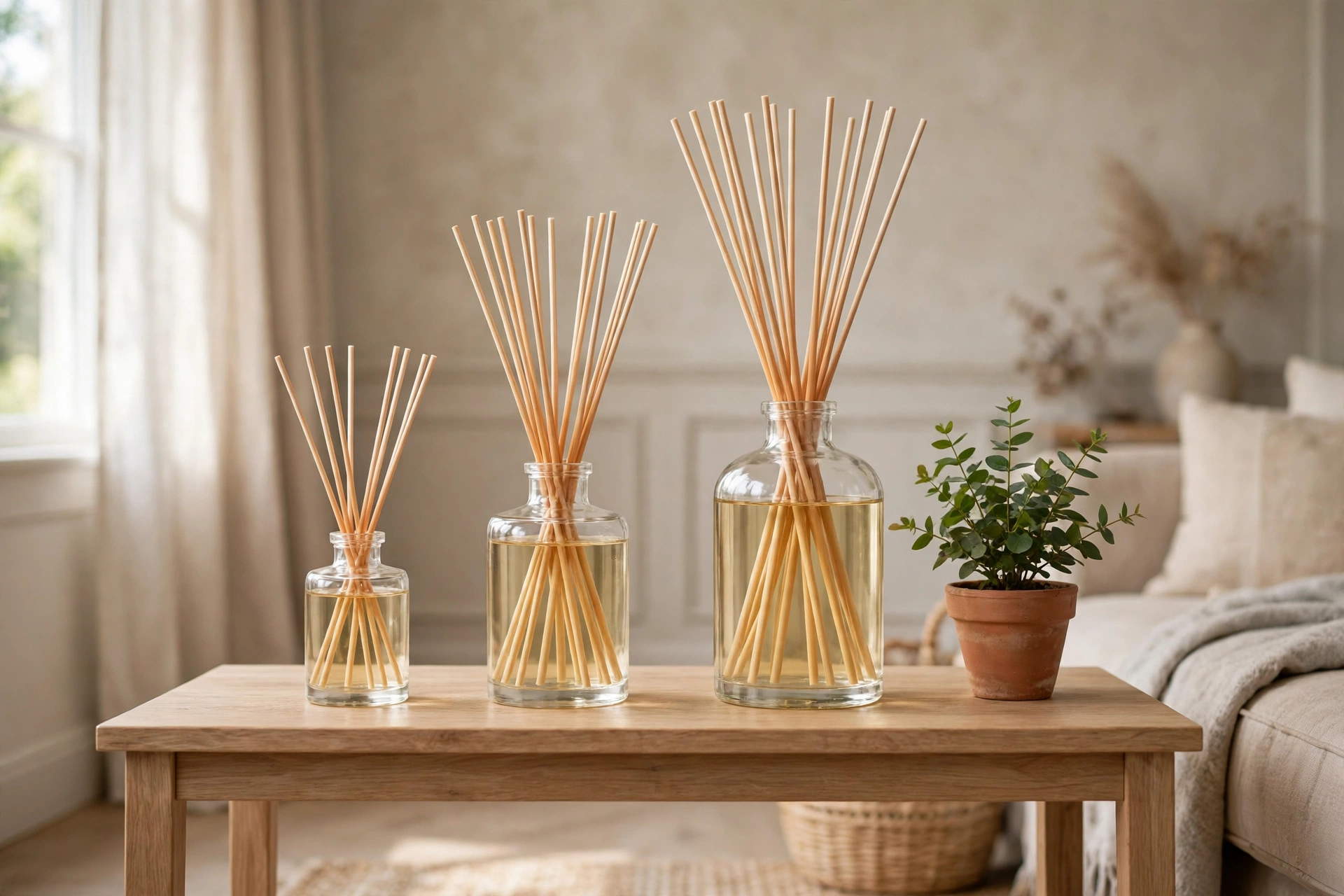
For rooms where pets sleep, or for homes with birds, a flameless format is the safer choice. A reed diffuser scents the room all day without a flame, and our guide to the best reed diffusers for UK homes and flats sets out which sizes suit which rooms. The full safety guidance, separated by animal, is a guide of its own, and this page will link to it once it is published.
Which Wax for Which Buyer
If you have read this far, you have enough to choose. Here is the short version, buyer by buyer.
Choose paraffin if strong scent is your top priority and budget matters most. It throws the strongest scent of the three and costs the least to buy. It suits large rooms and open-plan spaces where a gentler wax would disappear. Accept that it burns fastest and needs the most care with the wick and draughts to keep soot down.
Choose soy if you want a clean, plant-based everyday candle. It burns slowly and cleanly at a fair price, and it suits bedrooms and small rooms where a gentle throw is enough. Check the label says 100 percent soy wax, or accept that you are buying a blend and judge it on how it burns.
Choose beeswax if you want the longest, cleanest burn and you value natural ingredients. It costs the most on the shelf but can work out cheapest per hour, and its warm honey note suits small rooms and slow evenings. Accept that the honey scent will compete with any added fragrance, and that it is not vegan.
Choose a blend if you want a clean burn with a stronger throw than pure soy. A soy-coconut blend, or a well-made soy-paraffin blend that says so on the label, can give you the best of both. Judge a blend on the label and on how it burns, not on a single wax name.
And whichever wax you choose, buy the right size for the room, give the candle a full first burn, trim the wick to about 5mm before each burn, and keep sessions under four hours. The wax sets the starting point. How you burn it decides how much of it you actually get.
Frequently Asked Questions
Which candle wax is best overall?
There is no single best wax. Paraffin throws the strongest scent and costs least. Soy burns cleanly and slowly at a mid-range price. Beeswax burns longest and cleanest but costs most. Choose by what matters most to you: throw, clean burning, cost per hour, or natural ingredients.
Which wax lasts longest?
Beeswax lasts longest, because it is dense and burns slowly. Soy lasts longer than paraffin. Paraffin burns fastest. Judge value by cost per hour, not by shelf price: divide the price by the stated burn time.
Which wax smells strongest?
Paraffin has the strongest scent throw, hot and cold. Soy has a moderate, soft and steady throw. Beeswax has the lightest added scent, because its natural honey note competes with the fragrance. Remember that fragrance load matters as much as wax type.
Which wax is cleanest to burn?
Beeswax soots least, then soy, then paraffin. But a long wick or a draught will make any wax soot, so trim the wick to about 5mm and keep the candle out of draughts.
Are soy candles really 100% soy?
Not always. Many candles labelled “soy” are soy-paraffin blends. Only a label stating “100% soy wax” is reliable. If a listing does not say 100 percent, ask the maker what percentage of the wax is soy.
Do beeswax candles purify the air?
No. The claim that beeswax candles purify the air by releasing negative ions is not supported by solid evidence, and no major independent health body has confirmed it. All candles produce some soot and particulates when they burn.
Is paraffin wax safe?
Occasional use of a paraffin candle in a ventilated room is generally low risk. Burning paraffin releases small amounts of volatile organic compounds, including benzene, toluene and formaldehyde. The concern grows with frequent use, poor ventilation and several candles burning at once, especially for people with asthma. Ventilate the room, burn one candle at a time and keep sessions under four hours.
Which wax is best for pets?
No wax is safer for pets than another: the flame, the fragrance and the room are what matter. Never leave a burning candle in a room a pet cannot leave, keep candles out of reach, keep the room ventilated, and consider a flameless format such as a reed diffuser for pet rooms. Birds are the most sensitive of all.
Is beeswax vegan?
No. Beeswax comes from bees, so it is not vegan. Soy and paraffin are the vegan choices among the three waxes.
Sources
This comparison restates the consensus of four maker comparison pages, all read on 8 November 2026. All four sell their own wax, so none of them is neutral, and this article uses them as sources for the facts they agree on, not as authorities to copy:
- Nobbier, “Soy, Paraffin & Beeswax Candle Wax Types Compared”: https://www.nobbier.com/blogs/editorial/soy-paraffin-beeswax-candle-wax-types/
- Cantrip Candles, “Are Soy Candles Better for You? Comparing Soy, Beeswax and Paraffin Candles”: https://cantripcandles.com/blogs/news/are-soy-candles-better-for-you-comparing-soy-beeswax-and-paraffin-candles
- LG Candle, “Candle Wax Showdown: Beeswax vs Soy vs Paraffin”: https://lgcandle.com/blogs/living-good-journal/candle-wax-showdown-beeswax-vs-soy-vs-paraffin
- Essence of Harris, “Everything You Need to Know About Soy Wax Candles”: https://essenceofharris.co.uk/blogs/news/everything-you-need-to-know-about-soy-wax-candles
Where those four disagreed, this article says so, or leaves the point out. Where they agreed, this article says what they agreed on and adds the two points they all left out: that fragrance load matters as much as wax type, and that many “soy” candles are blends.