How to Choose a Scented Candle
Quick answer: Start with the room, not the scent. A small candle of about 100g to 150g suits a bathroom or a small bedroom, a standard candle of about 180g to 220g suits an average living room, and a large open-plan space needs a large candle of 300g or more, or two standard candles. Then match the scent family to the room: fresh and citrus for kitchens and bathrooms, soft florals for bedrooms, warm woods for living rooms. Judge a candle by its hot throw, the scent it gives off while burning, not by sniffing the unlit jar. Read the label for the wax percentage and the stated burn time, check the wick sits in the centre, and compare candles by cost per hour, not by shelf price. The six steps below work through each decision in order.
Choosing a scented candle looks simple until you stand in front of a wall of them. Every jar promises the same thing, a home that smells wonderful, and every jar smells lovely when you lift the lid and sniff it. Yet the candle that smells perfect in the shop so often disappoints at home: too faint in the living room, too strong in the bedroom, gone in a week, or tunnelled down the middle with half the wax still stuck to the glass.
That gap between the shop and the home is not bad luck. It is because the things that decide whether a candle works are mostly invisible at the point of sale. The scent you smell in the shop is the cold throw, and it tells you almost nothing about how the candle performs when lit. The size that looks generous on the shelf may be far too small for your room. The wax, the wick and the fragrance load, the three things that decide throw, burn time and soot, are hidden inside the jar and described, if at all, in small print on the label.
This guide is written for buyers, not makers. It gives you a decision order that works: room first, then scent family, then size, then the label, then the price maths. Follow it and you will stop buying candles that disappoint you. It is written for UK homes specifically, with their small bedrooms, open-plan living rooms, high Victorian ceilings, winter radiators and draughty period windows, because all of those change what a candle can do in a room.
Step 1: Start With the Room, Not the Scent
The most common buying mistake is choosing the scent first. You fall for a fragrance, buy the candle, and only then discover it does not suit the room it ends up in. The right order is the other way round. Decide where the candle will burn, then choose a scent family that works in that room, then choose the size that fits the space.
Every room asks something different from a candle. A bedroom wants a soft scent that does not overwhelm a small, closed space, and it wants a candle that burns calmly for an evening wind-down. A living room wants a scent with enough presence to fill a larger space and to welcome guests, and it often needs to work in open-plan air that drifts into the kitchen or hallway. A bathroom wants freshness in a small, humid space, where a heavy scent becomes cloying within minutes. A kitchen wants a scent that sits well with food and cuts through cooking smells without fighting them.
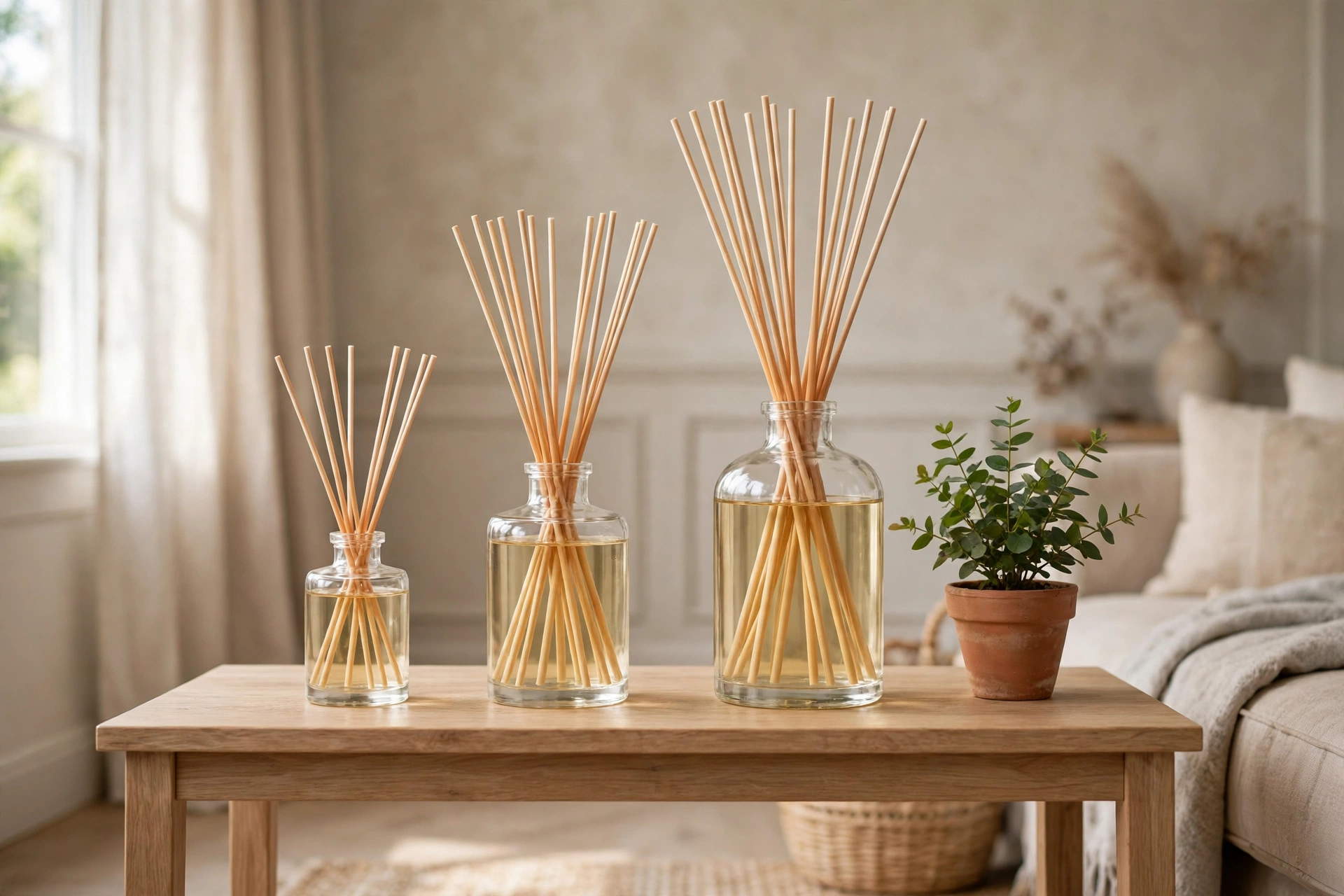
The room also decides the format. A candle is a poor choice for a room where you only spend twenty minutes at a time, because a candle needs at least an hour to form a proper melt pool and give its best scent. A bathroom visit or a quick kitchen tidy is better served by a reed diffuser or a room spray, which scent continuously without a flame or a burn time to manage. A candle earns its place in rooms where you sit for an hour or more: the living room in the evening, the bedroom before sleep, the study while you work.
UK homes add three complications that overseas buying guides rarely mention. The first is room size. British bedrooms, especially in flats and terraced houses, are often small, and a standard candle can be too strong in one. The second is open-plan living. Many British living rooms open onto a kitchen or a hallway, so the scent has far more air to fill than the room you are sitting in. The third is ceiling height. High ceilings in Victorian and Edwardian houses let warm scented air rise and pool near the ceiling, well above nose height, so a candle that would scent a modern flat beautifully can seem almost scentless in a tall period living room. None of these is a reason not to buy a candle. They are reasons to size the candle to the room you actually have, which is Step 2, and to test in a small room first, which is Step 3.
One more room question matters before you choose a scent: who else uses the room. A candle in a shared living room needs a scent the whole household can live with, which usually means a middle-ground family such as a soft wood or a light floral rather than a strong spice or a heavy musk. A candle in a bedroom shared with someone who is sensitive to scent needs the gentlest option you can find, and a short burn rather than an all-evening one. A candle in a home with pets or small children needs to burn somewhere stable, out of reach, and never left unattended, whatever the scent. The safety rules that apply to every candle, in every room, are in our scented candles guide.
Step 2: Match the Scent Family to the Room
Candle makers sell scent names, not scent families, and the names tell you very little. “Winter Walk”, “Sunday Morning” and “No. 4” could be anything. What matters is the fragrance family underneath the name, because families behave differently in different rooms. There are four families you will meet most often, and each one has rooms where it works and rooms where it does not.
Floral scents, such as lavender, rose, jasmine and peony, are soft and welcoming. They suit bedrooms and living rooms, where a gentle, familiar scent works best. Lavender and chamomile are the usual choices for a bedroom, because their softness suits a small, quiet space at the end of the day. A light floral also works in a living room, especially a smaller one, where it reads as fresh without being sharp. Florals are the safest family for a first candle, because they are the least likely to overwhelm a room or to clash with the smells already in it.
Citrus and fresh scents, such as lemon, bergamot, grapefruit, eucalyptus, mint, sea salt and green tea, read as clean. They suit kitchens and bathrooms, where they cut through cooking smells and humidity and make a small space feel fresh. A citrus candle in a kitchen works with food smells rather than against them, because citrus is a food scent itself. A fresh scent in a bathroom works because the room is small and the scent does not need to travel far. Citrus and fresh scents are also the best choice for a room that smells stale or stuffy, because they lift it rather than covering it with a heavier layer.
Woody scents, such as cedar, sandalwood, vetiver and cashmere wood, are warm and grounded. They suit living rooms and studies, where a deeper scent fits the furniture and the mood of the room. A woody candle in a large living room gives the space a presence that a light floral cannot, and it works well in the evening, when the room is used for relaxing rather than for work. Woody scents are the best family for open-plan spaces, because their warmth carries further than a light scent and does not thin out as quickly in moving air.
Spicy and oriental scents, such as cinnamon, clove, amber, vanilla and warm musk, are rich and cosy. They suit autumn and winter evenings, when a heavy, warming scent matches the season and the darker evenings. A spicy candle in a living room in December feels right in a way it would not in June. The same richness is the reason to be careful with this family in small rooms. A spicy candle in a small bedroom or a bathroom will overwhelm the space within minutes, and a spicy scent in a kitchen will fight with food smells rather than sitting alongside them.
Two practical rules follow from the families. First, match the family to the room, not to the prettiest name on the jar. A heavy spicy candle in a small bathroom will overwhelm the room, while a light citrus candle in a large living room will disappear. Second, do not mix families that fight each other in the same space. One family per room, or one family across the home with different expressions of it, is the rule that keeps a home smelling deliberate rather than confused. A woody candle in the living room and a citrus candle in the kitchen is a coherent home. A spicy candle, a floral candle and a citrus candle all burning in the same open-plan space is a muddle.
The seasonal question fits here too. Many people rotate candles by season, and the families make that easy: fresh and citrus for spring and summer, florals for late spring, woody and spicy for autumn and winter. Store the candles you are not using with their lids on in a cool cupboard, and give the surface a quick wipe with a dry cloth before the first burn of the season. They will keep their scent for months if stored that way. The full storage routine is in our guide on how to make a scented candle last longer.
Step 3: Size the Candle to the Room
Scent throw is a matter of scale. A candle releases a fixed amount of fragrance, and the bigger the space, the thinner that fragrance spreads. A small candle that fills a bathroom with scent will barely register in a large open-plan living room. Buying the right size for the room is the single most useful thing you can do before you spend any money, and it is the step most buyers skip, because jars are judged by how they look on the shelf rather than by how much air they have to scent.
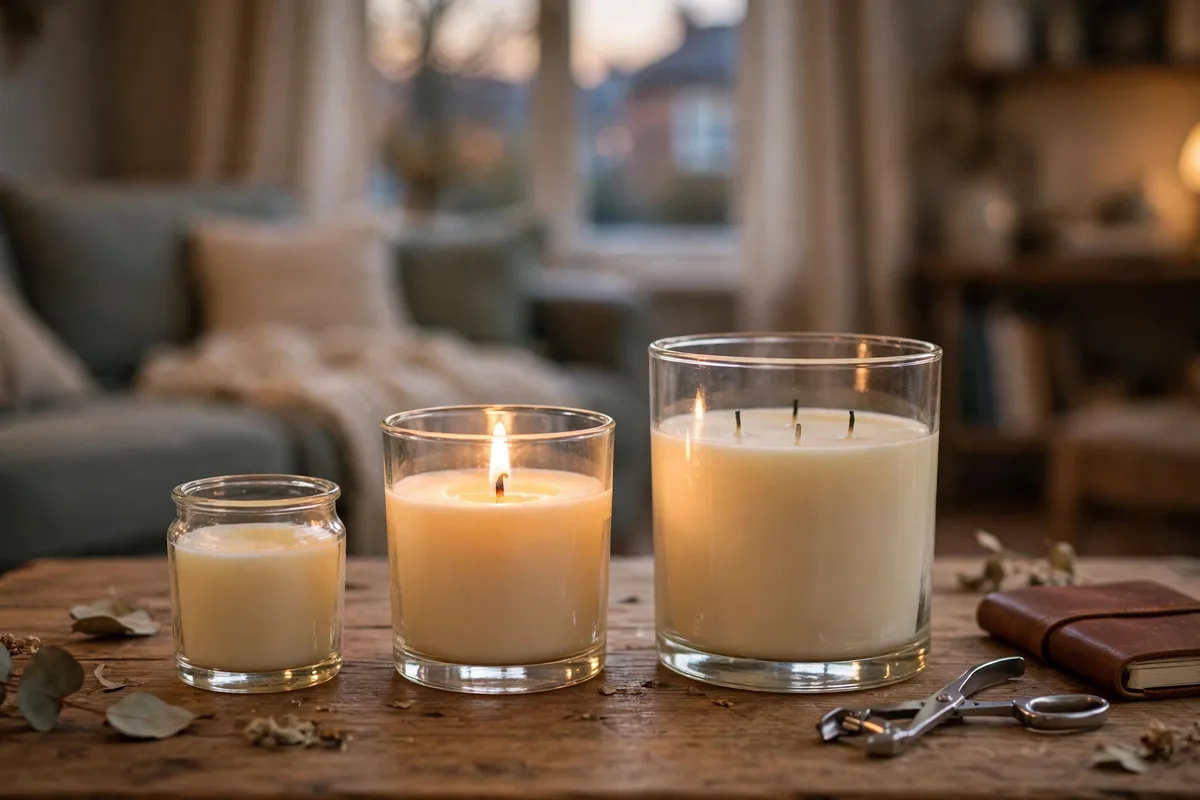
As a rough guide, a small candle of about 100g to 150g suits a small room such as a bathroom or a small bedroom. A standard candle of about 180g to 220g suits an average living room or a medium bedroom. A large open-plan space, a room with high ceilings, or a room with the doors open to a hallway will usually need a large candle of 300g or more, or two standard candles burning at opposite ends of the room.
| Room | Usual size | Wick count | Notes |
|---|---|---|---|
| Bathroom, small bedroom | 100g to 150g | 1 | Small, enclosed space; scent builds fast; keep sessions short |
| Average bedroom, study | 150g to 220g | 1 | One standard candle is usually enough; avoid heavy spicy families here |
| Average living room | 180g to 220g | 1 | Standard single-wick jar; give it a full first burn to the edges |
| Large or open-plan living room | 300g or more, or two standard candles | 2 or 3 | Multi-wick or two jars at opposite ends; one candle will not carry the space |
| High-ceiling period room | 300g or more | 2 or 3 | Warm scented air rises; you need more fragrance to reach nose height |
Wick count follows size, and it matters for a reason beyond the number on the label. A single wick suits a small or standard jar, because one flame can melt the wax out to the edges of a narrow container. A wide jar needs two or three wicks, because one flame in the middle cannot melt the wax at the edges, and the candle will tunnel. If you are buying a wide candle, check that it has enough wicks for its diameter. A wide single-wick candle is a tunnelling candle waiting to happen, whatever the scent. The tunnelling guide explains the fix ladder for candles that have already tunnelled, and the first-burn rule that stops it happening in the first place, in our guide to candle tunnelling.
There are three practical answers when a candle is too small for the room. The first is to use the candle in a smaller room, where it can do its best work. The second is to burn two candles, or a larger candle, in the big room. The third is to switch format for that room. A reed diffuser scents a room continuously and is often the better tool for a large or open-plan space, because it works all day rather than only while it is lit.
One useful test costs nothing and settles the size question for any candle you already own. Light the candle in a small room with the door closed, and leave it for an hour. If it smells strong there and weak in the big room, the problem is the room, not the candle. Move it to the smaller room and enjoy it there.
Step 4: Hot Throw, Cold Throw and How to Test Before You Buy
Every candle has two different scents, and they are often very different from each other. Cold throw is what you smell when you sniff the unlit candle. It is the scent that rises off the surface of the solid wax at room temperature. Many candles smell strong in the jar, and that is by design: makers know you will sniff before you buy, and a strong cold throw sells candles. Hot throw is what you smell once the candle is burning. It is the scent released from the warm liquid wax in the melt pool, carried into the room on the warm air rising from the flame. Hot throw is the scent you actually live with, and it is the one that matters.
The reason the two throws differ is simple. Some fragrance oils are made to smell strong at room temperature but are too volatile to survive the heat of a flame. They flash off quickly or break down in the hot wax, so the scent fades within minutes of lighting. Other fragrance oils are made for hot throw. They release steadily from warm wax and keep going for the whole burn. The wax matters too. Soy wax often smells lovely unlit but throws more gently once burning, while paraffin wax usually throws more strongly. None of this is visible from the jar, which is why the sniff test in a shop tells you so little about how a candle will perform at home.
That does not mean you cannot test a candle before you buy it. It means you should test it differently. First, stop judging a candle by lifting the lid and sniffing the cold wax. A strong cold throw is a selling trick as often as it is a sign of quality. Second, ask the maker or the shop for the stated burn time and the fragrance load, if they will share it, because those two figures tell you more than the sniff test. A maker who states burn time plainly is a maker who has thought about it. Third, buy the smallest size first when you are trying a new maker or a new scent family. A small jar costs little, burns for a few weeks, and tells you everything about the hot throw before you commit to a large one. Fourth, give the candle a proper test at home: a full first burn of two to four hours, in the room it is meant for, with the door closed, before you decide whether it works. A candle judged after twenty minutes in a draughty room has not been tested at all.
If a candle smells weak after a proper burn in the right room, the cause is usually inside the candle: low fragrance load, or the wrong wax for the job. Our guide on why a candle does not smell strong works through those causes in order, from the melt pool to the fragrance load. The point for this guide is simpler: a weak hot throw after a fair test is a property of the candle, not of your nose, and the honest answer is to note the maker and choose differently next time.
Step 5: Read the Label Like a Maker
The label is the one place where a maker has to tell you something true, and most buyers never read it. Five things on it matter, and they take less than a minute to check.
1. The wax, stated as a percentage. The label should say what wax the candle is made from, and in what proportion. “100% soy wax” means what it says. “Soy wax candle”, “made with soy wax” and “soy blend” do not mean the same thing, and “soy blend” is the honest one of the three, because it at least tells you it is mixed. Many candles sold as soy are blends of soy and paraffin, sometimes mostly paraffin, sold under a soy label. A candle that is 20 percent soy and 80 percent paraffin will behave like a paraffin candle, not a soy one: it will throw strongly, burn fast and soot more, and the buyer who chose it for a clean, plant-based burn has been misled. If a listing does not say 100 percent, ask the maker what percentage of the wax is soy. A maker who knows and answers plainly is a maker you can trust. A maker who will not say is telling you something too. The full neutral comparison of the three waxes, including burn times, soot and cost, is in our guide to soy vs paraffin vs beeswax candles.
2. The fragrance: fragrance oil or essential oil. Fragrance oils made for candles are designed to survive heat and release steadily from warm wax. Essential oils, by contrast, are volatile. They evaporate quickly and break down under heat, so a candle made with essential oils will often smell lovely unlit and weak once burning. If a candle is sold as made with pure essential oils, expect a gentler throw, and do not pay a premium for strength it cannot deliver. If a label says “phthalate-free” fragrance oil, that is a genuine quality marker, and it is worth noting. What no label should promise is that a candle is “toxin-free” or that it purifies the air. All combustion produces some soot and particulates, including the cleanest beeswax candle, and no candle cleans the air in your home. Treat any candle that promises to do so as a candle that is selling you a story.
3. The stated burn time. A maker who states burn time plainly, in hours, has measured it, and that figure is the basis for the price maths in Step 6. Be cautious with burn times that look too good. Makers rarely agree on how they measure them, so treat any stated figure as a guide, not a guarantee, and compare candles by the same maker’s figures where you can. A candle with no stated burn time at all is a candle whose maker has not thought about it, or does not want you to do the maths.
4. The wick. Most UK candles use cotton wicks, made from braided cotton fibre, sometimes with a paper core to keep them upright. Cotton wicks are the standard, and a well-sized cotton wick gives a steady, even burn. Wooden wicks are the other common choice. They are thin strips of wood, usually cedar, that crackle gently as they burn, which many buyers enjoy. A wooden wick needs a wider melt pool to stay lit, so it suits larger containers, and it needs trimming too, though you snap or trim the charred wood rather than cutting it like cotton. Look down at the candle before you buy and check the wick sits in the centre. If it leans to one side, straighten it gently while the wax is cool, or ask for a replacement if the candle is new. One safety point is worth knowing: lead-core wicks, which were once common because the lead kept the wick upright, have not been used by UK makers since the 1970s, but cheap imported candles may still use them. A lead-core wick is a reason not to buy a candle, however cheap it is.
5. The safety and care information. A proper label carries the safety warnings, the maximum burn time per session, usually four hours, and the instruction to keep the candle away from draughts and flammable materials. A label with no safety information at all is a warning sign about the maker, not just about the candle. The care routine that keeps any candle burning well, trimming the wick to about 5mm before every burn, giving it a full first burn, keeping sessions under four hours, is in our guide on how to make a scented candle last longer.
Step 6: Price Against Burn Hours, Not the Shelf
The honest way to compare candles is cost per hour. Divide the price by the burn time the maker states, and compare candles that way rather than by jar size or shelf price alone. A candle that costs the most can work out cheapest per hour of burning, because it lasts longest. A cheap candle that burns fast can be the dearest one you own.
Typical UK shop prices give you a starting point. A small candle of 100g to 150g usually costs about £8 to £15. A standard candle of 180g to 220g usually costs about £15 to £30. A large candle of 300g or more usually costs about £30 to £55, and premium or luxury candles can cost £50 or more. These are typical ranges, not fixed prices, and a small maker at a craft market may charge differently from a high street shop for the same size. What matters is not the range but the maths: a £25 candle that burns for 45 hours costs about 56p per hour, while a £12 candle that burns for 15 hours costs 80p per hour. The cheaper candle is the more expensive one to burn.
Three things change the maths. The first is wax. Beeswax burns longest, so a beeswax candle that costs the most can work out cheapest per hour. Soy burns longer than paraffin, so a mid-priced soy candle often beats a cheap paraffin one on cost per hour as well. Paraffin is cheapest to buy and dearest to burn, because it disappears fastest. The second is fragrance load. A heavily scented candle burns through its fragrance faster, and the scent fades before the wax runs out, so the last hours of the candle are worth less than the first. The third is how you burn it. A candle burned in short sessions tunnels, wastes wax on the sides of the jar, and gives you fewer hours than the stated burn time. A candle given a full first burn and trimmed before every session gives you the hours you paid for. The care routine is worth real money, not just better scent.
There is one more price question worth asking before you buy: what are you paying for. With candles, you pay for wax, fragrance, the container, and the maker’s time. A pretty jar adds to the price without adding to the scent, and a heavy glass container can make a candle look like better value than it is, because you are paying for glass by weight. Judge a candle by its stated burn time and its cost per hour, not by the weight of the jar in your hand. And if a candle is very cheap, ask why. A candle sold for a few pounds has had its costs cut somewhere, usually in the fragrance load or the wax, and those are the two things that decide whether it smells of anything at all once lit.
The Mistakes That Waste Money
Most disappointing candles are not bad candles. They are good candles bought for the wrong room, burned the wrong way, or judged by the wrong test. These are the mistakes to avoid, and each one is cheap to fix.
Buying by cold sniff alone. The jar smells strong in the shop and faint at home, because cold throw is not hot throw. Judge a candle after a proper burn, not after a sniff.
Buying too small for the room. A standard candle cannot scent a large open-plan living room, and no amount of careful burning will fix that. Size the candle to the room first.
Buying too strong for a small room. A heavy spicy candle in a small bedroom or bathroom overwhelms the space. Match the family to the room.
Lighting a new candle for twenty minutes. Short first burns set a tunnel that wastes a third of the wax. Give every new candle a full first burn, about one hour for every inch of diameter, and never more than four hours in one session.
Never trimming the wick. A long wick burns hot and fast, soots the glass, and shortens the candle’s life by hours. Trim to about 5mm before every burn.
Burning in a draught. A candle beside an open window, a door that opens often, or a radiator with a strong convection current will flicker, soot and burn unevenly. Move it to a still spot.
Storing candles in sunlight or without a lid. Fragrance evaporates from the surface wax, sunlight fades the colour and weakens the scent, and dust settles into the surface and burns dirty next time. Store candles cool, dry, upright and with the lid on.
Burning the last centimetre. Stop when about 10mm of wax remains. The last centimetre will not burn cleanly, the glass can overheat and crack, and the scent has largely burned away by then.
A Quick Decision Checklist
Use this checklist in the shop or before you click buy. If a candle passes all six, it is a good buy for the room you have in mind.
- Room: I know which room this candle will burn in, and how big that room is.
- Family: The scent family suits that room, and it does not clash with the other scents in the home.
- Size: The candle is the right size for the room, with enough wicks for its diameter.
- Throw: I am judging it by hot throw after a proper burn, not by sniffing the cold jar.
- Label: The label states the wax as a percentage, the burn time in hours, and the wick type, and it carries proper safety information.
- Price: I have divided the price by the stated burn time, and the cost per hour is fair for the size and the wax.
If a candle fails one of these, it is not necessarily a bad candle. It may simply be the wrong candle for that room. A large spicy candle is a fine candle for a living room in December and a poor one for a small bathroom in July. The checklist does not tell you which candle to love. It tells you which candle will work where you plan to burn it, and that is the decision that decides whether you enjoy it or regret it.
Frequently Asked Questions
How much should I spend on a scented candle?
Spend by cost per hour, not by shelf price. A standard UK candle of 180g to 220g usually costs about £15 to £30 and should burn for roughly 30 to 50 hours, depending on the wax and the fragrance load. Divide the price by the stated burn time. A candle at 50p to 70p per hour is fair value for a good quality standard candle. Below that, check the fragrance load and the wax. Above that, you are paying for the brand, the container or the maker’s name, which is fine if that is what you want, but it will not make the candle smell stronger.
Is a bigger candle always better value?
Usually, but not always. Larger candles usually cost less per gram and per hour than small ones, because the container and the maker’s time are spread over more wax. But a large candle only gives you that value if you burn it properly. A large candle burned in short sessions will tunnel, waste wax on the sides, and give you fewer hours than the stated burn time. A large candle in a small room will also be too strong, and you will burn it for shorter sessions to cope, which wastes more wax. Buy the size that fits the room, not the biggest jar you can afford.
Should I buy soy, paraffin or beeswax?
There is no single best wax, only the best wax for what matters most to you. Paraffin throws the strongest scent and costs the least, but it burns fastest and soots the most. Soy burns slowly and cleanly at a mid-range price, with a gentler throw. Beeswax burns longest and cleanest, but costs the most and its natural honey scent competes with added fragrance. The full comparison, with burn times, soot and cost per hour, is in our guide to soy vs paraffin vs beeswax candles.
Why does my candle smell strong in the shop and weak at home?
Because you are smelling two different things. In the shop you smell the cold throw, the scent rising off the unlit wax, which makers design to be strong because it sells candles. At home you live with the hot throw, the scent released from the warm melt pool while the candle burns. Some fragrance oils smell strong cold and fade fast when heated. Other causes are room size, a melt pool that has not reached the edges, or a low fragrance load. Test a candle with a full first burn in the room it is meant for before you decide it is weak.
Can I mix different scents in the same room?
You can, but keep to one family. A woody candle and a soft floral in the same living room will usually sit together well, because they are both warm families. A spicy candle and a citrus candle in the same room will fight each other, because one is heavy and the other is sharp. One family per room is the rule that keeps a home smelling deliberate. If you want variety, vary the scent between rooms, not within them.
What is the single most important thing to check before buying?
The size against the room. A candle that is too small for the room will never scent it, whatever the scent family or the wax. A candle that is too strong for a small room will overwhelm it. Get the size right, and the rest of the decisions become easy. Get it wrong, and no scent choice can save the candle.
Buy the Candle for the Room You Have
Choosing a scented candle is not about finding the best candle in the shop. It is about finding the right candle for the room you have, the way you live in it, and the amount you want to spend per hour of burning. Start with the room. Match the scent family to it. Size the candle to the space. Judge it by its hot throw after a proper burn, not by the cold sniff in the shop. Read the label for the wax percentage, the burn time and the wick. Then do the cost per hour maths, and buy the candle that passes all six checks.
A candle chosen this way will do what you bought it for: fill the room with a scent you enjoy, burn evenly to the bottom of the jar, and last as long as you paid for. The candle that disappoints is almost never a bad candle. It is a good candle bought for the wrong room, and the checklist above is the cheapest way to make sure that does not happen again.
Sources
The buying guidance in this article restates the consensus of five guides read on 11 Nov 2026: ClearMyth, “How to Choose the Right Scented Candle for Your Home”; Hestia Launch, “Master the Art of Scented Candles”; NDTV Shopping, “How To Choose Aroma Candles: A Buying Guide”; Best Candle (Australia), “Beginner’s Guide to Scented Candles”; and Bougie Hermit, “How to Choose the Perfect Scented Candle”. The room-size figures, wax comparison, wick guidance and care routine are cross-checked against our own live guides on this site, linked above. No claim here is presented as our own survey or test, and no volume or keyword difficulty figure is stated, because none has been verified.